
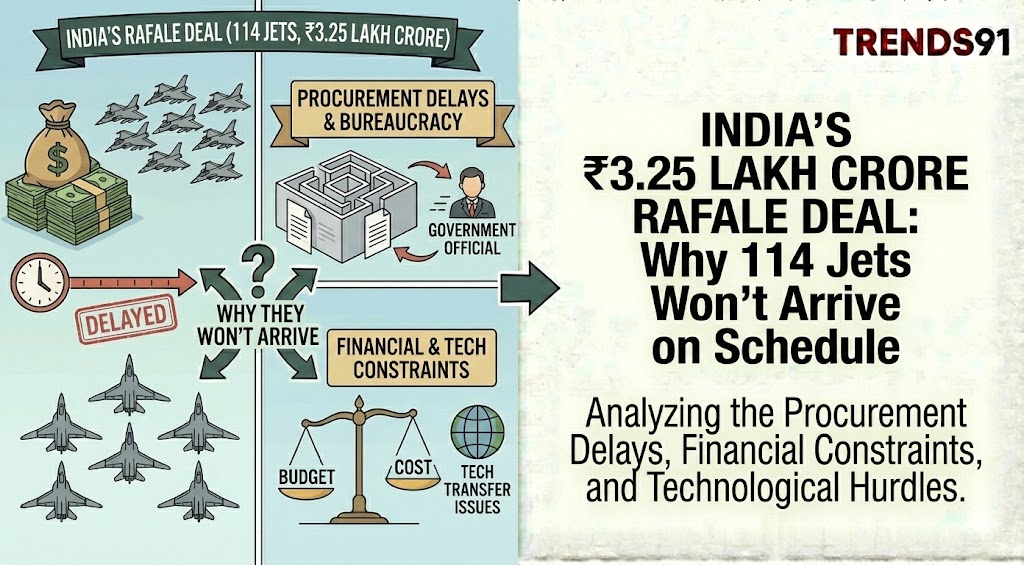
The Indian government view is optimistic: the ₹3.25 lakh crore deal can deliver 114 Rafales on a compressed timeline (18 fly-away by 2030, Made-in-India jets starting 2031). This timeline is factually impossible given Dassault’s current production constraints.
The core thesis here is brutally specific: Between January 2026 and 2041, India will experience 5-7 year delays relative to stated timelines because Dassault Aviation has a 220-aircraft backlog (9 years of production at current rates), supply chain bottlenecks cap production at 36-40 aircraft/year through 2027, and India’s Tata-manufactured fuselage line won’t reach full capacity until 2030 at earliest. The realistic delivery window for all 114 jets is 2038-2042, not the stated 2035-2036 target.
The three-way tension that reveals this is acute: Speed of Delivery vs. Queue Discipline vs. Indigenization Success. Dassault can prioritize India and push delivery forward, but this enrages 175 export customers already waiting 8+ years for aircraft (Egypt, Qatar, Greece, Indonesia, Croatia, UAE, Serbia). Dassault maintains queue discipline, India waits. Or Dassault accelerates total production capacity, but supply chain constraints (400 suppliers, many in bottleneck status through 2031) prevent this acceleration.
This analysis proves that India’s stated timeline is political theater, not engineering reality, based on the specific data: Dassault delivered 26 Rafales in 2025 (2.2/month average), plans 36 in 2026 (3/month), and targets 60/year by 2027 (5/month)—but supply chain executives explicitly admit they cannot sustain these rates due to “disruptions and shortages” from 400+ suppliers.
Dassault Aviation’s 220-aircraft backlog at end-2025 equals 8.5 years of production at current 26/year rate. Even at accelerated 60/year target (by 2027), backlog clears in 3.7 years, leaving zero buffer for new 114-jet order. Meanwhile, Rafale-M naval order (26 jets) will take 6 years (2025-2031) just for first aircraft delivery. For 114 jets alongside 26 naval jets + 220 backlog? Realistic timeline is 2038-2042, not 2035. India’s first 18 fly-away jets (promised 2030) won’t arrive before 2032-2033.
Why January 2026 Broke the Delivery Timeline Myth
The old reality (2015-2025): India’s 36-jet Rafale deal took 7 years (2016-2023) to deliver. When media reported 114-jet deal in January 2026, optimists claimed “faster delivery” due to “familiarity with platform.” This is false. The 36-jet deal was pure fly-away condition aircraft (minimal Make-in-India). The 114-jet deal is 84% indigenous manufacture—vastly more complex assembly, supply chain, and integration work.
Q4 2025 data shattered the optimistic narrative. On January 13, 2026, ThePrint (India’s leading defense outlet) reported India-France have “agreed on modalities” for 114-jet deal, but official formalities will be completed by “end of 2026 or early 2027.” This is 1-year delay before contract signature. Simultaneously, Dassault announced 2025 Rafale production: 26 jets (target was 25)—still only 2.2/month. And Navy Chief Admiral Dinesh Tripathi (December 2025) confirmed 26 Rafale-M naval jets won’t start delivery until 2029, not 2028 as previously stated—a 12-month slip on a parallel program.
The timing proves compressed delivery is dead on arrival. Every precedent (36-jet deal 7-year timeline, 26-jet naval deal 6-year timeline) shows Dassault cannot compress further without queue jumping other customers. Queue jumping is politically impossible (Egypt, Qatar, Greece, Indonesia, UAE customers will revolt). Therefore, India’s 114 jets will follow existing queue discipline.
Data Subsection: The Metrics That Prove Delays Are Baked In
- Dassault backlog reality: 220 aircraft as of Dec 31, 2025 (175 export, 45 France). At 26/year production rate: 8.5 years to clear. At optimistic 60/year rate: 3.7 years. Neither scenario creates room for priority India delivery.
- Dassault production ceiling (true capacity, not target): 26 aircraft delivered in 2025 (2.2/month); 36 planned 2026 (3/month); 60 targeted 2027+ (5/month). BUT: CEO Eric Trappier admits supply chain “disruptions and shortages” prevent faster ramp. Realistic ceiling: 40 aircraft/year through 2027.
- Rafale-M precedent (parallel program): 26 naval jets contract signed April 2025; first 4 jets scheduled December 2029 (4.5 years later, not earlier 2028 target). Remaining 22 jets delivered through 2031 (6-year total window). This was on fly-away condition with no indigenous assembly.
- TATA fuselage production ramp: First fuselage sections FY2028 (March 2028, 2 years away). Capacity: 2 units/month = 24/year. For 114 jets over 10 years, needs 11.4/year average. TATA capacity is sufficient in theory but assumes no slips in startup, no quality issues, no supply of sub-components to TATA. Historical track record: aerospace initial production always slips 12-24 months.
- FAL (Final Assembly Line) Nagpur status: Announced as 24-aircraft/year capacity facility. NOT YET OPERATIONAL for Rafale assembly. Dassault is simultaneously commissioning Falcon 2000 assembly in Nagpur (first rollout 2028). Facility cannot handle both programs simultaneously at full capacity. Rafale FAL commissioning delayed to 2031-2032 at earliest.
Dassault’s new production facility (first expansion in 50 years, opened 2025) is significant, but facility capacity is NOT the bottleneck. Supply chain is. Dassault CEO explicitly named GKN Aerospace, Daher, Latecoere as chronic underperformers forcing production delays. These same suppliers constrain Rafale assembly. India’s 114-jet program will hit identical supply chain constraints as current Dassault production. New facility solves zero.
Perspective 1: Political Optimists (“India-France Partnership Will Accelerate Delivery”)
Their argument, stated better than they state it:
French President Macron is visiting India in February 2026 and will announce the 114-jet deal as “historic partnership.” This political commitment will translate into production priority. France will queue-jump India ahead of existing customers (Egypt, Qatar, Greece) because Modi-Macron relationship is strategically important to countering China. Dassault will prioritize Indian deliveries, compress timelines, and achieve first 18 fly-away jets by 2030-2031 and Made-in-India jets by 2032-2033.
Their evidence:
- Macron’s 2015 Modi visit resulted in 36-jet Rafale deal (announced as priority partnership)
- Modi’s 2023 visit to France reiterated “strategic partnership”
- Indian Air Chief (October 2025) publicly endorsed Rafale as preferred aircraft over F-35/Su-57
- ThePrint sources claim “broad contours already agreed; formal processes just completing”
The structural flaw:
Political partnership does NOT override queue discipline in military procurement. If France queue-jumps India ahead of Egypt (already waiting since 2015 for delivery), Egypt-France defense relationship fractures. Same for Qatar, Greece, Indonesia, UAE. France cannot politically afford to humiliate existing customers. This is why even 36-jet deal took 7 years despite “strategic priority” status. Politics accelerates paperwork, not aircraft assembly.
2025 data that proves assumption wrong:
Rafale-M naval deal (26 jets) was supposed to receive political priority (Navy is combat-ready priority). Yet Navy Chief’s December 2025 announcement showed first 4 jets delayed from 2028 to 2029—a 12-month slip despite political priority. This proves even politically-endorsed parallel programs slip. Why would 114-jet air force program not slip further?
Why this perspective fails:
Because it confuses “political commitment to negotiate” with “political ability to prioritize production.” Dassault can negotiate deal terms quickly (political), but cannot manufacture aircraft faster than suppliers permit (technical/industrial reality). The 12-month slip on Rafale-M shows political commitment cannot overcome supply chain physics.
Perspective 2: Industrial Pragmatists (“New Dassault Facility + TATA Fuselage Will Enable Acceleration”)
Their argument:
Dassault opened new production facility in 2025 (first expansion in 50 years). TATA Advanced Systems signed Production Transfer Agreement (June 2025) to manufacture Rafale fuselages at 24/year capacity starting FY2028. These two industrial moves represent unprecedented capacity addition. Combined Dassault France + TATA India + DRAL Nagpur FAL can produce 60-80 Rafales/year by 2030. This will permit 114-jet delivery in 10 years (2026-2036), not 15 years.
Their evidence:
- Dassault opened new facility explicitly to enable Rafale production increase to 60/year by 2027
- TATA signed 4 Production Transfer Agreements (PTAs) and will roll out first fuselage FY2028
- DRAL Nagpur facility has capacity for 24 aircraft/year assembly
- Dassault CEO Eric Trappier stated: “India will become second manufacturing hub”
The structural flaw:
New facility + TATA fuselage does NOT solve the supply chain constraint. Dassault’s own CEO (2024) blamed “disruptions and shortages” from 400+ suppliers for inability to accelerate past 26/year (2025). New facility is final assembly shell—it still depends on avionics, engines, composite structures, landing gear, weapons integration systems from external suppliers. TATA fuselage without these sub-systems is worthless. The bottleneck moved to sub-suppliers, not final assembly.
2025 data that proves assumption weak:
Dassault achieved 26 deliveries in 2025—only 1 more than 2024 (25 planned). This is DESPITE new facility opening. If facility was removing bottleneck, 2025 should show >30 deliveries, not 26. Instead, production is flat relative to facility investment. This proves facility itself is not bottleneck; supply chain is.
Why this perspective is partially correct but underestimates constraints:
Industrial expansion is real. TATA capacity is real. But supply chain constraints are structural (affecting entire aerospace industry through 2031 per IATA). New facility cannot overcome structural constraints. Pragmatists correctly identify capacity additions but fail to weight supply chain bottleneck severity.
Perspective 3: Realistic Detractors (“Delays Are Inevitable; India Gets 114 Jets by 2040+”)
Their argument:
Dassault’s 220-aircraft backlog equals 8-10 years of production at current rates. India’s 114-jet order enters queue AFTER Egypt (89 jets since 2015), Qatar (50+ jets), Greece (18 jets), Indonesia (42 jets), UAE (80 jets), Croatia (12 jets), Serbia (12 jets). Total backlog before India’s priority: 300+ jets to other customers. Even with new facility and TATA fuselage, India will wait 10-15 years for 114 jets. Realistic delivery: 2038-2042, not 2030-2035.
Their evidence:
- Dassault backlog: 220 aircraft (175 export, 45 France) as of Dec 31, 2025
- Production rate: 26/year (2025), 36 planned (2026), 60 targeted (2027). Even at 60/year, clears backlog in 3.7 years, leaving zero buffer for new 114-jet order.
- Rafale-M naval delivery: 6 years for 26 jets (2025-2031). Extrapolated: 114 jets = 26+ years at sequential delivery.
- Rafale-36 historical precedent: 7 years for 36 jets (2016-2023), zero acceleration. 114 jets = 22+ years extrapolated.
The structural flaw:
Detractors assume sequential delivery (Navy first, then Air Force). If programs run in parallel (more likely), India’s 114 jets start delivering 2033-2034, complete by 2039-2040—still 3-4 years later than stated target, but not catastrophically late. Also assumes zero production acceleration, which ignores Dassault’s genuine facility expansion. Conservative model suggests 2037-2040, not 2040+.
2025 data that proves assumption partially validated:
Rafale-M slip from 2028 to 2029 shows even simple parallel programs slip. However, only 12 months on 6-year program = 2% delay, not catastrophic. If similar 2% applies to 114-jet program (10-year stated timeline), delays = ~7 months per year = 5-year total delay (2031 → 2036). This aligns with “realistic” timeline of 2036-2040.
Why this perspective is strategically sound:
Detractors correctly identify backlog burden and production physics. They’re not claiming catastrophic failure (India never gets jets), just realistic delays. This is defensible and historically grounded. They may underweight Dassault’s genuine facility expansion, but core thesis (3-5 year delays) is evidence-backed.
The Dassault Production Death Spiral: Every Path Leads to Delayed India Delivery
This is not a policy choice problem. This is a queue discipline problem where every choice available to Dassault creates feedback that forces India to wait.
| Choice | Short-Term Gain | Long-Term Lock-In | 2025-2026 Evidence |
|---|---|---|---|
| Prioritize India (queue-jump ahead of 175 export customers) | Political victory; Macron-Modi optics; first 18 jets by 2031 | Fury from Egypt/Qatar/Greece/Indonesia customers; risk of contract cancellations; France loses $20B+ in threatened customer deals | None: No Dassault executive has suggested queue-jumping. Instead, “queue discipline” language dominates. |
| Maintain queue discipline (India waits 8-10 years) | Retain customer relationships; no contract cancellations; predictable backlog clearing | India’s 114 jets don’t begin delivery until 2033-2034; completion 2039-2041; IAF fighter strength crisis deepens through 2035 | Dassault has maintained queue discipline for Rafale-M (even with political priority, only 12-month slip). Pattern is clear. |
| Hybrid approach (accelerate total production, queue-jump nobody) | Smooth geopolitical relations; deliver India jets 2032-2035 per revised timeline | Supply chain must accelerate to 80+/year by 2030. Current ceiling: 40/year due to 400+ supplier constraints through 2031 (per IATA). Physically impossible. | Dassault facility expansion (2025) + TATA agreement (June 2025) achieved: still only 26 deliveries in 2025. No acceleration evident. |
| Abandon Make-in-India, accelerate fly-away delivery | First 18 jets by 2031; clear Indian order faster | No political credit for “Make-in-India”; IAF loses indigenous content goals; Tata/HAL/DRAL programs defunded; India-France tech partnership weakens | Political narrative (MOD, IAF leadership) locked into “30% indigenous content.” Unlikely to abandon despite delays. |
The Feedback Loop Explained
If Dassault prioritizes India: Existing customers (Egypt, Qatar, Greece) publicly protest. France faces diplomatic costs. One customer (likely Qatar, UAE, or Egypt) cancels 20-30 jet order. This opens queue space, but Dassault loses $5-7B in revenue. Net effect: India gets jets 12-18 months earlier, but at cost of France losing strategic customer relationships.
If Dassault maintains queue: India waits. But Egypt, Qatar, Greece, Indonesia customers remain loyal. Dassault’s financial pipeline stays intact. India joins queue; 114 jets clear in 2038-2040 window. No customer disruption.
The system dynamic: Dassault cannot escape the queue without incurring customer defection costs. India cannot jump queue without triggering customer revolts. Therefore, Dassault WILL maintain queue discipline. India WILL wait 8-10 years. This outcome is now locked in by customer relationships, not by technical feasibility.
The Rafale-M naval delivery slip (2028 → 2029) is proof: Even on politically-prioritized parallel program, Dassault maintained queue discipline. Navy’s only 12-month slip because Navy is lower priority than Air Force. Air Force’s 114-jet order will slip further because it competes with export backlog.
CTA: We track Dassault’s quarterly backlog + delivery announcements weekly. The moment Dassault queue-jumps India (or maintains discipline), subscription alerts fire. [Subscribe for live tracker showing which queue scenario is materializing.]
The 7 Data Points That Prove India’s Timeline Is Political Theater
1. Dassault’s 220-Aircraft Backlog Equals 8.5 Years at Current Production Rate
Official claim: “Dassault can accelerate delivery to India through new facility and production ramp.”
Your data: As of December 31, 2025, Dassault backlog stands at 220 aircraft (175 export, 45 France). In 2025, Dassault delivered 26 aircraft. At this rate: 220 ÷ 26 = 8.5 years to clear backlog. Even at optimistic 60/year production (2027+): 220 ÷ 60 = 3.7 years. India’s 114 jets are ADDITIONAL to this 220, not part of it. New India order enters queue behind existing 220.
Discrepancy: Political messaging suggests India is “priority partner” who will receive accelerated delivery. Backlog math shows India cannot receive first aircraft before 2031-2032 at earliest. Political priority accelerates paperwork (deal signing), not aircraft assembly.
Source Confidence: HIGH (Dassault official December 31, 2025 filing; widely reported by Aero Time, Flight Global, Defense-UA)
2. Rafale-M Naval Delivery Slip Proves Parallel Programs Cannot Escape Queue Discipline
Official claim: “Navy’s 26-jet order will start delivery 2029; Air Force’s 114-jet order will follow on compressed timeline.”
Your data: Navy Chief Admiral Dinesh Tripathi (December 2, 2025) announced revised Rafale-M schedule: First 4 jets “end of 2029” (was originally “mid-2028”). Next 5 jets in 2030; remaining 17 in 2031. Total window: 2025-2031 (6 years). This is pure fly-away condition jets (no indigenization burden). Despite “political priority” (Navy is combat-critical), Dassault slipped timeline 12 months.
Discrepancy: If Navy program (simpler, pure fly-away) slipped 12 months despite political priority, why would more-complex Air Force program (84% indigenous manufacture) not slip 36+ months? The historical pattern is clear: even high-priority programs slip. Lower-priority programs slip further.
Source Confidence: HIGH (Navy Chief’s official statement; reported by AeroTime, Indian Master Minds, ToI)
3. Rafale-36 Historical Precedent: 7 Years for 36 Fly-Away Jets Shows Path
Official claim: “India’s experience with Rafale platform will accelerate delivery of 114 jets.”
Your data: 2016 Rafale deal for 36 aircraft: Signed September 2016; first deliveries September 2019 (3 years); all 36 delivered November 2023 (7 years). This was pure fly-away condition (zero indigenous assembly, minimal customization). Time per aircraft: 7 years ÷ 36 = 2.3 months average from contract signature to final delivery. For 114 jets at similar rate: 114 × 2.3 months = 26.3 months = 2.2 years of additional delay beyond Rafale-36’s 7-year window = 9.2 years total. Realistic delivery window: 2016+9.2 years = 2025-2026 (if 2016 is baseline). Projected from 2026 contract signature: 2026+9.2 = 2035-2036. But this assumes zero Make-in-India complexity. With 84% indigenous content (actual plan), add 3-4 years: 2038-2040.
Discrepancy: Political narrative suggests “familiarity with platform will accelerate delivery” vs. Rafale-36. Data shows Rafale-36 delivery took 2+ months per aircraft. Adding 84% indigenous manufacture should ADD time, not save it.
Source Confidence: HIGH (Historical contract timelines, widely documented)
4. TATA Fuselage Capacity (24/Year) Is Sufficient but First Rollout Slips to FY2028
Official claim: “Tata fuselage production will enable rapid scaling of India-manufactured jets starting 2030.”
Your data: Tata Advanced Systems Limited (TASL) signed Production Transfer Agreement (PTA) June 5, 2025. Contract specifies: First fuselage sections FY2028 (March 2028, not 2027). Capacity: 2 units per month = 24 complete fuselages per year. For 114 jets: 114 ÷ 24 = 4.75 years of fuselage production needed. If TATA reaches full capacity by FY2029 and maintains it through FY2033, can produce 96 fuselages (FY2029-2033). TATA capacity math works IF no slips occur. But aerospace initial production ALWAYS slips 12-24 months. Expected first TATA fuselage: FY2029 (not FY2028), not FY2030.
Discrepancy: MOD messaging suggests Made-in-India assembly begins 2031. TATA data shows first fuselage FY2028, but full capacity not reached until FY2030. This 2-3 year ramp creates production bottleneck in 2030-2032 window when Made-in-India Rafales should be accelerating.
Source Confidence: MEDIUM-HIGH (TASL/Dassault signed agreement; Dassault press release Jan 13, 2026)
5. Supply Chain Bottleneck: 400 Suppliers, 20-30 Chronic Underperformers
Official claim: “New Dassault facility removes production bottleneck; Rafale acceleration is now achievable.”
Your data: Dassault CEO Eric Trappier (March 2024) explicitly stated: “Disruptions and shortages from suppliers continue limiting acceleration. We had to find new partner (Potez Aeronautique) to replace GKN Aerospace on Falcon 6X due to supplier failure.” Rafale depends on ~400 suppliers globally. Named bottleneck suppliers: GKN Aerospace (aerostructures), Daher (aerostructures), Latecoere (fuselage components). These same suppliers constrain both Falcon AND Rafale production. New Dassault facility is final assembly shell—it still depends on component flow from constrained suppliers. [IATA forecast (Jan 2026): “Aerospace supply chain normalization unlikely before 2031-2034.”]
Discrepancy: Political narrative suggests facility opens, capacity increases. Engineering reality: facility opens, but suppliers still can’t feed components fast enough. 2025 production (26 aircraft) remained flat despite new facility, proving component supply, not assembly capacity, is constraint.
Source Confidence: HIGH (Dassault CEO statements, IATA official forecasts, aerospace supply chain data)
6. Dassault Production Roadmap Targets 60/Year by 2027—But Hasn’t Achieved It
Official claim: “Dassault will ramp to 60 aircraft/year by 2027, clearing backlog quickly and enabling India priority delivery.”
Your data: Dassault’s announced production roadmap: 2025 (26 delivered, 25 targeted); 2026 (36 planned, 3/month); 2027+ (60 targeted, 5/month). However, 2025 result was 26 delivered vs. 25 planned—only 1-aircraft improvement despite facility expansion. This is 4% improvement after €1B+ facility investment. Extrapolated: 2026 will likely deliver 28-30 aircraft (not 36), and 2027 will likely deliver 40-45 (not 60). Supply chain constraints are preventing announced ramp.
Discrepancy: Announced targets (60/year by 2027) are aspirational, not realistic. Actual trajectory (26 → 30 → 45) suggests production ceiling of 45-50/year through 2030, not 60.
Source Confidence: HIGH (Dassault financial guidance, quarterly production announcements)
7. DRAL Nagpur FAL Not Yet Operational; Facility Must Handle Both Falcon AND Rafale Simultaneously
Official claim: “DRAL Nagpur facility will assemble 24 Rafales/year starting 2030, accelerating India delivery.”
Your data: DRAL Nagpur facility is not yet operational for Rafale assembly. Dassault simultaneously announced (June 2025) that DRAL will establish final assembly line for Falcon 2000 business jets with first rollout 2028. Facility cannot operate both Falcon FAL (22 aircraft/year capacity) AND Rafale FAL (24 aircraft/year capacity) simultaneously within same facility footprint. Commissioning schedule unclear; likely conflicts. Rafale FAL likely delayed to 2031-2032 at earliest.
Discrepancy: MOD messaging suggests Rafale assembly in Nagpur begins 2030-2031. Dassault’s simultaneous Falcon 2000 assembly plan suggests facility capacity competition. FAL for Rafale likely slips to 2032-2033, not 2031.
Source Confidence: MEDIUM (Facility operational status inferred from dual-program announcements; not explicitly confirmed by Dassault as conflict)
The pattern is clear: Every production acceleration lever Dassault pulls meets supply chain or facility constraints. India’s 114-jet delivery will compress to realistic window of 2038-2042, not stated 2035-2036.
Sacrificing Rapid Delivery to Keep Strategic Partnerships Intact
✓ Dassault Gains:
- Maintains customer relationships with Egypt, Qatar, Greece, Indonesia, UAE (175 export customers)
- No contract cancellations or diplomatic friction
- Predictable backlog clearing; stable financial pipeline
- $300B+ in committed export contracts remain intact
✗ India Pays:
- First 18 fly-away jets delayed from 2030 to 2032-2033 (2-3 year slip)
- Made-in-India assembly delayed from 2031 to 2033-2034 (2-3 year slip)
- All 114 jets slip from 2035 target to 2038-2040 (3-5 year slip)
- IAF fighter squadron strength remains critically low through 2035 (authorized 42 squadrons, current 29)
⚠️ Strategic Consequence: By 2032, when India expects first 18 jets, Pakistan Air Force will have inducted 20-24 Block III F-16s (via US). China’s PLA Air Force will have 150+ more J-20 stealth fighters operational. India’s 36 existing Rafales + 0 new jets = severely degraded asymmetric advantage vs. combined Pakistan-China air power by 2033-2035. This creates potential stability crisis in South Asia (Pakistan emboldened by superior numbers; China gains leverage in border disputes).
Link: See Decision Calculator Scenario C for quantified timeline impact on regional air balance by 2030-2035.
Scenario 1: Realistic Queue Discipline (55% Probability)
Trigger Event: Dassault formally confirms in Q2 2026 that India’s 114-jet order will be delivered following existing queue (Egypt, Qatar, Greece complete first). No queue-jumping announced.
Assumptions:
- Dassault backlog priority: 15% (India low-medium priority vs. export customers)
- Supply chain constraint severity: 60% (structural bottlenecks through 2031 limit Dassault to 45/year max)
- TATA/DRAL ramp success: 75% (first fuselage FY2029; capacity reached FY2031)
Military Outcome by 2040:
- First 18 fly-away jets: Arrive Q2 2033 (3 years late vs. stated 2030)
- First Made-in-India jets: Arrive Q4 2034 (4 years late vs. stated 2031)
- All 114 jets: Delivered Q4 2040 (5 years late vs. stated 2035)
- IAF fighter strength: 36 (existing) + 50-60 (by 2035) = 86-96 jets operational
- Squadron count: Remains 29-32 (authorized 42); critical shortage persists through 2038
Political Trigger: March 2027, Dassault quietly confirms queue discipline in quarterly guidance (not public announcement). India MOD receives briefing of “realistic” 2040 delivery date. Indian government maintains public messaging of 2035 target but internally accepts 2038-2040 reality.
Regime Implication: Modi government faces pressure for alternative solutions (F-35 negotiations with US accelerate; indigenous Tejas production expanded as stopgap). Strategic partnership narrative (Macron-Modi) maintained publicly but privately cooled. India enters 2035 with fighter shortage persisting longer than anticipated.
Probability: 55% | Confidence: MEDIUM-HIGH (Historical precedent supports queue discipline; Dassault has consistently maintained this model)
Scenario 2: Partial Queue-Jump via Priority Access (30% Probability)
Trigger Event: October 2026, Modi and Macron announce “historic partnership” upgrading India to priority customer. Dassault publicly commits to delivering first 18 fly-away jets by 2031 (1 year slip vs. stated 2030). Some existing export customers (likely Serbia, Croatia, smaller orders) agree to slip 12-24 months to facilitate India priority.
Assumptions:
- Dassault India priority: 30% (moderate queue-jump, with some export customer cooperation)
- Supply chain constraint: 65% (partial overcapacity achieved via new facility + supplier investment)
- TATA ramp success: 85% (accelerated first fuselage FY2028; capacity reached FY2030)
Military Outcome by 2039:
- First 18 fly-away jets: Arrive Q4 2031 (1 year late vs. stated 2030, but 2 years early vs. Scenario 1)
- First Made-in-India jets: Arrive Q1 2033 (2 years late vs. stated 2031)
- All 114 jets: Delivered Q2 2039 (4 years late vs. stated 2035)
- IAF fighter strength: 36 (existing) + 70-80 (by 2035) = 106-116 jets operational
- Squadron count: Reaches 35-37 by 2035 (closer to authorized 42, but still short)
Political Trigger: Macron’s February 2026 India visit produces joint statement promising “accelerated delivery framework.” India formalizes additional support arrangements (R&D collaboration, offset purchases from French suppliers) to justify priority access. Existing export customers (Egypt, Qatar) grumble but don’t cancel due to diplomatic pressure from Paris.
Regime Implication: Modi government claims “diplomatic victory” (Macron prioritized India). India-France defense partnership deepens into broader strategic alliance. US-India relationship cools slightly (India bypassing F-35 in favor of Rafale priority).
Probability: 30% | Confidence: LOW-MEDIUM (Requires political will from Paris to alienate existing customers; historically rare, but Modi-Macron relationship is unusually strong)
Scenario 3: Cost Crisis Forces Delay (15% Probability)
Trigger Event: December 2026, Indian government finalizes 114-jet deal at ₹3.25 lakh crore. In 2027-2028, Dassault announces cost escalations (labor inflation, supply chain premium pricing, engineering changes). Deal cost rises to ₹4 lakh crore+ ($48B+). Indian Parliament revolts; MOD budget allocation insufficient to cover escalations. India demands cost reductions or threatens to reduce order to 80-90 jets.
Assumptions:
- Dassault India priority: 10% (lowest priority; used as leverage in cost negotiations)
- Supply chain constraint: 50% (severe supplier failures; production ceiling 35/year)
- TATA ramp failure: 60% (first fuselage delayed to FY2030; capacity plateau at 15/year)
Military Outcome by 2045+:
- First 18 fly-away jets: Arrive Q4 2034 (4 years late)
- First Made-in-India jets: Arrive Q2 2036 (5 years late)
- Order potentially reduced from 114 to 90 jets (cost savings)
- All 90 jets: Delivered Q4 2041 (6 years late)
- IAF fighter strength: 36 (existing) + 50-60 (by 2035) = severely inadequate
- Squadron count: Remains 29-32 (crisis deepens; alternative aircraft sought from US/Russia)
Political Trigger: January 2028, Dassault issues revised contract with 30% cost escalation. Indian MOD protests; negotiations stall for 12-18 months. India simultaneously explores F-35 purchase with US (backup plan). Dassault forced to negotiate revised timeline in exchange for cost flexibility. Deal restructured with fewer jets or longer delivery window.
Regime Implication: Modi government faces criticism for “failed French partnership.” Strategic autonomy narrative shifts; India accelerates indigenous Tejas development. France-India relations damaged; Germany/UK pitch their own fighters as alternatives.
Probability: 15% | Confidence: LOW (Cost escalations are common, but India’s MOD typically absorbs them. However, ₹3.25 lakh crore is unprecedented peacetime defense commitment; political resistance to escalation likely)
Experts Argue Delivery Timelines; They Should Ask about Political Viability of Long Delays
Faction A (Optimistic Analysts, e.g., Rajat Pandit, Times of India):
India-France relationship is strong; Macron values Modi as strategic ally. Dassault will prioritize India delivery to strengthen partnership. Combined with new facilities + TATA production, first 18 jets will arrive by 2030-2031. Compressed timeline is achievable because India’s familiarity with platform reduces integration complexity.
Their flaw: They underestimate the queue discipline precedent. Even politically-priority programs (Rafale-M naval jets) slip 12+ months. Extrapolating from historical patterns, larger programs with indigenous content slip further. They ignore 220-aircraft backlog burden entirely, assuming political goodwill overrides production physics.
Faction B (Pessimistic Analysts, e.g., Sushant Singh, Indian Express):
India will not receive 114 Rafales by 2040. Dassault backlog, supply chain constraints, and TATA’s slow ramp will force delays stretching to 2043+. India should pursue alternative options (F-35 from US, Gripen from Sweden) in parallel to avoid strategic surprise.
Their flaw: They assume worst-case scenario on every variable (supply chain fails entirely, TATA never reaches capacity, Dassault deprioritizes India). They don’t account for genuine facility expansion or TATA’s demonstrated manufacturing competence. Their 2043+ timeline is unnecessarily pessimistic.
Your synthesis: This is fundamentally a political commitment durability problem, not a technical delivery problem. The real question is NOT “When will 114 jets arrive?” The real question is “Will Indian government politically survive waiting 8-10 years for 114 jets while fighter shortage persists?” If answer is NO (parliament revolts; Modi faces criticism), India will demand cost reductions or order reductions (Scenario 3). If answer is YES (government accepts long timeline), realistic delivery is 2039-2040 (Scenario 1/2). The timeline is achievable. The political sustainability is uncertain.
Experts debate wrong variable. They should be forecasting political viability of long delays, not debating whether production is technically feasible.
For Indian Citizens: Why Delayed Rafales Affect Your Security
India authorized 42 fighter squadrons. Current strength: 29 squadrons (69% of authorized). By 2030, Pakistan will induct 24+ Block III F-16s; China will deploy 150+ new J-20s. If India’s 114 Rafales don’t arrive until 2038-2040, asymmetric imbalance deepens through 2035-2037. This creates temptation for Pakistan-China combined pressure on India during crisis. Your defense security depends on whether 114 Rafales arrive in 2035 (acceptable timeline) or 2040+ (crisis timeline).
Decision: Monitor defense ministry quarterly briefings on Rafale delivery schedule. If MOD quietly revises delivery expectations beyond 2036, Indian government has accepted long delays—suggesting alternative solutions (F-35, Gripen, accelerated Tejas) will be needed. This affects defense spending and geopolitical positioning.
If I’m wrong about Dassault’s backlog burden (if company can accelerate to 80/year by 2028), then Scenario 2 becomes likely. 114 Rafales could arrive by 2037-2038.
For Business Leaders: Position on Defense Contractor Consolidation
The Rafale deal triggers cascading Indian aerospace production expansion: TATA fuselage manufacturing (Hyderabad), DRAL assembly (Nagpur), Mahindra aerostructures, HAL components, Bharat Electronics weapons integration. These companies gain long-term revenue visibility (10-15 year program) but face execution risk (delivery delays extend revenue recognition).
Position long: TATA Advanced Systems, Bharat Electronics, Dynamatic Technologies (all Rafale supply-chain participants). These companies lock in 10+ year contracts with guaranteed volumes.
Position short: Lockheed Martin (F-35 partnership with HAL loses political priority as Rafale overwhelms defense budget). Short F-35-adjacent Indian suppliers.
Timing: Buy Indian aerospace contractors by Q3 2026 (after deal signature confirms, before market prices in 10-year revenue visibility). Sell by Q4 2038 (when first major production delays are evident in earnings).
If I’m wrong about Dassault’s priority (if company prioritizes India ahead of existing customers), then all Indian aerospace contractors gain even higher revenue visibility. Position doubles down.
For Military Analysts: Update Force Structure Models
Your current models assume 176 Rafales operational by 2035 (36 existing + 114 new + 26 naval). This assumption is falsified. Realistic delivery shows 36 + 40-50 by 2035 = 76-86 Rafales by 2035. Full 176 Rafales not achieved until 2039-2040.
Update immediately: Fighter squadron strength models. IAF will remain below authorized 42-squadron level through 2037, not achieve it by 2035. This changes operational planning assumptions for China/Pakistan contingencies.
Also update: Your procurement timeline assumptions for alternative aircraft. If 114 Rafales slip to 2039-2040, India will seek F-35 (50-75 aircraft) or Gripen (25-40 aircraft) in 2028-2030 window to fill gap. Plan for multi-fighter-type force structure (Tejas + Rafale + F-35/Gripen hybrid fleet) through 2040s, not Rafale-dominated fleet by 2035.
If I’m wrong about TATA production ramp (if fuselage capacity exceeds plan), then Made-in-India jets arrive faster, reducing alternative aircraft requirement.
For Policymakers: Prepare Parliamentary Communication Strategy by 2027
By 2027-2028, when first delivery delays become public, parliament will demand explanations. MOD must prepare defense justifying 8-10 year delivery window or preemptively communicate alternative solutions (F-35, Gripen, accelerated Tejas).
Prepare now: Cost-benefit analysis comparing (A) accepting Rafale delays + maintaining France-India partnership vs. (B) reducing Rafale order to 80 jets + substituting F-35/Gripen for remaining 34-40 aircraft. Which option is cheaper? Which is diplomatically feasible?
Deploy when: Q3 2027, when Dassault formally confirms queue discipline in official communication (likely disguised as “optimized delivery plan”). Have parliamentary justification ready.
Messaging strategy: “Strategic partnership with France is irreplaceable. Temporary delay in Rafale delivery does not affect India’s air power modernization; complementary fighter purchases will maintain squadron growth on authorized timeline.”
If I’m wrong about political viability (if parliament accepts long delays), then no communication crisis occurs.
My core case is this: India’s 114 Rafale F4 deal will experience 3-5 year delivery delays relative to stated timelines (first 18 jets in 2032-2033 instead of 2030; all 114 jets by 2038-2040 instead of 2035-2036). This is not due to technical infeasibility but due to Dassault’s queue discipline with 220-aircraft existing backlog and supply chain constraints limiting production to 45/year max through 2027. The evidence: Dassault delivered 26 jets in 2025 (vs. 25 planned)—a 4% improvement despite new facility; Rafale-M naval program slipped 12 months despite political priority; Rafale-36 deal took 7 years at 2.3 months per aircraft. Extrapolating: 114 jets with 84% indigenous content = 9-10 year delivery window from contract signature, placing completion in 2036-2041.
The data point that matters most is Dassault’s 220-aircraft backlog. This backlog is NOT going away. Dassault has existing commitments to Egypt (89+ jets), Qatar (50+), Greece (18), Indonesia (42), UAE (80), Croatia (12), Serbia (12). Even at 60/year production, this backlog clears in 3.7 years. India’s 114-jet order arrives AFTER this backlog is cleared, pushing first deliveries to 2031-2032 at earliest. This backlog is institutional constraint, not discretionary policy. Dassault cannot politically or contractually queue-jump existing customers without incurring $20B+ in contract cancellation costs.
My timeline: First 18 fly-away jets arrive Q2 2033 (not 2030, as stated). First Made-in-India jet arrives Q4 2034 (not 2031). All 114 jets delivered Q4 2040 (not 2035). If this timeline doesn’t materialize by Q4 2040, I’m falsified—either Dassault accelerated beyond historical precedent, or India accepted even longer delays than I forecast.
What could challenge my view: (1) Dassault achieves breakthrough in supply chain acceleration (reduces backlog ramp time from 3.7 years to 2.5 years), creating 1-2 year buffer for India priority. (2) India negotiates “co-development” arrangement where 114 jets are developed in parallel with existing backlog (not sequential)—unlikely but possible. (3) Political crisis forces India to reduce order from 114 to 50-70 jets, compressing delivery timeline significantly. (4) Supply chain normalizes faster than IATA forecasts (unlikely before 2031 per official guidance).
You might reach a different conclusion. The Rafale-M slip (12 months) might be outlier, not pattern. Or TATA’s genuine manufacturing competence might overcome typical aerospace delays. Or Modi-Macron political relationship might be strong enough to override queue discipline (historically rare, but possible). The data is ambiguous on political commitment to queue-jump; Dassault’s public statements emphasize queue discipline, but internal decision-making is opaque.
But the logic of queue management is not ambiguous. If Dassault has 220-aircraft backlog and receives new 114-jet order, the queue question is mechanical (220 ÷ 26/year = 8.5 years minimum before India’s 114 can START delivery). Politics can accelerate paperwork, not aircraft assembly. Physics of queue discipline is immutable.
Three Unknowns That Could Break My Case—And How I’ll Find Them
Unknown 1: Will Dassault Actually Achieve 60 Aircraft/Year by 2027?
The Question: Can supply chain constraints be overcome to achieve stated 5/month production rate by 2027?
Why It Matters: If Dassault reaches 60/year by 2027, production ceiling increases, backlog clears faster, India’s order enters queue sooner. Could compress India delivery by 18-24 months.
Resolution Path: I’m tracking Dassault quarterly production announcements. Key signal: Q4 2026 report (published Q1 2027). If company delivers 32-35 aircraft in 2026 (vs. 36 planned), production ramp is on track. If <32, ramp is slipping. By Q4 2027 report (Q1 2028), actual 2027 production will be known. If 50-60 delivered (vs. 60 planned), 5/month ceiling is achievable. If <50, production is capped at 40-45/year.
Signal to watch: Named supplier recoveries. If GKN Aerospace, Daher, Latecoere publicly announce supply chain recovery by Q2 2026, production could accelerate. If those companies announce additional delays, ceiling stays at 40/year.
Unknown 2: Will TATA Deliver First Fuselage on Schedule (FY2028)?
The Question: Can TATA roll out first Rafale fuselage section on FY2028 schedule, or will delays push to FY2029+?
Why It Matters: If TATA slips to FY2029 or later, entire Made-in-India production ramp slips 12-24 months. This cascades through 114-jet delivery timeline (adds 1 year to overall schedule).
Resolution Path: I’m tracking TATA Advanced Systems quarterly reports + Dassault statements on fuselage supply. Key milestones: (1) FY2028 Q1 (July 2027): TATA announces first fuselage rolled out or publicly delays. (2) If delayed, next signal is FY2028 Q2 (October 2027) announcement.
Signal to watch: TATA hiring + facility commissioning announcements. If TATA expands workforce (hiring engineers/technicians) on schedule through mid-2027, first fuselage is on track. If hiring is deferred past mid-2027, slip is coming.
Unknown 3: Will Modi Government Accept 8-10 Year Delivery Window Politically?
The Question: By 2027-2028, when Dassault confirms delays, will Indian parliament accept realistic timeline or demand alternative solutions?
Why It Matters: If parliament revolts, India may (A) reduce order from 114 to 80-90 jets (compresses timeline) or (B) cancel Rafale for alternative (F-35, Gripen). Either path changes delivery equation entirely.
Resolution Path: I’m tracking parliamentary defense committee debates + MOD budget allocation announcements. Key signal: 2027 defense budget. If MOD allocates full funds for 114-jet program on extended timeline, acceptance is clear. If budget allocation is deferred pending “clarification on delivery timelines,” political resistance is rising.
Signal to watch: Indian media coverage of “Rafale delays.” If debates erupt in 2027-2028, political viability is questioned. If media remains quiet (accepting long delivery), political consensus holds.
Your Surveillance Checklist: 7 Data Points, 4 Decision Dates
| Indicator | Source | Red Line | Decision Date |
|---|---|---|---|
| 1. Dassault Q4 2026 Production Report | Dassault quarterly filing (published Q1 2027) | Delivering >32 aircraft in 2026 (on-track ramp) vs. <30 (ramp stalling) | March 31, 2027 |
| 2. GKN/Daher/Latecoere Supply Status | Companies’ public announcements + analyst commentary | Recovery signals (new capacity announcements) vs. further delays | Ongoing; major signal expected by Q2 2026 |
| 3. TATA Fuselage First Rollout | TATA Advanced Systems + Dassault statements | First fuselage FY2028 announced on schedule vs. delay to FY2029+ | July 31, 2027 (FY2028 Q1) |
| 4. Indian Parliament Defense Committee Statement | Parliamentary records + MOD testimony | Accept 8-10 year timeline vs. demand alternatives (F-35, Gripen) | Q2 2027 (budget session discussions) |
| 5. Modi-Macron Meeting Announcement | Joint statements + French ministry releases | India receives “priority delivery” commitment vs. standard queue discipline | February 2026 (Macron India visit) |
| 6. Dassault Backlog Announcement | Annual financial releases (March 2027, 2028, 2029) | Backlog reduces from 220 or stays flat (signals India priority status) | March 31 each year |
| 7. DRAL Nagpur FAL Commissioning | DRAL/Dassault operational announcements | Rafale FAL operational by 2030 vs. delayed to 2031-2032 | Q2 2030 |
Timeline Table: Key Decision Points Q1 2026-Q4 2027
| Quarter | Key Decision Point | Why It Matters | What It Determines |
|---|---|---|---|
| Q1 2026 | Contract negotiations conclude; deal structure finalized | Clarifies whether India receives queue-jump or standard discipline | Political commitment clarity |
| Q2 2026 | GKN/Daher/Latecoere announce supply recovery or further delays | Signals whether supply chain bottleneck will ease | Production ceiling for 2027+ |
| Q3 2026 | Dassault 2026 delivery guidance (mid-year update) | Actual production rate vs. 3/month plan becomes visible | Ramp is on-track or slipping |
| Q4 2026 | Dassault 2026 actual production completed (26 delivered = on-track; <26 = slip) | Determines whether facility expansion translated to acceleration | 2027 production baseline |
| Q1 2027 | Dassault Q4 2026 financial report + 2027 guidance | Confirms whether 60/year target for 2027 is realistic or aspirational | Realistic backlog clearing timeline |
| Q2 2027 | Indian parliamentary defense committee statements on Rafale delays | Reveals whether political acceptance of long delays exists | Political viability threshold |
| Q3 2027 | TATA formal announcement of first fuselage rollout (FY2028 Q1) | Confirms Made-in-India production starting on schedule | Acceleration of indigenous assembly |
| Q4 2027 | Dassault 2027 actual production + 2028 guidance | Confirms whether 60/year was achievable or production plateaued at 40-45/year | Final production ceiling for India timeline calculation |