
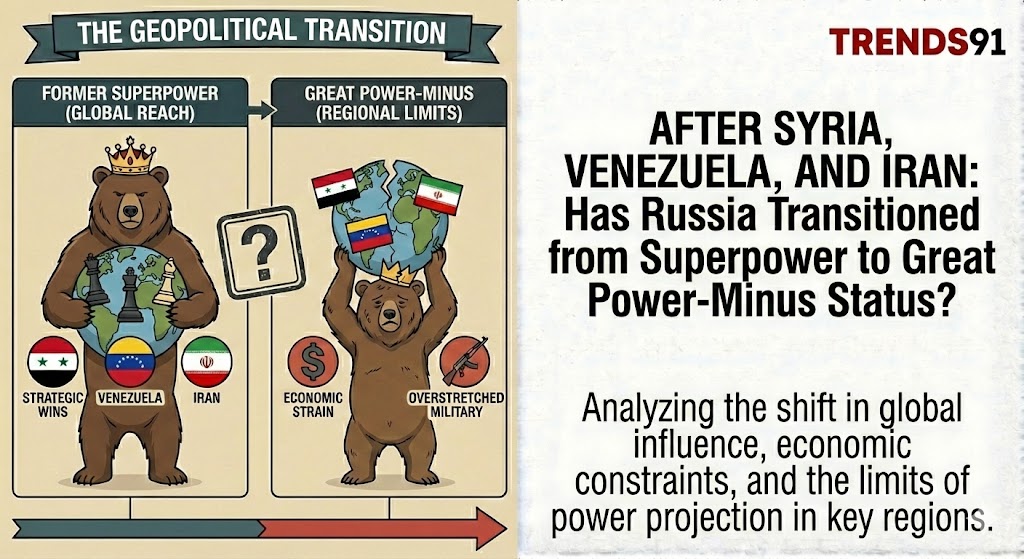
Russia’s recent geopolitical losses—the fall of Bashar al-Assad’s regime in Syria (December 2024), the capture of Nicolás Maduro in Venezuela (January 2026), and its refusal to provide military support to Iran during a twelve-day conflict with the United States and Israel (2025)—present a critical inflection point in assessing Russian power status. The question whether Russia remains a superpower or has degraded to “Italy with nukes” requires rigorous examination of the definitions of superpower status, Russia’s capacity constraints, and the structural weaknesses now defining its geopolitical position.
The verdict: Russia has lost superpower status and should be classified as a declining great power with significantly diminished capacity to project global influence. Its nuclear arsenal remains its only asymmetric advantage, but weaponry alone does not constitute superpower status under established international relations frameworks. The collapse of key regional proxy governments, coupled with a three-year demographic hemorrhage in Ukraine and accelerating dependency on China, demonstrate that Russia can no longer fulfill the core requirement of a superpower: persuading nations across multiple regions to act against their interests.
Italy, conversely, operates within NATO’s collective security architecture, maintains G7 membership, and influences Mediterranean and African geopolitics through the EU framework. While Russia’s military is vastly larger, its ability to convert that force into sustained geopolitical influence has evaporated. The analogy to Italy is not unflattering; rather, it accurately reflects a country of significant military capability that operates within constraints and alongside allies rather than as an independent hegemonic force.
Understanding Russia’s current status requires precisely defining superpower versus great power status. These are not interchangeable terms; they represent distinct categories in international relations hierarchy.
Superpower Definition (from established IR scholarship): A sovereign state that holds a dominant position characterized by the ability to exert unmatched influence and project power on a global scale through combined economic, military, technological, political, and cultural means, as well as diplomatic and soft power influence. Critically, superpower status requires the capacity to persuade nations in every region of the world to take important actions they would not otherwise take, according to Ian Bremmer’s definition from the Eurasia Group. Traditionally, superpowers are preeminent among great powers—no other state can challenge their authority without significant cost.
Great Power Definition (from established IR scholarship): A sovereign state recognized as having the ability to exert influence on a global scale through military and economic strength, supplemented by diplomatic and soft power capability. Great powers possess regional and sometimes global interests, can maintain their own security, and influence international affairs. However, unlike superpowers, great powers may be challenged by peer competitors, cannot necessarily persuade other nations to act globally against their interests, and often operate within constraints (alliances, treaties, balances of power).
The distinction is crucial: superpowers set the rules of the international system; great powers operate within them. Superpowers face no meaningful military constraint from any peer competitor. Great powers do.
By these definitions, the Soviet Union was unambiguously a superpower during the Cold War—it could project military power globally, maintain a nuclear arsenal comparable to the US, and force weaker states into its orbit through credible threat of intervention. Russia post-1991 has never been a superpower, despite occasional reassertions of great power status under Putin. Russia was a declining great power attempting to prevent complete diminishment.
Syria, Venezuela, and Iran—The Cascade of Losses
The Syria Collapse: First Breach in the Façade
Russia’s 2015 intervention in Syria was explicitly framed as a strategic anchor for maintaining Russian influence in the Middle East. The Assad regime represented not merely a client state but the linchpin of Russian military basing in the Eastern Mediterranean, ISR (Intelligence, Surveillance, Reconnaissance) capabilities across the Middle East, and a hedge against Iranian dominance in the region.
The military arithmetic appeared favorable. Russian air power proved decisive in 2015-2016, arresting the Assad regime’s military collapse. Yet the contradictions inherent in the relationship became apparent by 2024. Syrian military officers described the Assad regime as “dishonest, corrupt and not working properly,” and by 2024 the Russian view of Syrian armed forces’ capacity was deeply pessimistic. More critically, from 2022 onward—following the Ukraine invasion—Russian resource allocation to Syria began an inexorable decline. By late 2023 and early 2024, Russia had “implemented much harsher cuts to their support, leaving the Syrian armed forces starved of funding and logistics.”
The proximate cause was straightforward: Ukraine consumed Russian military capacity. Russia could not simultaneously sustain a high-intensity war against Ukraine, maintain Syrian force sustainment, and project power elsewhere. This is not an operational challenge; it is a structural admission: Russia’s economy and military-industrial complex cannot support multiple concurrent major theater operations.
By December 2024, the Assad regime collapsed despite Russian military presence. Syrian opposition forces, led by Hay’at Tahrir al-Sham (HTS), overwhelmed government forces that had been abandoned to attrition. Russia’s remaining forces in Syria—”special forces, base security and an aviation unit”—were insufficient to prevent the collapse, and despite renewal of airstrikes, Russian air power failed to halt opposition offensives.
The geopolitical meaning is unambiguous: Russia could not defend a regime that had become essential to its stated regional strategy. A true superpower does not lose regional anchor states. This signals either inability or unwillingness to mobilize sufficient force—both of which undermine superpower claims.
Venezuela: The Quiet Retreat
Russia’s Venezuela engagement represents a different but equally revealing dynamic. Over more than two decades, Russia had embedded itself deep within Venezuela’s military, energy sector, and political elite. The relationship was transactional but institutionalized: Russian military advisers, intelligence assets, and periodic strategic deployments (most notably, Wagner Group forces in 2019 and 2024) sustained the Maduro regime.
The strategic value to Russia was clear: a foothold in the Western Hemisphere, countervailing US dominance in Latin America, and a source of oil revenue critical to Venezuelan regime survival and Russian political leverage.
Then, in January 2026, the US captured Maduro through what one analyst described as “direct military action.” The response from Russia was remarkable primarily for its absence. Putin made no public comment for ten days following Maduro’s capture. Russian military personnel who might have been deployed to prevent regime collapse—as was reportedly considered—”amounted to little when Washington shifted to direct military action, which exposed the weakness of Russian defense and security support.”
More revealing still was the apparent acquiescence. One analysis suggests Russia’s relative quiet reflected its “longstanding desire for an understanding in which Russia would accept US dominance in the Western Hemisphere in exchange for Moscow’s free rein in what it considers its own sphere of influence, particularly in Ukraine.” In other words, Russia revealed itself willing to abandon hemispheric ambitions to concentrate limited capacity on Ukraine.
This is not superpower behavior. A superpower does not trade away entire regions. It is great power behavior during resource constraints—precisely the pattern observed when great powers enter asymmetric competition with near-peers that exhaust their capacity.
Iran’s Twelve-Day War: The Refusal to Support an Ally
The most damning evidence emerges from Russia’s non-response to Iran’s military crisis in 2025. Following escalating tensions, Iran engaged in a “twelve-day war with the United States and Israel.” This occurred despite Russia and Iran signing a Comprehensive Strategic Partnership Treaty in January 2025, with Putin publicly calling it a “real breakthrough” in bilateral relations.
When Israeli and American airstrikes targeted Iranian military infrastructure, Moscow offered only “diplomatic gestures” while explicitly clarifying that the Comprehensive Strategic Partnership treaty “does not oblige Moscow to defend the Iranians from attack.” The Kremlin “sidestepped questions over the possibility of military aid” while underlining these limitations.
The historical context sharpens the significance. Iran had been a crucial military supporter of Russia’s Ukraine war for three years. It supplied thousands of Shahed attack drones, provided technological blueprints enabling Russian domestic production, and sustained a military partnership upon which the Kremlin relied given Western sanctions and NATO opposition. Iran had earned a security guarantee by any reasonable standard of military partnership.
Russia’s refusal to reciprocate is not a diplomatic misstep; it is a structural incapacity masquerading as policy choice. Moscow’s senior analyst from the Carnegie Endowment notes: “Iran has already lost the status of an important military partner for Russia that it enjoyed during the first few months following the invasion of Ukraine, since Russia is now producing Iranian drones itself in a modified version that surpasses the original.” Russia no longer needs Iran militarily; thus Iran’s security does not constrain Russian decision-making.
The implication is devastating to Russian credibility: Russia cannot defend allies even when explicitly bound by treaty. Iran now understands that Moscow will purchase its support but will not expend military resources to ensure its security. This is not how superpowers manage alliances. Superpowers deter challenges to their allies through credible commitment to escalation. Russia’s refusal to escalate against US and Israeli strikes on Iranian territory signals that such commitments are hollow.
The Military Paradox—Size Without Capacity
By conventional military metrics, Russia is incomparably more powerful. Yet metrics alone do not determine capacity. The Ukraine war demonstrates this with crystalline clarity.
Russian Personnel Losses and Unsustainability:
Over three years and six months of war in Ukraine, Russia has sustained between 900,000 and 1.3 million total casualties, including 190,000 to 350,000 deaths. The 2024 casualty rate was the worst year of the war: 430,790 personnel, with November and December 2024 recording record daily losses. These losses occurred while Russia conquered approximately 4,200 square kilometers of Ukrainian territory—an exchange rate exceeding 100 casualties per square kilometer.
At this rate of exchange, sustaining territorial conquest becomes mathematically unsustainable. Extrapolating conservatively: to conquer the remaining 80% of Ukraine would require twelve additional years at current conquest rates, generating cumulative casualties of approximately 5 million personnel with 1 million deaths. No state can sustain such losses for an indefinite period without state collapse.
The demographic basis for these casualties is eroding. Russia has experienced declining birth rates since 2006. The unemployment rate stands at a historical low of approximately 2%, masking a severe labor shortage. Hundreds of thousands of military-age Russians have emigrated to avoid conscription. The defense sector is poaching civilian workers from civilian industries, degrading overall economic productivity. Combined, these factors suggest Russia will face critical personnel shortages within 12-24 months if the Ukraine war continues at current intensity.
Equipment Losses and Replacement Capacity:
Beyond personnel, Russia’s equipment losses are substantial: 3,689 tanks destroyed or abandoned, 8,956 armored vehicles, 13,050 artillery systems, 407 air defense systems, and 313 MLRS systems. While Russia maintains large reserves of older equipment that can be refurbished, replacement of modern systems is constrained by production capacity.
Russia’s military-industrial complex, already strained, faces compounding pressures. The defense budget consumes 7.2% of GDP in 2025 (15.5 trillion rubles)—matching Cold War-era spending during the Soviet-Afghan conflict. Most of Russia’s military production capacity is devoted to sustaining the Ukraine war. The capacity available for export, technology development, or modernization is minimal.
The Capacity Ceiling:
The critical insight: Russia cannot sustain simultaneous major operations. One senior analyst noted: “Much of Russia’s military strength is now thought to be deployed in Ukraine, with very little spare capacity available for other tasks.” This was confirmed during the Syria collapse and Venezuela loss—Russia lacked sufficient deployable capacity to even attempt to intervene effectively.
A superpower can simultaneously project power across multiple theaters without fundamentally compromising its capacity to defend core interests. The United States can simultaneously sustain forward deployments in the Pacific, Middle East, and Europe while maintaining homeland defense. Russia, by contrast, appears unable to sustain Ukraine operations, maintain Syrian positions, and deter NATO without trade-offs.
Economic Weakness and Structural Constraints
Beyond military capacity lies the economic foundation—and here Russia’s weakness becomes apparent.
GDP and Economic Scale:
Russia’s nominal GDP is approximately $2.1 trillion USD (2024). Its PPP-adjusted GDP is estimated at $7.1-7.7 trillion international dollars, placing it fourth globally behind the US, China, and India. By nominal GDP, Russia ranks approximately 11th globally, behind Canada, South Korea, Spain, and Mexico.
For context: Italy’s nominal GDP is approximately $2.0-2.2 trillion USD. Russia’s economy is marginally larger in nominal terms, but significantly more reliant on commodity exports (oil and gas), more vulnerable to sanctions, and more demographically fragile.
Oil and Gas Dependency:
Russia’s budget is heavily dependent on hydrocarbon revenues. In 2025, oil and gas revenues are expected to constitute 27% of total budget income, down from historical highs of 30-35% in prior years. Oil prices are expected to average $57 per barrel in 2025, down from $70 in 2024, further constraining fiscal space.
This dependency creates acute vulnerability. Western sanctions on Russian oil exports have been partially effective; Russian crude trades at a discount compared to global benchmarks. The defense budget increases have been funded partially through reduced allocations to education (0.7% of GDP) and healthcare (0.87% of GDP)—both dangerously low.
Fiscal Constraints:
Russia faces a projected budget deficit of 0.5% of GDP in 2025, modest on paper but problematic given that defense spending comprises 32-41% of total expenditures and economic growth has decelerated to 0.6-1.1% annually. Sustaining defense spending at 7.2% of GDP while managing sanctions, currency depreciation, and labor shortages is straining fiscal capacity.
Comparative Analysis: Why This Matters:
Italy, while facing its own fiscal constraints (135% of debt-to-GDP ratio), operates within NATO’s collective security framework, the EU’s economic integration, and has access to capital markets. Italy’s defense spending target is 2% of GDP, with a trajectory toward 3-3.5% by 2035 through multilateral European initiatives. Italy does not bear the singular burden of continental defense; it pools resources with 30 NATO allies.
Russia, by contrast, cannot access Western capital markets, cannot leverage alliance burden-sharing, and must independently fund continental-scale military operations. The economic sustainability of Russia’s current defense posture is questionable beyond the next 12-24 months.
Soft Power Collapse and Alliance Erosion
Military and economic metrics only partially determine great power status. Equally important are diplomatic influence, soft power, and alliance cohesion.
Global Soft Power Index Ranking:
Russia ranks 16th in the Global Soft Power Index (2025), having “held its position despite facing widespread condemnation in Western countries for its aggression towards Ukraine.” However, this ranking masks regional fragmentation. Russia’s soft power is supported by “Eastern allies” while facing “sharp regional divide in perceptions of Russia.” In other words, Russia’s soft power is regionally concentrated, not globally distributed.
By contrast, the United States ranks 1st (79.5/100), and China has surpassed the UK for 2nd place (72.8/100). The US and China possess genuinely global soft power reach—their cultural products, educational institutions, and diplomatic messaging resonate across regions and demographies.
Alliance Degradation:
Russia’s alliance structure is deteriorating. The most significant relationship—China—is increasingly asymmetric in China’s favor. Chinese scholars candidly acknowledge Russia has become a “junior partner of China,” and Russia’s own liberal experts have begun repeating the Western warning of a “China threat” as Russia loses autonomous great power status.
The India-Russia relationship is weakening critically. India’s 2025 Ambassador to India stated that Russia would remain neutral in any India-China conflict—a statement that effectively signals Russia cannot be relied upon for strategic support in the Indo-Pacific, India’s core interest area. As India’s comprehensive national power rises and the US tilts toward India as a counterweight to China, Russian relevance to Indian strategic thinking is declining.
Iran, as discussed, has learned that Russia’s security guarantees are ephemeral when tested.
Credibility Deficit:
The pattern across Syria, Venezuela, and Iran reveals a single credibility crisis: Russia cannot be relied upon to support allies when doing so requires expending military resources or accepting risk. This is not a temporary tactical problem; it reflects structural incapacity. Once allies understand that commitments are contingent on Russian spare capacity, alliances become transactional rather than strategic.
The Nuclear Arsenal Question—Differentiator or Mirage?
The final argument in Russia’s favour is its nuclear arsenal: approximately 6,000 deployed and non-deployed warheads, roughly comparable to the US inventory. Does nuclear capability constitute a sufficient basis for superpower status despite the losses catalogued above?
The Case for Nuclear Differentiation:
Nuclear weapons are genuinely differentiated in geopolitical impact. They prevent conventional military defeat or invasion. They grant Russia a permanent UN Security Council seat. They provide diplomatic leverage in crisis negotiations. No state can ignore Russia’s nuclear capability, and that asymmetry prevents Russia from being treated as a merely regional power.
The Case Against Nuclear Sufficiency:
However, superpower status requires more than the capacity to deter defeat—it requires the ability to achieve positive geopolitical objectives and persuade other nations to act in accord with one’s interests. Nuclear weapons are tools of denial (preventing others’ objectives), not tools of coercion (forcing others to act as you wish).
The historical record confirms this. The Soviet Union possessed nuclear weapons but lost the Cold War not through military defeat but through economic exhaustion and loss of ideological appeal. China developed nuclear weapons in 1964 but remained a great power, not a superpower, for decades until economic growth provided the economic and soft power foundation for great power status. Conversely, the US throughout the Cold War leveraged its military, economic, technological, and cultural superiority alongside nuclear weapons to achieve superpower status.
Russia’s nuclear arsenal has done precisely what nuclear arsenals do: prevented invasion and enabled diplomatic leverage. But it has not enabled Russia to prevent the fall of Syria, defend Venezuela, or protect Iran. It has not reversed the erosion of Russian soft power or enabled Russia to sustain concurrent major operations.
What Russia Has Become—and What Comes Next
The evidence accumulated across Syria, Venezuela, and Iran, combined with the military degradation in Ukraine and structural economic constraints, points to a single conclusion: Russia is a declining regional power with nuclear weapons, attempting to maintain great power status through the last vestiges of Soviet-era military strength.
This is neither hyperbole nor Western bias. Russian scholars and policymakers are themselves grappling with this reality. The realization that Russia has become a junior partner to China, that India increasingly sees Russia as a declining asset, and that allies cannot rely on Russian security commitments, are existential challenges to Moscow’s self-conception.
The Path Dependency:
Russia’s trajectory was not inevitable. Had the Ukraine war been conducted differently, had Russia achieved rapid victory and consolidated control, Russia might have emerged in 2024 with somewhat diminished but still-credible great power status. Instead, three years of attrition, alliance abandonment, and the revelation of military limits have crystallized Russia’s decline.
The Structural Problem:
Russia’s economy cannot sustain simultaneous great power competition with NATO, China, and the US while also maintaining internal stability and demographic reproduction. No state that is losing 100,000+ personnel annually to a single war theater can simultaneously defend multiple regional interests. Russia has chosen Ukraine, implicitly accepting diminishment elsewhere.
Implications:
This is not an argument that Russia is powerless. Russia can still wage war, disrupt regional stability, conduct cyber operations, and deploy nuclear-armed submarines. What Russia cannot do is remake the geopolitical order, achieve sustained expansion, or maintain dependent client states against determined opposition. These are precisely the capabilities that differentiate superpowers from great powers.
The fall of the Assad regime in Syria, the capture of Maduro in Venezuela, and Russia’s refusal to defend Iran during a military conflict represent more than tactical setbacks. They are the visible manifestations of structural decline—the transition of Russia from a declining great power attempting to maintain superpower pretensions to a clearly defined regional power with global nuclear capability but limited ability to project conventional force beyond its borders or maintain its alliances.
Russia’s position, is eroding. Its military is larger but less capable, straining its economy and demographic base. Its alliances are transactional and degrading. Its soft power is collapsing. Its nuclear arsenal prevents defeat but cannot achieve victory.
The question posed—”Can we say Russia is no longer a superpower?”—can now be answered with confidence: Russia has not been a superpower in the post-Cold War era, and recent events have clarified that it is transitioning from a declining great power to a regional power with residual Cold War military capability.
The “only differentiator” of a nuclear arsenal, as the query suggests, is accurate but incomplete. The more precise formulation: Russia is a nation that possesses the world’s second-largest nuclear arsenal—a genuinely differentiated capability that prevents its defeat and grants diplomatic leverage—but lacks the economic, military, diplomatic, and soft power foundation that characterizes superpower status.
This is not a prediction of Russia’s future so much as a diagnosis of its present. Whether Russia stabilizes as a regional power, undergoes further decline, or undergoes internal transformation is a question for future analysis. The evidence presented here establishes only that Russia’s current trajectory, illuminated by Syria, Venezuela, and Iran, does not support superpower status.