
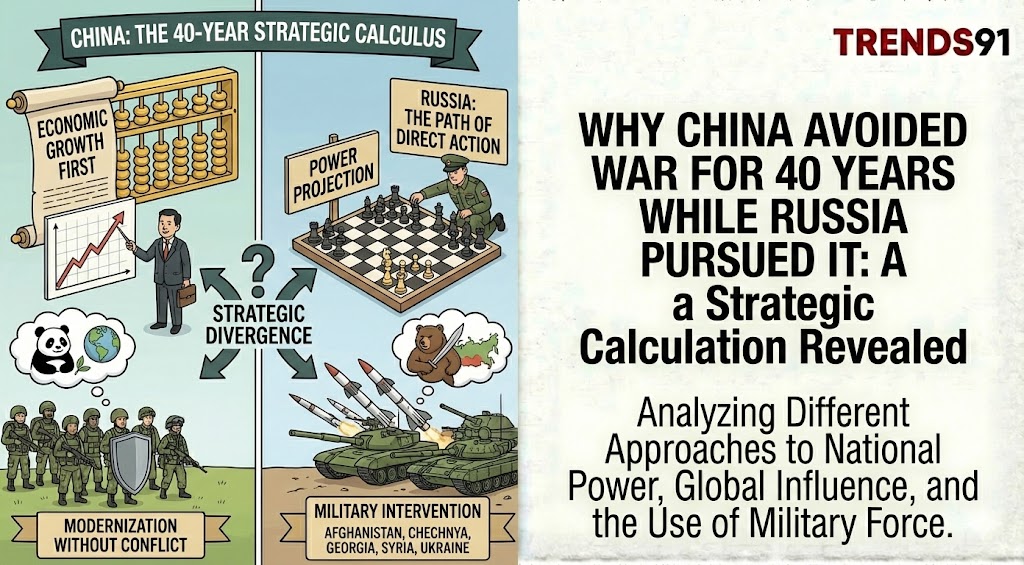
For four decades, China possessed the military capability to seize Taiwan, challenge U.S. dominance in the Pacific, or expand its territorial holdings. Yet it did not. Over the same period, Russia—economically weaker and militarily inferior to China—engaged in military conflicts with Georgia (2008), Ukraine (2014), and a full-scale invasion (2022).
The conventional wisdom attempts to explain this through intentions: China is more patient, more strategically wise, more committed to peace; Russia is aggressive, insecure, driven by imperial nostalgia. But this misses the deeper truth. The difference between China’s restraint and Russia’s aggression is not about whether each nation wants peace—it is about the structural strategic calculation that makes war rational or irrational for each.
China did not avoid war because of peaceful intentions. China avoided war because, given its structural position (trade-dependent economy, development stage, demographic trajectory, strategic window opening), war was the wrong strategy. Military conflict would have disrupted the conditions necessary for the economic growth that has enabled China to become the world’s second-largest economy and approaching military peer of the United States.
Russia, by contrast, pursued military aggression because, given its structural position (energy-dependent economy, sphere of influence threatened, strategic window closing, lower cost of isolation), military action appeared to be the only available tool to prevent further loss of regional control.
This is not a story about peaceful and aggressive nations. It is a story about how structural constraints shape rational strategic choice. When you change the structural conditions, you change the calculation. Understanding this explains not only why China and Russia followed different paths, but also what might change those paths in the future.
How Economic Integration, Demographic Pressure, and Strategic Windows Determine War/Peace Calculations
Why China Systematically Chose Restraint: The Structural Logic
In 1978, Deng Xiaoping made a strategic choice: China would pursue economic development before military expansion. This was not idealism—it was strategic calculation. A closed, sanctioned China surrounded by U.S. allies (Japan, South Korea, Philippines) could not compete militarily with the United States. But an open China integrated into global trade could accumulate capital, upgrade technology, and gradually develop the economic base for military modernization.
This required stability. Military adventures would have triggered international isolation, sanctions, and disruption of trade relationships essential to development. China’s defense spending remained under 2% of GDP for 30 years—deliberately modest—while the U.S. spent 3-4% of GDP on military, because China made an explicit choice to prioritize economic growth.
The payoff was dramatic. Over 40 years, China became a manufacturing superpower. It accumulated capital. It developed technological expertise. It built the economic base necessary for its military to modernize. And critically: it did not have to fire a shot to achieve dramatic power increase. Through trade, China gained influence that military force could not have purchased.
This is the logic Sun Tzu articulated: “Winning without fighting is the supreme art of war.” China’s interpretation: Build the economic and military capability so overwhelming that opponents will not dare fight you. Then, your power itself becomes deterrent.
But—and this is crucial—this strategy only works if you have time. If your strategic window is closing, patience becomes irrational. If your economy is deteriorating, waiting means weakness, not strength. If your demographic structure means you cannot sustain long-term development, delaying conflict may be suicide.
Why Russia Chose Aggression: The Structural Counter-Logic
Russia, by contrast, faced a different strategic situation. After the Soviet collapse, Russia’s economy shrank 40% in the 1990s. By the 2000s, it had recovered but remained dependent on energy exports—less integrated with Western markets than China, more vulnerable to sanctions, less capable of accumulating capital through trade.
More critically: Russia perceived its strategic window as closing, not opening. NATO expanded eastward through the 1990s and 2000s. Ukraine moved toward NATO. Georgia moved toward NATO. Each expansion moved Western military capability closer to Russian borders. From Moscow’s perspective, the sphere of influence that had existed since 1945 was disappearing.
This created urgency. If Russia waited passively, NATO would continue expanding, and Russia’s relative position would continue declining. The 2008 Georgia invasion and 2014 Crimea annexation were not unprovoked aggression from Moscow’s perspective—they were attempts to restore control over a sphere of influence that Russia perceived as being taken from it.
Russia could not wait for its economy to develop and its military to outmatch the U.S. (as China hoped to do) because:
- Russia’s economy is not developing; it is stagnating under sanctions
- Russia’s integration into global markets is declining, not increasing
- Russia’s strategic window is closing due to NATO expansion, not opening
- Patience for Russia means accepting permanent loss
The Demographic Dimension: Why China’s Aging Population Argues Against War
Here is the detail that most analysis misses: China’s demographic crisis actually provides additional structural incentive against military aggression.
China’s population is aging rapidly. In 2026, 323 million people—23% of China’s total population—are over age 60. The UN projects that by 2100, half of China’s population could be over 60. This creates massive pressure on pensions and healthcare systems. As the workforce shrinks, economic growth slows.
This has direct military implications. Economic slowdown means reduced defense spending growth. Aging populations are less willing to support prolonged wars (their children are fewer in number, and they worry about economic security more than expansion). Smaller recruitment pools of young soldiers make large military operations harder to sustain.
Most importantly: This creates powerful incentive AGAINST military aggression for China. A military conflict with Taiwan or the U.S. would disrupt the economic growth China desperately needs to fund pensions, healthcare, and manage social stability as it ages. War is, demographically speaking, the worst strategic choice China could make.
Russia, by contrast, faces less severe demographic pressure. Its population is stable, though aging, and it has a younger recruitment base than Western Europe. Russia’s demographic constraints are real but less acute than China’s.
So we have a paradox: China is becoming more powerful militarily AND more constrained strategically (due to economics and demographics). Meanwhile, Russia is becoming weaker militarily BUT feels more urgent pressure (due to NATO expansion and closing window).
What China’s Military Choices Reveal About Strategic Rationality
When examining China’s actual military actions over 40 years, the pattern is striking: China has engaged in military conflict only when:
- It telegraphed the action beforehand (not sneaking attacks)
- It correctly assessed opponent response (not miscalculating)
- It achieved limited objectives and withdrew (not seeking permanent occupation)
The Korean War (1950): China entered with advance warnings to the U.S. that it would intervene if U.S. forces approached the Yalu River. The CIA believed China would not enter because a broader war would be rational. China correctly calculated that the U.S. would not attack the Chinese mainland. This assessment proved correct—the war remained bounded.
The Sino-Indian War (1962): India engaged in increasingly belligerent border actions. China responded with military action, overwhelmed Indian forces, then voluntarily withdrew before consolidating gains. China could have occupied disputed territory permanently. Instead, it demonstrated capability, achieved psychological victory, then withdrew. The border remained contested but unresolved—China did not overextend.
The Sino-Vietnamese War (1979): Limited incursion, not attempt at territorial occupation. Ideologically driven (responding to Vietnam’s invasion of Cambodia) but not sustained.
The Pattern: All three conflicts were announced or telegraphed beforehand, carefully calibrated, and voluntarily limited. None escalated to sustained war. None achieved only territorial gains that required permanent occupation. This is the strategy of a nation that has other ways to win besides military conquest.
Compare this to Russia:
- Georgia 2008: Responded to Georgian military actions with overwhelming force and sustained occupation of Abkhazia and South Ossetia. Has not withdrawn.
- Crimea 2014: Annexed peninsula and has held it. Permanent territorial acquisition.
- Ukraine 2022: Full-scale invasion aimed at regime change or large territorial acquisition. Sustained for years.
Russia’s military actions aim at territorial control and permanent changes to political boundaries. China’s military actions (when they occur) aim at demonstration of capability without territorial acquisition.
This reflects different underlying strategic calculations: Russia fights to restore and hold a sphere of influence. China fights to demonstrate capability while preserving the conditions for economic development.
How Structural Differences Create Different Rational Choices
The key insight is this: Given China’s position, restraint was rational. Given Russia’s position, aggression appeared rational (to Russian decision-makers).
This is not moral judgment about which nation is better or more peaceful. It is structural analysis of which strategic choice makes sense given each nation’s constraints.
Why War Is Economically Irrational For China
China’s economy is integrated into global trade. China exports manufactured goods to the U.S., Japan, Europe, South Korea, and dozens of other Western-aligned nations. This trade generates the capital necessary for:
- Healthcare and pensions for an aging population
- Debt service (China has substantial internal debt)
- Infrastructure investment required to manage its massive population
- Military modernization (which requires investment in technology and precision equipment)
A military conflict would shut down this trade. Sanctions would isolate China economically. Supply chains would break. Capital flows would stop. The economic growth that has enabled China’s military modernization would be replaced by contraction—precisely the opposite of what China needs.
Therefore, from China’s perspective, war is economically catastrophic. It would trade temporary military gains for permanent economic damage.
Russia, by contrast, has less to lose economically from isolation. Russia’s economy is already isolated (U.S./EU sanctions already in place). Russia does not rely heavily on integrated global supply chains. Russia’s primary exports are energy, which it can always sell (despite Western efforts).
Therefore, from Russia’s perspective, military action does not carry the same economic cost. The barriers to military action are lower.
Why Patience Is Strategically Rational For China
China’s strategic window is opening, not closing. Every year, China becomes relatively stronger compared to the United States. China’s economy, despite recent slowdowns, is larger than Japan + Germany combined. China’s military modernization continues, and the quality gap with the U.S. narrows annually.
Given this trajectory, patience is rational for China. In 2025, China may not be able to win a war with the U.S. over Taiwan. But in 2035, 2040, or 2050, the balance of power will have shifted further in China’s favor. Military power will eventually be so overwhelming that opponents will not dare fight.
Russia’s strategic window, by contrast, is closing. NATO has already expanded. Ukraine has already slipped from Russia’s sphere of influence. Georgia has already moved toward the West. If Russia waits, more territory will be lost, more neighbors will join NATO, and Russia’s relative position will continue declining.
Therefore, Russia felt urgency to act now, before the window closed entirely.
This explains the timeline: China became increasingly capable militarily in the 1980s-1990s-2000s-2010s-2020s but became less aggressive, not more. China’s restraint increased as its capability increased because patience was rational—the power differential was moving in China’s favor. Russia became increasingly aggressive in the 2000s-2010s-2020s precisely as its relative position weakened because it felt urgency—the strategic window was closing.
Why Demographic Decline Argues Against War For China
Finally, China’s demographic crisis creates powerful additional incentive against military aggression. An aging population requires increasing government spending on pensions and healthcare. A shrinking workforce makes labor scarce and expensive. Economic growth slows.
Precisely when China needs maximal economic growth to fund aging population care, military conflict would disrupt growth. It is strategically perverse—the exact opposite of rational timing.
Moreover, an older population is more war-averse. Older people worry about economic security, not national expansion. They do not want their children dying in distant wars. Public support for military adventurism declines in aging societies.
Russia does not face this constraint to the same degree. Russia’s aging is severe but not as acute as China’s. Russia’s population is stable. Russia can maintain military spending without the same crowding-out of social welfare.
Evidence That Structural Constraints, Not Intentions, Drive War/Peace Decisions
Defense Spending Patterns Validate the Theory
If China’s restraint were due to peaceful intentions, we would expect China to keep defense spending low forever. But that is not what happened:
- China’s defense spending has grown consistently and substantially
- 2025 defense budget: $247-318 billion (official to SIPRI estimates)
- Growth rate: 7.2% annually in 2025
- Total military spending estimates as high as $471 billion
- Yet defense/GDP ratio kept deliberately below 2% for three decades
This pattern makes sense given the strategic calculation: Develop military capability steadily while maintaining economic openness. Raise military spending enough to support modernization, but not so much that it disrupts economic growth.
Russia’s spending pattern is different: Russia spent heavily on military in the 1990s-2000s despite lower GDP, because it faced immediate threats. Russia shifted from investment in economic development to military maintenance of regional control.
Taiwan’s Status Quo Validates the Theory
If China intended to invade Taiwan, why hasn’t it? The standard answer is “It’s waiting until it’s stronger.” But this exactly confirms the strategic calculation logic:
- China has enough military capability now to attempt an invasion
- But the cost (economic disruption, Western response, losses) exceeds any gain
- Therefore, patience is rational
- Status quo of Taiwan as separate but not officially independent suits China’s strategic interests
- This will remain true as long as economic growth matters more than territorial expansion
Compare to Russia: Russia saw Ukraine’s move toward NATO as urgent threat that couldn’t be managed through patience. Russia acted immediately.
Economic Performance Validates the Theory
China’s 40-year restraint produced: The world’s 2nd largest economy, technological advancement, military modernization, and regional dominance without formal military conquest.
Russia’s periodic aggression produced: Economic isolation, sanctions, stagnation, military losses, and relative decline.
The outcomes validate the strategic calculation: Restraint + development = power increase; Aggression + isolation = stagnation.
The Real Costs of China’s Restraint vs Russia’s Aggression
China’s Restraint Sacrifices:
✓ Gains: Economic development, military modernization, regional influence, economic dominance
✗ Loses: Immediate territorial gains (Taiwan remains separate, South China Sea contested), control over immediate neighbors, ideological satisfaction of unification
The question for China is whether slow power accumulation through economic development is worth the cost of delaying territorial unification. Current Chinese leadership calculates: Yes. The economic costs of military adventure exceed benefits.
But this could change. If:
- Economic growth permanently stalls (demographic decline accelerates faster than expected)
- Taiwan unifies on its own (unlikely but possible)
- U.S. disengages from the Pacific (geopolitical shift)
- Internal Chinese instability forces nationalist action
…then the calculation changes. If China can no longer rely on economic growth to manage aging population and social stability, military expansion becomes more attractive as a distraction and resource-generator.
Russia’s Aggression Sacrifices:
✓ Gains: Temporary restoration of sphere of influence, nationalist satisfaction, strategic depth (control of buffer states)
✗ Loses: Economic integration with West, capital flows, technological transfer, opportunity to develop economically
Russia gambled that military control of regional territory was more valuable than economic development. The payoff has been negative: Military victories (Crimea, parts of Ukraine) have not translated to improved economic conditions. Sanctions have worsened Russia’s economic trajectory.
But from Russia’s perspective in 2008-2014, the calculation was: If I wait for my economy to develop, the West will expand into my sphere of influence before I become powerful enough to resist. Better to act now while I still have regional military dominance.
When Would China Abandon Restraint? When Might Russia Abandon Aggression?
Scenario 1: China Abandons Restraint (Low Probability – 15%)
This would require a fundamental change in the structural calculation. Triggers would include:
- Economic Stagnation Becomes Permanent: If China’s growth rate falls to 2-3% permanently (not temporarily) and stays there due to demographic collapse, the value of patient economic development decreases. If China cannot generate the economic growth needed to fund aging population care regardless of strategy, then the cost-benefit of military expansion changes.
- Internal Instability Requires Nationalist Distraction: If China faces internal unrest (unemployment from automation, social fragmentation, regional instability), military action could serve as nationalist rally point. This would increase likelihood of Taiwan adventure.
- Technological Parity Achieved: If China determines it has achieved military parity or superiority over U.S. in Pacific theater, the calculation shifts. At that point, economic disruption from war might be acceptable if China believes it can win decisively.
- U.S. Commitment to Taiwan Wavers: If U.S. reduces forces in Pacific or makes ambiguous statements about Taiwan, China’s cost-benefit analysis for unification changes.
Scenario 2: Russia Abandons Aggression (Low Probability)
This would require either:
- Ukraine Stabilizes Under Russian Dominance: Russia accepts partial control and freezes conflict, treating it as successful restoration of sphere of influence.
- Economic Recovery Occurs: If Russia’s economy recovers despite sanctions (due to new trade partnerships, energy price spikes, or Western sanctions fatigue), the pressure for aggressive action decreases. With economic recovery, Russia can pursue gradual influence through economic means rather than military force.
- NATO Expansion Stops: If Western nations accept that further NATO expansion is off the table, Russia’s perceived threat decreases. Strategic urgency diminishes.
Currently, none of these are occurring. China’s growth is slowing but not stopping. Russia’s economy is not recovering.
The Real Uncertainties About Future Chinese/Russian Behavior
Question 1: Is China’s Restraint a Permanent Strategy or a Temporary Necessity?
Analysts disagree on whether “peaceful rise” is:
- Permanent doctrine: China’s long-term strategic preference (some argue this is deeply embedded in Chinese strategic culture)
- Temporary necessity: China is patient only while weaker; once strong enough, China will become aggressive
The data suggests: As China becomes stronger, it becomes more restrained militarily, not less. China in 2000 seemed more hawkish than China in 2025. This suggests restraint is structural (based on economic needs) rather than ideological.
But uncertainty remains: If economic growth truly stalls, will restraint continue?
Question 2: How Certain is China’s Demographic Decline as Strategic Constraint?
Analysts disagree on whether demographic aging truly constrains military action:
- Constraint view: Aging population + slower growth = reduces appetite for war
- Aggression view: Demographic decline + closing economic window = increases urgency for territorial action while still militarily capable
Precedent: Japan in 1930s also faced demographic challenge and became more expansionist. Did aging population cause aggression, or did economic stagnation cause both aging-related policy problems AND aggressive expansion?
China faces the same ambiguity: Is aging a constraint that prevents war, or a crisis that drives war as solution?
Question 3: Can Russia Ever Return to Economic Development Strategy?
Analysts disagree on whether Russia could pivot back to economic development if conditions changed:
- Possible view: If sanctions end or trade normalizes, Russia could shift from aggressive defense of sphere of influence to economic integration
- Unlikely view: Russian strategic culture is now committed to sphere of influence restoration; economic opportunity alone won’t change that
Historical precedent is mixed. Russia has oscillated between Western integration (1990s) and spherical control (2000s-present). Future oscillation is possible.
For the General Reader: Why This Analysis Matters
China’s 40-year restraint and Russia’s recent aggression are not accidents of leadership personality or national character. They reflect rational strategic calculation given each nation’s structural position.
Understanding this matters because it tells you: If structural conditions change, strategic behavior will change. The question is not “Is China aggressive or peaceful?” but rather “Under what structural conditions would China find military action rational?”
The answer: If economic integration reverses, if demographic pressure eases, if technological parity is achieved, or if internal instability requires nationalist action, China’s rational calculation might shift.
For U.S. policymakers and European allies, this means: The goal is to maintain structural incentives that keep military action irrational for China. This requires:
- Continuing economic integration with China (makes war costly for both sides)
- Technological investment to prevent Chinese dominance
- Demographic management to prevent China from facing the choice between internal chaos and external expansion
For those worried about China’s rise: China’s growth does not automatically make war more likely. In fact, as China becomes more invested in international economic order, the costs of disrupting that order increase. The more China profits from global trade, the more it has to lose from military conflict.
What the Data Actually Reveals
Taken as a whole, the evidence strongly suggests that structural constraints, not intentions or character, explain why China chose restraint and Russia chose aggression.
China’s restraint is rational given:
- Trade dependence requiring stability
- Economic development strategy requiring capital flows
- Demographic crisis requiring growth for pension/healthcare funding
- Strategic window opening (can afford patience)
- Cost-benefit of economic development > military expansion
Russia’s aggression is rational given:
- Lower integration with Western economy (fewer costs to isolation)
- Perception of closing strategic window (must act now)
- Sphere of influence doctrine requiring forward defense
- Less severe demographic constraints
- Cost-benefit of military control > economic development
This explains the paradox: As China became more powerful militarily, it became more restrained. As Russia became relatively weaker, it became more aggressive. This is exactly backwards from what an intentions-based analysis would predict. It only makes sense through structural strategic calculation.
What Could Challenge This Assessment:
- If China’s economic growth truly permanently stopped (not just slowed): Demographic pressures and domestic instability might make military expansion appealing despite economic costs. But current evidence suggests growth is slowing, not stopping.
- If Russia’s economy recovered: Pressure for aggressive action would decrease. Russia could revert to economic integration strategy. But current trajectory shows sanctions solidifying, not weakening.
- If Taiwan moved toward unification: China’s calculation would shift dramatically. Unification cost would decrease, making military action more rational. But Taiwan’s current trajectory is toward deeper separation from mainland.
- If U.S. visibly disengaged from Pacific: This would reduce the cost of Chinese military action significantly. Current U.S. strategy is opposite (deepening engagement), so this is low probability.
None of these are occurring at baseline probability, so the structural calculation remains: China rational to wait; Russia rational to act (from its perspective).
The Real Open Questions About Future Strategy
Question 1: Will China’s Demographic Crisis Accelerate or Stabilize?
If demographic decline accelerates (lower births, faster aging), pressure for war increases. If demographic decline stabilizes (immigration, family subsidies increase births), pressure decreases.
2026 Birth rates hit record low; aging accelerates. Current trajectory = accelerating crisis, which increases long-term pressure for war. But this is 10-20 year timeline, not immediate.
Question 2: Can China Maintain 5% GDP Growth Despite Demographic Headwinds?
If China can maintain steady growth through automation and technology, restraint remains rational for 10+ more years. If growth falls below 3% sustainably, timeframe for strategic shift moves up dramatically.
2026 Growth at 5%, expected to slow further. Uncertain whether slowdown stops at 3% or continues to 2% or below.
Question 3: Will Taiwan’s Status Quo Become Untenable?
If Taiwan drifts toward independence (hostile to Beijing), China’s calculation shifts. If Taiwan drifts toward unification (friendly), China’s calculation stays stable. If Taiwan remains status quo indefinitely, restraint remains rational.
2026 Taiwan drifting toward deeper separation, not unification. Status quo stable, though tense. This argues for continued Chinese restraint.
Question 4: Will U.S. Commitment to Taiwan Remain Credible?
If U.S. appears willing to abandon Taiwan (through rhetoric or policy), China’s cost-benefit for military action changes dramatically. If U.S. commitment is visibly strengthened, restraint remains rational for China.
2026 U.S. military presence in Pacific increasing; commitment statements stronger. This reinforces Chinese restraint (military action still too costly).
Key Indicators of Whether Strategic Calculations Are Shifting
Watch China’s Economic Data:
If GDP growth sustainably falls below 4%, demographic pressure increases significantly. If growth remains 4-5%+, restraint remains rational. This is the most important indicator.
Watch Taiwan’s Political Trajectory:
If Taiwan moves toward formal independence declaration, China’s calculation shifts. If Taiwan remains in status quo ambiguity, restraint continues. Monitor electoral outcomes and referendum results.
Watch China’s Defense Budget Growth:
If defense spending growth accelerates (>8% annually) while economic growth slows (<4%), this signals shift in priorities from growth to military expansion. Current pattern (7.2% growth in defense despite 5% economic growth) shows defense spending prioritized but not yet dominant.
Watch Taiwan Military Capability:
If U.S./allied support for Taiwan’s military strengthens (advanced missile systems, submarine capability), China’s cost for invasion increases. If Taiwan’s capability stagnates, China’s cost decreases.
Watch China-U.S. Economic Decoupling:
If decoupling accelerates (rising tariffs, supply chain separation), China’s cost from military conflict decreases. If integration continues, cost remains high. Current trajectory: Modest decoupling, but high interdependence remains.
Stay Ahead of Strategic Calculation Shifts
The question “When will China become aggressive?” cannot be answered through speculation about leadership intentions. It can only be answered through monitoring of structural conditions: economic growth rates, demographic trends, Taiwan’s political trajectory, and U.S. commitment levels.
Subscribe to Trends91 for:
- Monthly economic data tracking: GDP growth, defense spending allocation, demographic indicators
- Taiwan political analysis: Electoral results, independence/unification sentiment shifts, military capability updates
- China-U.S. economic decoupling tracking: Trade patterns, tariff impacts, supply chain shifts
- Scenario updates: How shifting structural conditions alter the war/peace calculation
- Comparative analysis: How Russia’s strategy shift validates or invalidates the structural calculation model
- Expert synthesis: What military analysts, economists, and China specialists are saying about shifting incentives
Join a community of strategists, investors, and defense professionals who monitor the structural conditions driving war and peace decisions—not personality and intentions.
For real-time analysis of breaking economic data and strategic shifts, follow @trends91blog on X (Twitter). For professional discourse on geopolitical strategy, connect on LinkedIn – Trends91.
Strategic calculations change as structural conditions shift. Get the analysis of what’s actually driving behavior before assumptions mislead you. Subscribe now.