
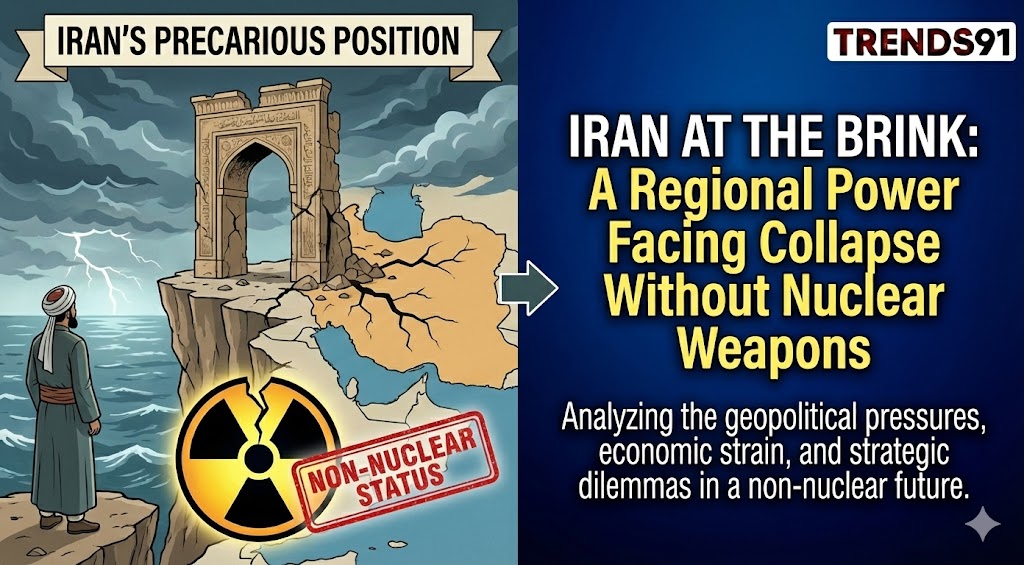
The potential collapse of Iran’s theocratic system would represent a geopolitical rupture of significant magnitude for the Middle East, but the analysis requires critical precision about Iran’s actual nuclear status. Iran does not possess nuclear weapons. Iran is not a nuclear-armed state. What Iran possesses is a nuclear enrichment program that has advanced to the threshold of weapons capability—a fundamentally different and more vulnerable position than actually possessing deployed weapons. This distinction is crucial because it shapes both the threat Iran poses and the vulnerabilities it faces.
As of May 2025, according to IAEA verification, Iran had accumulated 408.6 kilograms of uranium enriched to 60 percent U-235. This is the highest level of enrichment by any non-nuclear weapons state. Uranium enriched to 60 percent is technically close to the 90 percent required for weapons-grade material. IAEA analysis indicates that Iran can convert its current 60 percent enriched uranium stockpile into sufficient weapon-grade uranium for 9 nuclear weapons within three weeks. More alarmingly, Iran can produce its first 25 kilograms of weapons-grade uranium in as little as two to three days if it began a full breakout.
Yet this capability is not the same as possession. Iran has not crossed the threshold into actual weaponization. US intelligence agencies continue to assess that “Iran is not building a nuclear weapon,” though they warn that Iran’s nuclear activities “better position it to produce nuclear weapons if it so chooses.” The critical gap between threshold capability and actual weapons is significant: Iran would still require several additional months to fabricate working nuclear warheads even after producing weapons-grade uranium. This window of time is what creates both the urgency in Israeli and American discussions of military strikes and the vulnerability of Iran’s position.
This distinction—between threshold capability and weapons possession—fundamentally changes the analysis of what Iran’s collapse would mean. Unlike an actual nuclear-armed power, whose collapse would trigger immediate international alarm about weapons security, Iran’s collapse poses a different threat: the possibility that a non-nuclear but near-nuclear actor loses state coherence precisely when it faces military pressure to prevent weaponization.
Iran’s Actual Crisis: Economic Collapse Without Nuclear Deterrent
Iran faces a genuine convergence of vulnerabilities, but they are conventional rather than nuclear in nature. The economic crisis is real and severe. Inflation reached 42.2 percent as of December 2025, with food inflation hitting 58 percent in September 2025. Bread and fruit prices have nearly doubled in months. The Iranian rial has collapsed against the dollar, losing half its value in two years. Between 22 and 50 percent of Iranians now live below the poverty line, a catastrophic increase from 2022. Youth unemployment stands at 20-23 percent, nearly triple the national average. Economic growth has stalled to 0.3-0.6 percent, essentially zero growth in an environment of 40+ percent inflation.
The military dimension compounds this crisis. In June 2025, Israeli forces conducted strikes on Iranian nuclear facilities, air defenses, and military infrastructure, killing senior IRGC commanders including Chief Hossein Salami, the armed forces chief of staff, and the air force commander. The strikes destroyed Iran’s most advanced S-300 air defense systems and degraded Iran’s ballistic missile production capacity. The June war lasted 12 days and demonstrated Iran’s inability to defend itself against sustained air strikes from a technologically superior adversary.
Critically, Iran’s Axis of Resistance allies—Hezbollah, Iraqi militias, Houthis—threatened retaliation during and after the June strikes and then failed to deliver meaningful responses. This demonstrated that even if Iran faces regime collapse, it cannot expect external rescue. Iran is isolated in a way it has not been since 1979.
The political vulnerability emerged starkly in late December 2025. Protests erupted on December 28, triggered by economic despair, currency collapse, and food price inflation. The protests spread to all 31 provinces within days.
Yet one critical element remains absent: fracture within the security apparatus. The IRGC, police, and Basij paramilitary have not defected. No military units have refused orders. Without this institutional fracture, current protests, however intense, have not yet reached the threshold of systemic challenge. But the vulnerabilities are such that fracture could emerge rapidly if external military pressure increases or if economic conditions deteriorate further.
Why Iran’s Collapse Is Distinct from Syria or Iraq
The potential fall of Iran differs fundamentally from Syria’s collapse in December 2024 or Iraq’s sectarian fragmentation. Syria’s fall was the loss of a client-state that had been hollowed out by civil war; the IRGC and Russian air force kept Assad alive artificially. When those props were removed, Syria fell relatively quickly to an internally organized insurgency. But Syria’s population is 23 million; its economy is devastated; its strategic position, while important, is not irreplaceable.
Iraq was destabilized by the 2003 US invasion, which triggered sectarian civil war. But Iraq never fully collapsed as a state. It maintained institutions, courts, parliament, and a nominal centralized government, even as it was torn by internal factions.
Iran is fundamentally different in scale and strategic importance. Iran is an 88-million-person nation with a substantial military capacity and control of the Strait of Hormuz—the chokepoint through which 20-25 percent of global oil supplies pass. Iran’s IRGC functions as a state within state, controlling massive economic enterprises, security operations, and regional proxies. Iran is the central organizing principle of Shia regional politics and influence. Iran’s collapse would not be the loss of another client-state caught in regional competition. It would be the dissolution of the central node of Shia political organization and the rebalancing of sectarian power across the region.
More critically, Iran’s collapse would occur at a moment of maximum vulnerability: when the regime lacks nuclear weapons to deter external military pressure (despite threshold capability) and faces potential internal fracture. This creates an asymmetric threat. If Iran’s regime collapses, it would not involve securing a deployed nuclear arsenal (which doesn’t exist). But it would involve managing a threshold nuclear program during state transition—ensuring that 408.6 kilograms of 60 percent enriched uranium doesn’t fall into the hands of successor factions, militias, or hostile neighbours in a context of civil chaos.
The Axis of Resistance Collapse: Already Underway
Iran’s geopolitical strategy since 1979 relied on the Axis of Resistance—a regional proxy network designed to project power beyond Iran’s borders and constrain rivals. This network is already in structural collapse, independent of Iran’s regime status.
Syria’s fall in December 2024 severed the essential land bridge connecting Iran to Hezbollah in Lebanon. For 13 years, Iran maintained IRGC forces in Syria, funnel weapons to Hezbollah, and sustained supply lines that allowed it to threaten Israel from multiple directions simultaneously. With Syria lost to a Sunni militant government (Hayat Tahrir al-Sham) hostile to Iran, this infrastructure is gone.
Hezbollah, which lost its leader Hassan Nasrallah in September 2024 and suffered massive personnel losses in the 2024-2025 war with Israel, is now cut off from its primary supply route. The organization faces potential existential challenge: it cannot sustain itself through recruitment in Lebanon (which is economically devastated and increasingly resistant to Iranian influence) and cannot be resupplied through Syria. Iran transferred hundreds of millions of dollars to attempt reconstruction, but without supply routes and with its own economy collapsing, this support is increasingly theoretical.
Iraq remains contested between Iranian and Western interests, but Iranian control is weakening. The Trump administration has threatened military action against Iranian-backed militias, creating pressure on Iraq’s government to constrain them. Yemen’s Houthis are weakened by economic collapse and Iranian inability to sustain supply lines; they can still threaten Gulf shipping but are no longer an expanding force.
The Axis of Resistance has been reduced to surviving militia groups in Iraq and Yemen, a decapitated Hezbollah in Lebanon, and Iran’s own severely degraded military capability. This collapse was triggered by Syria’s loss and Israel’s military strikes—both of which occurred independent of Iran’s internal political crisis. But if Iran’s regime does collapse, the Axis dissolution becomes complete and irreversible.
Why This Matters for Global Order: The Sectarian Rebalancing
An Iranian regime collapse would produce permanent reordering of Middle Eastern sectarian and strategic alignment. Where Ukraine demonstrated weakness of one power and strength of another, Iran’s potential collapse would demonstrate the permanent end of the 40-year Shia Crescent strategy and structural ascendancy of Sunni states (particularly Saudi Arabia), Israel, and Turkey.
The Sunni-Shia competition that has defined Middle Eastern conflict since 2003 would be decisively resolved in Sunni favor. The Iranian ideological and strategic competition for regional influence would end. Sunni states would no longer fear Iranian encirclement or Iranian support for sectarian insurgencies across their borders. The regional order would return to pre-2003 structures but without the Sunni hegemon (Iraq) that previously provided balance.
Saudi Arabia would emerge as the primary regional power without serious regional challenger. Unlike earlier eras when regional powers balanced each other, the post-collapse Middle East would see a Saudi-led order contested only by Israel and Turkey—a fundamentally unbalanced configuration. Israel would become the dominant military force in the Levant without peer competition, having permanently won the competition for Levantine dominance. Great power competition (US dominance, European interests, Chinese hedging, Russian decline) would become secondary to regional power dominance.
The refugee crisis could be severe. Ukraine produced roughly 6 million refugees; Afghanistan produced 2 million. An Iranian civil conflict (if collapse triggers internal armed conflict) could produce 5-10 million refugees across a region already saturated with refugee populations from Syria, Iraq, Afghanistan, and Palestine. Energy security would be threatened: a potential closure of the Strait of Hormuz would disrupt 20-25 percent of global oil supplies and spike prices, triggering global economic shock exceeding Ukraine’s economic impact.
The Nuclear Dimension: Threshold Risk Without Deterrent
Here is where Iran’s actual situation differs critically from possession of deployed weapons: Iran faces maximum vulnerability precisely because it has not crossed the weaponization threshold. Iran can produce 9 nuclear weapons’ worth of uranium in three weeks, but it doesn’t have 9 nuclear weapons sitting in secure arsenals. This means:
- No nuclear deterrent against strikes: Iran lacks the deployed weapons that would deter Israeli or American military action. Israel struck Iran in June 2025 without fear of Iranian nuclear retaliation because Iran had no nuclear weapons to use. This is why Netanyahu and Trump are discussing further strikes.
- Threshold capability as provocation: Iran’s 60 percent enriched uranium—enough to quickly cross into weapons-grade material—serves as a constant provocation. The US and Israel argue that Iran’s enrichment levels pose an unacceptable proliferation risk requiring military prevention. Iran cannot argue that it already possesses weapons and therefore military strikes would be counterproductive.
- Weaponization window still open: Even if Iran’s regime collapsed tomorrow, the threshold nature of Iran’s program means it would take additional months to weaponize any uranium Iran enriched. This window means external powers (Israel, US, potentially others) retain options to intervene militarily or prevent weaponization even during regime transition.
- Security of materials during transition: If Iran’s regime collapses into civil conflict, the 408.6 kilograms of 60 percent enriched uranium must be secured. This is not a problem faced by actual nuclear weapons states (which have secure arsenals). Iran’s threshold status means its most dangerous nuclear materials could theoretically become vulnerable during state collapse—a proliferation risk that actual nuclear-armed states don’t pose.
Timing and Probability: 2026 as Potential Inflection Point
Netanyahu and Trump are actively discussing “round 2” strikes on Iran in 2026, with Trump indicating support if Iran shows “tangible and verifiable” actions to reconstitute its nuclear program. The threshold for what constitutes “reconstitution” is deliberately vague, giving the Trump administration flexibility to justify strikes if it chooses.
Iran faces an impossible dilemma. If it attempts to further enrich uranium toward weapons-grade (which it will, because enrichment is its only path to eventual deterrence), it triggers strikes. If it does not enrich, it remains vulnerable to military attack without nuclear deterrent. The regime cannot accept permanent vulnerability, but pursuing enrichment invites strikes that could cascade into regime collapse.
Internal protests provide additional vulnerability. Economically desperate populations are not successfully controlled through security force violence alone. If the regime attempted economic reforms (subsidy elimination, austerity, price liberalization), it would trigger political backlash. If it does not attempt reforms, economic deterioration continues and political pressure mounts. The regime is trapped between economically unsustainable continuation and politically unsustainable reform.
The critical timing question is whether security force fracture occurs before or after external strikes. If fracture occurs first, external strikes become possible without regime survival. If strikes occur first, they might trigger the fracture by demonstrating regime inability to defend itself and inability to deter attack through nuclear enrichment. Either way, the progression appears directional toward instability rather than stabilization.
A Regional Power at the Threshold
Iran’s potential collapse would constitute a geopolitical rupture for the Middle East comparable in magnitude to the 1979 Islamic Revolution itself—a fundamental reorganization of the region’s political structure. But Iran’s actual vulnerability is distinct from what nuclear-armed states face precisely because Iran is not nuclear-armed. Iran has advanced to the threshold of nuclear weapons capability without crossing into weaponization. This creates a specific and dangerous vulnerability: a state that is militarily weak (cannot defend itself against Israeli strikes), economically collapsing (40+ percent inflation), politically delegitimized (70-80 percent supporting regime change), and possessing threshold nuclear materials (408.6 kg of 60 percent enriched uranium) without the deterrent that actual weapons would provide.
The coming months will test whether Iran’s regime stabilizes despite economic crisis and political pressure, or whether it enters terminal decline. What is clear is that Iran’s Axis of Resistance has already collapsed independent of regime change, and the regional order will not wait for Iran’s internal resolution. The Sunni states, Israel, and Turkey are already repositioning as if an Iranian strategic void is imminent. Whether that void is filled by regime transition or regime collapse, the Middle East that emerges will be fundamentally different from the Iran-centered regional order of the past 40 years.