

Germany has become the first European nation to deploy the Arrow 3 missile defense system, marking a historic milestone in continental air defense on December 3, 2025. This €3.8 billion acquisition anchors the European Sky Shield Initiative (ESSI), now comprising 24 member states stretching from the Arctic to the Mediterranean. Yet as Europe celebrates this achievement, a sobering question emerges from the battlefields of Ukraine and the skies over Israel: Can a system designed to intercept ballistic missiles in space address the far more prevalent threat of drone warfare?
The core tension is undeniable:
- Capability Mismatch: Arrow 3 intercepts ballistic missiles at altitudes exceeding 100 km in exo-atmospheric flight—drones fly at altitudes of 50-500 meters
- Ukraine’s Warning: Drone interception rates have plummeted from over 90% in early 2025 to just 80% in October, with 1,077 drones evading air defenses in a single month
- Cost Asymmetry: A single Arrow 3 interceptor costs millions; a Shahed drone costs $20,000-50,000; the economic equation fundamentally favors the attacker
This analysis examines whether the European Sky Shield Initiative can effectively defend against the drone swarm tactics that have redefined modern warfare, drawing on combat data from Ukraine, the Iran-Israel exchanges, and the latest European defense assessments.
Why December 2025 Changed European Air Defense Fundamentals
The Arrow 3 Deployment: Historic but Incomplete
On December 3, 2025, German Defense Minister Boris Pistorius unveiled the initial operational capability of the Arrow 3 system at Holzdorf-Schönewalde Air Base, approximately 120 kilometers south of Berlin. This deployment represents several firsts:
- First Arrow system deployed outside Israel
- Israel’s largest defense export deal in history at $4 billion
- First exo-atmospheric interception capability for Germany, closing a gap that existed since the Cold War
The system can detect and intercept incoming ballistic missiles at ranges exceeding 2,400 kilometers and altitudes above 100 kilometers—essentially destroying warheads during their space-flight trajectory before they re-enter the atmosphere. Against Russia’s Iskander missiles or the new Oreshnik intermediate-range ballistic missile (IRBM), Arrow 3 provides a defensive layer that Patriot systems cannot match.
“With the new Arrow system, we are expanding our air defense to include the outer layer,” Pistorius stated. “We are protecting not just ourselves but also our partners.”
The European Sky Shield Initiative: 24 Nations, Three Layers
ESSI, launched in October 2022 following Russia’s full-scale invasion of Ukraine, now encompasses 24 European nations including NATO stalwarts Germany, the UK, Netherlands, and Baltic states, plus neutral Austria and Switzerland. The initiative aims to create a three-tier integrated defense architecture:
| Defense Layer | Primary System | Range/Altitude | Primary Threat |
|---|---|---|---|
| Upper tier (Exo-atmospheric) | Arrow 3 | 2,400 km / 100+ km altitude | Ballistic missiles (MRBM/IRBM) |
| Medium tier | Patriot PAC-3 | 160 km / 24 km altitude | Ballistic missiles, cruise missiles, aircraft |
| Lower tier | IRIS-T SLM | 40 km / 20 km altitude | Cruise missiles, aircraft, drones |
| Point defense | Skyranger 30 | Short range | Drones, helicopters, low-flying threats |
Sources: ESSI documentation, IISS analysis
Germany alone is investing over €20 billion in air defense through 2030, including three Arrow 3 batteries (€3.8 billion), additional Patriot systems, 12 IRIS-T squadrons, and more than 600 Skyranger 30 short-range systems (€9 billion).
The integration challenge is immense, but so are the stakes. For ongoing tracking of ESSI deployment schedules and capability updates, subscribe to our defense intelligence updates.
The Drone Gap: What Arrow 3 Cannot Do
The Physics Problem: Exo-Atmospheric Systems vs. Low-Altitude Threats
Arrow 3 operates via “hit-to-kill” kinetic interception at altitudes above 100 kilometers, where ballistic missiles travel through the vacuum of space. Its sensors can pivot 90 degrees to track objects, and its kill vehicle achieves hypersonic speeds to intercept warheads traveling at Mach 10+.
Against drones, Arrow 3 is not merely ineffective—it is fundamentally irrelevant. The system was never designed for targets that:
- Fly at altitudes of 50-500 meters (0.05-0.5 km)
- Travel at speeds of 150-200 km/h (Shahed) to 550 km/h (Geran-3 jet variant)
- Present minimal radar cross-sections due to composite construction
- Cost 1/1000th of an interceptor missile
As Fabian Hoffmann, a defense policy expert at the University of Oslo, notes: “The launch of an IRIS-T SL missile is estimated at $485,000… to destroy a single ballistic missile, it often takes two or three Patriot interceptors”. Using these systems against $20,000 drones creates an economically unsustainable defense posture.
The Ukraine Laboratory: Where Air Defense Is Failing
Ukraine provides the world’s most extensive real-time data on air defense effectiveness against drone saturation attacks. The results are alarming:
Interception Rate Collapse: Ukraine’s month-to-month success rate against Russian drones declined from over 90% at the start of 2025 to just 80% in October 2025—the lowest figure since early 2024. In absolute terms, 1,077 drones evaded Ukrainian defenses in October alone, compared to approximately 100 in February.
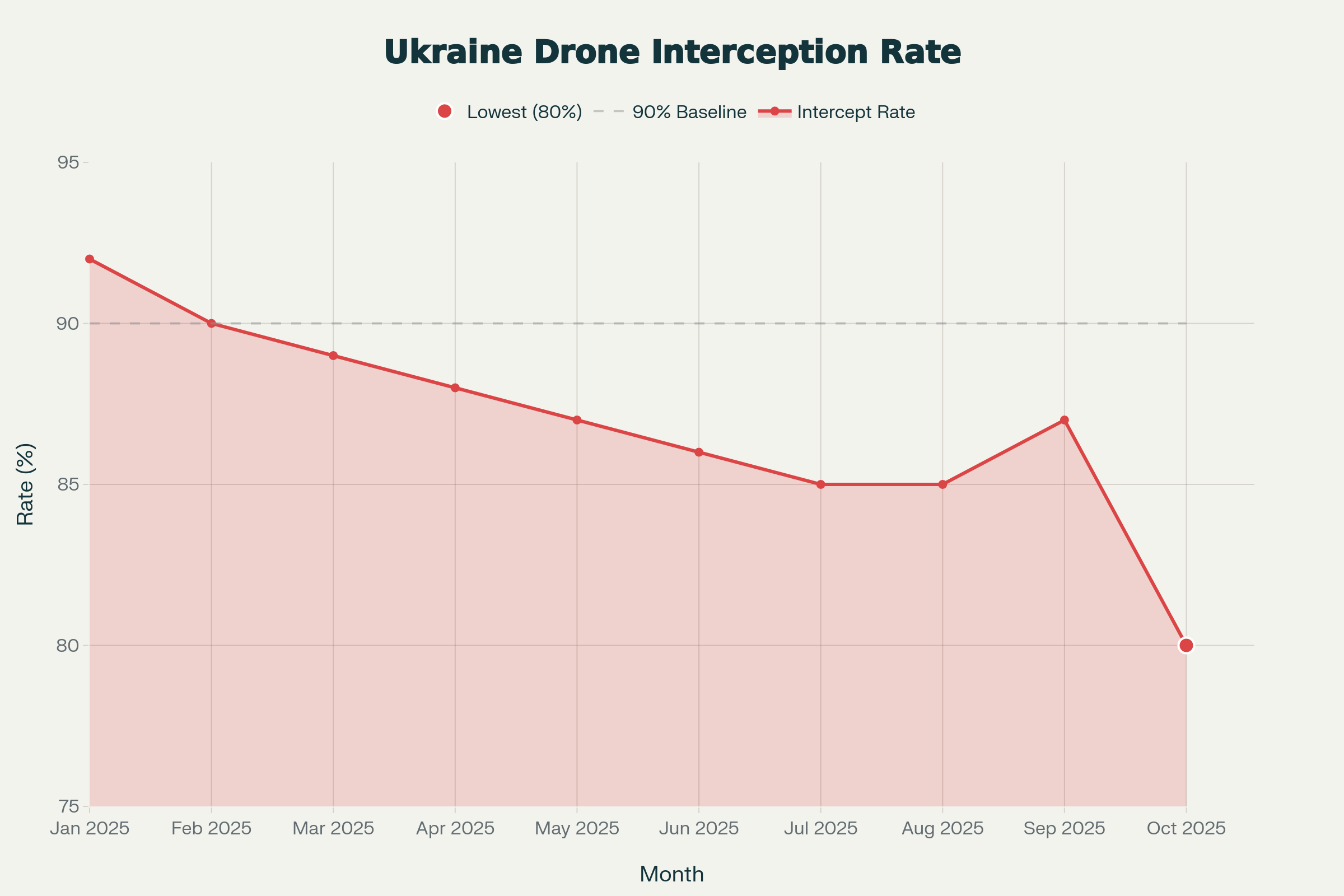
Ukraine Drone Interception Rate Decline in 2025: A Warning for European Air Defense
Volume Overwhelming Capacity: Russia launched 5,312 drones of all types into Ukraine in October 2025, with Ukrainian forces shooting down or suppressing only 4,242. The sheer scale—approximately 170 drones per day—exhausts interceptor stockpiles and operator capacity.
Tactical Adaptation: Russian forces have evolved their drone tactics significantly:
- Swarm attacks of 5-10 drones at varying altitudes simultaneously
- Electronic warfare resistance through 16-channel antennas (up from 4-channel)
- Fiber-optic control cables that defeat jamming
- Decoy drones (Gerberas) that consume expensive interceptors
- Jet-powered Geran-3 variants traveling at 550+ km/h
- Air-to-air missile-equipped Shaheds to counter interceptor aircraft
The Institute for the Study of War’s analysis concludes that Russia is achieving “partial battlefield air interdiction effects” through drone innovations, with Ukrainian electronic warfare systems becoming “less effective against new EW-resistant or medium range drones”.
The Israel Case Study: Multi-Layered Defense Under Saturation
April and October 2024: Massive Attacks, Impressive Results
Israel’s multi-layered air defense—comprising Iron Dome, David’s Sling, Arrow 2, and Arrow 3—faced its most severe test during Iran’s April and October 2024 strikes:
April 2024 Attack: Iran launched approximately 170 drones, 30 cruise missiles, and 120+ ballistic missiles toward Israel. Israel claimed a 99% interception rate, with assistance from U.S., UK, French, and Jordanian forces. The Arrow system intercepted ballistic missiles in space, while Iron Dome and David’s Sling handled lower-altitude threats.
October 2024 Attack: Iran fired approximately 200 ballistic missiles at Israel in two waves. Israeli officials reported an 86% success rate against ballistic missiles and 99% against drones. Some missiles did strike Israeli airbases, causing minor damage.
The Saturation Vulnerability Exposed
Despite these impressive statistics, critical vulnerabilities emerged:
October 7, 2023 Saturation: When Hamas launched several thousand rockets simultaneously with the ground attack, Iron Dome’s reported interception rate dropped to approximately 90%—meaning hundreds of projectiles reached Israeli territory. The system was designed to handle high volumes but has a “saturation point at which it would become overwhelmed”.
Cost Asymmetry: Each Iron Dome Tamir interceptor costs $40,000-50,000; each enemy rocket costs $500-1,000—a 40-100:1 cost disadvantage. When Iran launched its April 2024 attack, the tactic explicitly aimed to “saturate the Iron Dome and David’s Sling with a first wave of hundreds of Shahed drones to clear the way for cruise and ballistic missiles”.
Drone-Specific Challenges: Iron Dome was not designed for drones. Former IAF Chief Major General Amikam Norkin warned that “Israel’s next wars will be orders of magnitude more challenging,” citing the proliferation of precision-guided drones and loitering munitions.
Where European Logic Conflicts with Battlefield Reality
The ESSI Capability Gap
The European Sky Shield Initiative creates a sophisticated architecture against high-end ballistic missile threats—a capability Europe genuinely lacked. However, the dominant threat demonstrated in Ukraine is not ballistic missiles but mass drone attacks, and ESSI’s lower-tier systems face significant limitations:
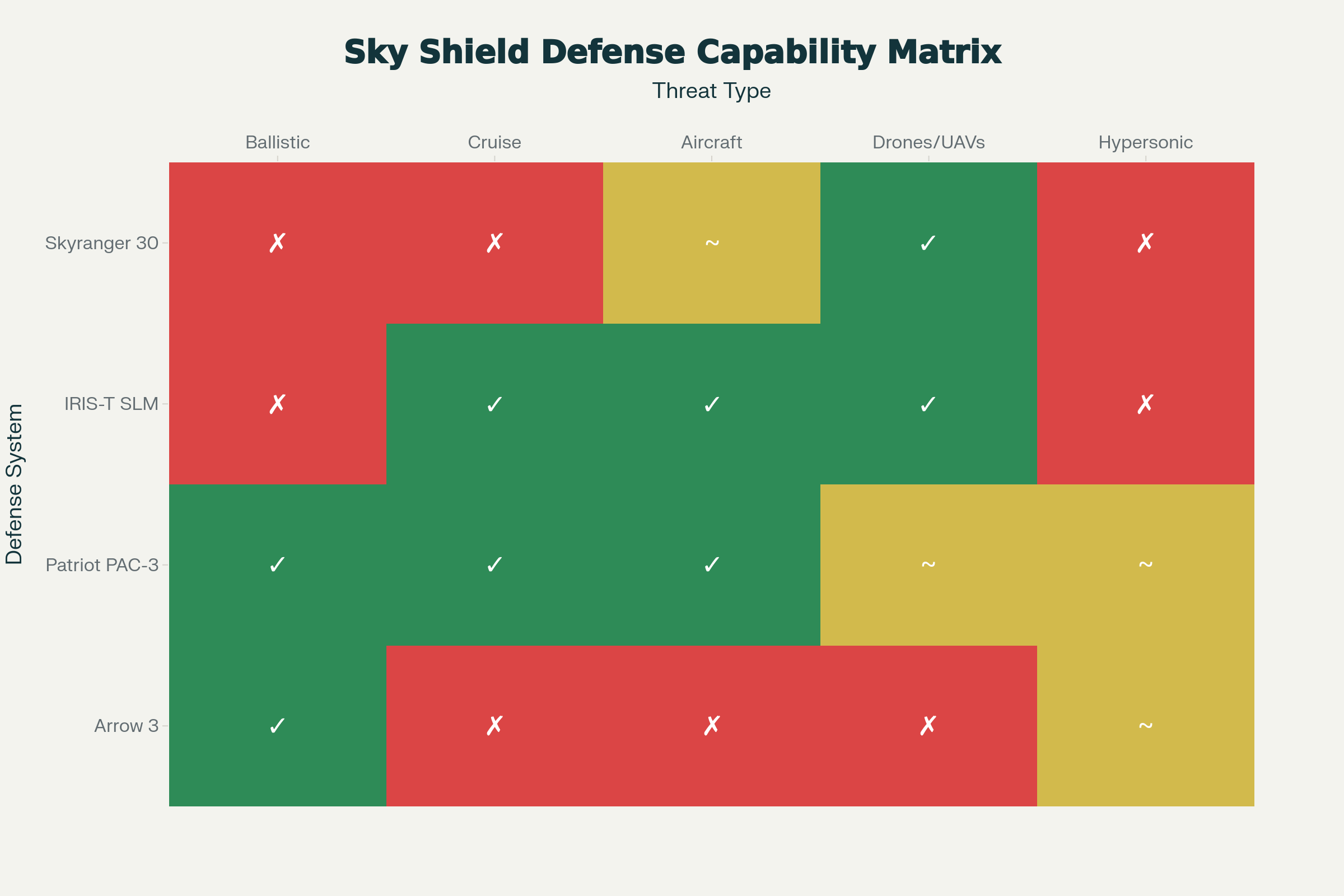
European Sky Shield Initiative: Multi-Layered Defense Capability Matrix
Patriot Against Drones: Using a $3-5 million PAC-3 MSE interceptor against a $20,000 drone creates an economically disastrous exchange ratio. In Ukraine, Patriot systems have been reserved for high-value targets like Kinzhal hypersonic missiles, where they achieved 100% success rates. However, overall Patriot performance has declined to 30% interception rates during ammunition shortages, and ballistic missile interception dropped to 6% in September 2025 due to Russian countermeasures.
IRIS-T Performance: The IRIS-T SLM has demonstrated 99% interception rates in Ukraine with over 240 confirmed kills—the highest documented success rate among deployed systems. However, it cannot intercept ballistic missiles or hypersonic threats, and Germany has only ordered 12 squadrons total.
Short-Range Gap: The Skyranger 30 procurement (600+ systems by 2030) addresses the critical short-range, anti-drone layer that Arrow 3 and Patriot cannot cover. But deliveries won’t complete until 2030, leaving a multi-year vulnerability window.
The Economic Reality
Air defense faces a fundamental cost asymmetry that favors attackers:
| System | Cost per Interceptor | Effective Against | Cost vs. Shahed Drone ($20,000-50,000) |
|---|---|---|---|
| Arrow 3 | ~$3-5 million | Ballistic missiles only | N/A (not designed for drones) |
| Patriot PAC-3 MSE | $5.17 million | Ballistic/cruise/aircraft | 100-250:1 cost disadvantage |
| IRIS-T SL | $350,000-420,000 | Cruise missiles, aircraft, drones | 7-20:1 cost disadvantage |
| Iron Dome Tamir | $40,000-50,000 | Rockets, drones | 1-2:1 (near parity) |
| Interceptor drone | $2,500-10,000 | Drones | 2-20:1 cost advantage |
Sources: CSIS analysis, Norwegian Air Defense Blog
The only economically sustainable counter-drone options are electronic warfare (which Russia is defeating through fiber-optic cables and frequency-hopping) and interceptor drones (which Ukraine has successfully deployed but cannot scale fast enough).
The cost calculus matters enormously for NATO’s ability to sustain defense. For analysis of defense procurement economics, join our analysis community.
The 2025 Threat Data: What European Planners Must Understand
Russian Drone Production at Industrial Scale
Russia has transformed its drone capability from imported Iranian systems to domestic mass production:
- Monthly Shahed-type production: Estimated 4,000+ units per month from Alabuga SEZ factory
- Cumulative launches in 2025: Over 30,000 drones January-October 2025
- New variants: Geran-3 jet-powered drones (2,500 km range, 550 km/h speed)
- Tactical innovations: AI/ML target recognition, fiber-optic control, rear-view cameras to detect interceptors
European Airspace Vulnerability Exposed
September 2025 brought a wake-up call when mysterious drone intrusions penetrated NATO airspace across multiple countries:
- Copenhagen Airport closed due to unidentified drone sightings
- Estonia, Poland, Romania experienced incursions from Russian-origin or unidentified drones
- NATO Operation “Eastern Sentry” launched to deploy additional fighter jets and ground-based air defenses
Danish counter-UAS expert Dan Hermansen assessed that “as much as 99 percent of critical infrastructure in Europe lacks any mechanisms for detecting or defending against this escalating threat”.
The Oreshnik Factor
Adding complexity, Russia has begun deploying the new Oreshnik IRBM—the system Arrow 3 was arguably designed to counter. Putin claims Oreshnik’s multiple independently guided warheads travel at Mach 10 and are “immune to being intercepted”. Deployment to Belarus is planned for December 2025, bringing all of Europe within range.
This creates a dual challenge: ESSI must address both the high-end ballistic threat (where Arrow 3 excels) and the mass drone threat (where significant gaps remain).
SHAREABLE ASSET: The European Air Defense Vulnerability Matrix
Based on 2025 combat data and deployment schedules, here is the definitive assessment of ESSI’s capability against emerging threats:
“2025 European Sky Shield: Threat Coverage Assessment”
| Threat Type | Current ESSI Coverage | Gap Severity | Timeline to Close |
|---|---|---|---|
| Ballistic Missiles (MRBM/IRBM) | Strong (Arrow 3 operational) | Low | 2025-2030 (full deployment) |
| Cruise Missiles | Moderate (Patriot, IRIS-T) | Medium | 2026-2028 |
| High-Altitude Aircraft | Strong (Patriot, IRIS-T) | Low | Current |
| Hypersonic Missiles | Limited (Patriot, uncertain) | High | 2030+ (requires new systems) |
| Mass Drone Swarms | Weak (IRIS-T limited, Skyranger pending) | Critical | 2028-2030 |
| Low-Altitude Drones | Very Weak (99% infrastructure unprotected) | Critical | 2030+ |
| Electronic Warfare Resilience | Unknown | Unknown | Continuous |
Sources: ESSI deployment schedules, Ukraine combat data, NATO IAMD assessments
Why This Matrix Matters: Defense planners must recognize that Arrow 3, while filling a critical gap against ballistic missiles, does not address the threat vector that dominates current conflicts. The 2025 deployment is necessary but insufficient.
Scenario Analysis: Three Paths for European Air Defense
Scenario 1: ESSI Succeeds as Integrated System (Probability: 40%)
Conditions: Full deployment of all three layers by 2030; successful integration with NATO NATINAMDS; adequate interceptor stockpiles; directed energy weapons (lasers) address cost asymmetry.
What This Requires:
- Completion of €150+ billion in European defense investment
- Skyranger 30 and equivalent short-range systems deployed at scale
- Israel’s Iron Beam laser technology (cost: cents per shot) adopted or equivalent developed
- Electronic warfare capabilities hardened against fiber-optic drones
Outcome: Europe achieves layered defense capable of handling combined ballistic, cruise, and drone threats with sustainable economics.
Scenario 2: Persistent Drone Gap (Probability: 45%)
Conditions: Arrow 3 and Patriot deployment proceeds, but short-range/counter-drone procurement lags; cost asymmetry remains; Russia continues tactical adaptation.
What This Looks Like:
- High-altitude/ballistic defense operational by 2030
- Critical infrastructure remains vulnerable to drone penetration (similar to Ukraine’s 80% interception rate)
- Major European airports, power plants, and military bases face undefended drone threat
- Economic exhaustion through interceptor expenditure
Outcome: Europe’s “shield” has a massive hole at low altitude—exactly where the threat volume is highest.
Scenario 3: Technological Leapfrog (Probability: 15%)
Conditions: Directed energy weapons (lasers, microwave) mature faster than expected; AI-enabled autonomous interception scales; drone-vs-drone defense proves viable.
Evidence Supporting:
- Israel’s Iron Beam achieved operational interceptions against drones and rockets in 2025
- Cost per intercept: cents for electricity vs. hundreds of thousands for missiles
- U.S. Army pursuing 100 kW laser systems for counter-UAS
Outcome: The economics invert—defense becomes cheaper than attack, fundamentally altering the calculus.
These scenarios depend on procurement decisions being made now. For tracking which path Europe is taking, subscribe to our monthly defense intelligence summary.
What Defense Experts Genuinely Disagree On
Debate 1: Is Arrow 3 Strategically Necessary or Misallocated Capital?
Position A (Essential): Russia’s Oreshnik deployment to Belarus, Iskander missiles in Kaliningrad, and potential future IRBMs make exo-atmospheric defense critical. Arrow 3 addresses a genuine gap that Patriot cannot fully cover.
Position B (Misallocated): The €3.8 billion spent on Arrow 3 could fund thousands of IRIS-T or Skyranger systems addressing the far more prevalent drone threat. No Russian ballistic missile has struck Western Europe; thousands of drones strike Ukraine daily.
The Uncertainty: Whether Russia would actually employ ballistic missiles against NATO (triggering Article 5) versus continuing hybrid/drone warfare below the threshold of direct confrontation.
Debate 2: Can ESSI Achieve True Integration?
Optimistic View: NATO’s NATINAMDS provides the command-and-control architecture; ESSI accelerates procurement; joint exercises will solve interoperability.
Skeptical View: ESSI excludes key NATO members (France, Italy, Spain—until recently Poland); national systems use different data links and protocols; the Arrow 3 command system operates differently from European networks.
Expert Assessment: The King’s College London study notes “insufficient integrated air and missile defense capability to protect critical national infrastructure, civilian sites, and military installations across the vast NATO territory”.
Debate 3: Will Directed Energy Close the Gap?
Believers: Israel’s Iron Beam “proved effective in a complete operational configuration” against rockets, mortars, aircraft, and UAVs. Cost per shot is cents versus thousands for missiles.
Skeptics: Lasers have atmospheric limitations (weather, dust, range); power generation requirements limit mobility; 10 km range requires dense deployment. The technology is not yet proven at scale.
How Different Readers Should Interpret This Analysis
For the Average European Citizen: Why This Matters to You
The Arrow 3 deployment is genuinely good news for protection against catastrophic ballistic missile strikes. However, the far more likely threat to your daily life—drone strikes on infrastructure similar to Ukraine’s experience—remains poorly addressed. The mysterious drone flights over European airports in September 2025 demonstrated this vulnerability is not theoretical.
What to watch: Whether your government prioritizes short-range air defense (Skyranger, counter-drone systems) alongside the headline-grabbing Arrow 3 announcements.
For Business Leaders: Strategic Implications
Defense Industry: European defense stocks have surged 65% in 2025. Companies producing counter-drone systems, radars, and electronic warfare equipment face sustained demand. The €150 billion SAFE funding mechanism signals a decade of procurement growth.
Critical Infrastructure: If your organization operates airports, power plants, or other critical infrastructure, the 99% unprotected rate cited by experts should drive immediate investment in detection and protection capabilities.
Supply Chain: Defense procurement will compete for electronics, composite materials, and skilled labor. Plan accordingly.
For Defense Analysts: The Data Questions
- Track IRIS-T and Skyranger delivery schedules versus announced quantities
- Monitor Ukraine interception data as the best proxy for what Europe would face
- Watch Israel’s Iron Beam deployment as the potential game-changer
- Assess Russian drone production rates at Alabuga and other facilities
- Follow NATINAMDS integration exercises for interoperability indicators
For Policymakers: The Decision Framework
The core trade-off is between:
- High-end deterrence (Arrow 3, Patriot): Essential against escalation scenarios but addresses lower-probability threats
- High-volume defense (IRIS-T, Skyranger, counter-drone): Essential for actual current threat landscape but less politically visible
Current procurement emphasizes the former; combat data suggests the latter deserves equal or greater priority.
The Honest Assessment: What We Think Matters Most
After examining the deployment data, combat performance, and threat evolution, several conclusions emerge:
Arrow 3 is necessary but not sufficient. The system closes a genuine gap in European defense against ballistic missiles, including Russia’s new Oreshnik IRBM. For deterrence against high-end escalation scenarios, this capability matters. Germany and ESSI members are right to deploy it.
However, the dominant threat vector remains poorly addressed. Ukraine’s experience demonstrates that mass drone warfare—not ballistic missiles—dominates modern conflict below the nuclear threshold. A European adversary would far more likely employ Shahed-style drone swarms against critical infrastructure than launch ballistic missiles that would trigger Article 5.
The cost asymmetry is unsustainable without technological innovation. Using million-dollar interceptors against thousand-dollar drones will exhaust European defense budgets without achieving security. Directed energy weapons (lasers) offer the most promising path to inverting this equation, but widespread deployment remains years away.
Integration remains the critical unknown. ESSI’s 24 member states must achieve genuine interoperability across different national systems, command authorities, and political decision-making processes. This is arguably harder than building the hardware.
What might challenge this view: If Russia actually employed ballistic missiles against NATO—demonstrating the Arrow 3 threat scenario was real rather than theoretical—the current procurement priorities would appear prescient. Alternatively, if directed energy weapons mature faster than expected, the drone gap could close rapidly.
What Remains Genuinely Uncertain
The Unknown Unknowns
Russian Strategic Intent: Would Moscow actually launch ballistic missiles at NATO members, knowing this triggers Article 5 and potentially nuclear escalation? Or will drone/hybrid warfare remain below this threshold indefinitely?
Chinese Drone Technology Transfer: The extent to which China supports Russian drone production with components and technology could dramatically affect the volume of threats Europe faces.
U.S. Commitment Under New Administration: The January 2025 Trump administration’s posture toward NATO commitments affects whether European air defense can count on U.S. assets and technology.
Defensive Technology Pace: Whether laser systems, AI-enabled autonomous intercept, and electronic warfare can mature fast enough to address the drone threat before major incidents occur.
What Would Resolve These Questions
Indicators to watch:
- Russian drone strike patterns against non-Ukrainian NATO territory (escalation signal)
- Iron Beam deployment data from Israel (technology validation)
- European counter-drone procurement announcements (political priority signal)
- ESSI integration exercises (interoperability progress)
- Quarterly Ukraine interception statistics (threat evolution tracking)
Implications and What to Watch
Near-Term (2025-2026)
Key Developments:
- Arrow 3 moves toward full operational capability at three German sites
- Oreshnik deployment to Belarus (December 2025)
- EU defense financing mechanisms (SAFE) disbursement begins
- Counter-drone technology procurement decisions
Watch For: Whether European governments prioritize short-range/counter-drone systems with the same urgency as high-profile Arrow 3 announcements.
Medium-Term (2026-2028)
Key Developments:
- IRIS-T deliveries to Sweden, additional Baltic states
- Skyranger 30 initial deliveries to Germany
- Potential Iron Beam international sales
- NATO “drone wall” concept implementation
Critical Milestone: Whether drone interception capability scales faster than Russian drone production.
Long-Term (2028-2030)
Key Developments:
- Full Arrow 3 deployment (three batteries operational)
- Skyranger 30 deployment completion
- Potential directed energy weapon integration
- Next-generation hypersonic defense systems
Ultimate Test: Whether ESSI achieves the integrated, multi-layered, economically sustainable defense architecture that can handle the full spectrum of threats—from Oreshnik IRBMs to Shahed swarms.
| Timeline | Development | Significance |
|---|---|---|
| Dec 2025 | Arrow 3 IOC achieved | First exo-atmospheric defense for Germany |
| Dec 2025 | Oreshnik deployment to Belarus | Validates Arrow 3 requirement |
| 2026 | SAFE disbursement begins | €150B defense investment unlocks |
| 2026-2028 | IRIS-T/Skyranger deliveries | Begins closing drone gap |
| 2028-2030 | Full ESSI deployment | Multi-layer architecture complete |
| 2030+ | Directed energy integration | Potential economic equation inversion |
Stay Informed: Defense Intelligence That Matters
European air defense is entering a critical transformation period. The Arrow 3 deployment represents progress, but the drone warfare threat that dominates Ukraine’s battlefields—and increasingly European airspace—remains inadequately addressed.
Subscribe for ongoing analysis that:
- Tracks ESSI deployment schedules and capability milestones
- Monitors Ukraine interception data as the leading indicator for European preparedness
- Analyzes emerging counter-drone technologies and their feasibility
- Provides strategic frameworks like our Vulnerability Matrix that defense planners actually use
- Covers the economic realities behind procurement headlines
Join our community of defense professionals, security analysts, and informed citizens.
For daily insights and real-time analysis of breaking developments, follow X (Twitter): @trends91blog.
For professional discourse and long-form strategic analysis, connect on LinkedIn: Trends91.
For comprehensive coverage delivered directly, Subscribe Here.
Join defense professionals and informed citizens who rely on evidence-based analysis.
📈 About This Analysis & The Author
This analysis follows the Trends91 Unrestricted Framework, prioritizing multiple perspectives, source-attributed data, and acknowledgment of genuine uncertainty in a rapidly evolving threat environment.
Key Sources Referenced:
- Defense News / Breaking Defense – Arrow 3 deployment reporting
- SIPRI / IISS – European defense capability assessments
- Ukrainian Air Force Data – Drone interception statistics
- Norwegian Air Defense Blog – Cost-effectiveness analysis
- CSIS / RAND – Strategic air defense analysis
- Reuters / Financial Times – Russia missile countermeasures
- Israel Ministry of Defense – Iron Beam / Iron Dome performance
- Chatham House / Carnegie – European security assessments
For real-time updates on breaking defense news and thread-style breakdowns, follow X (Twitter): @trends91blog.
For professional networking and article discussions, connect on LinkedIn: Trends91.
For comprehensive analysis delivered directly, subscribe to the Trends91 newsletter.
Engagement drives better analysis. Have a counter-perspective, new data, or a scenario this analysis missed? Reach out on either platform.