
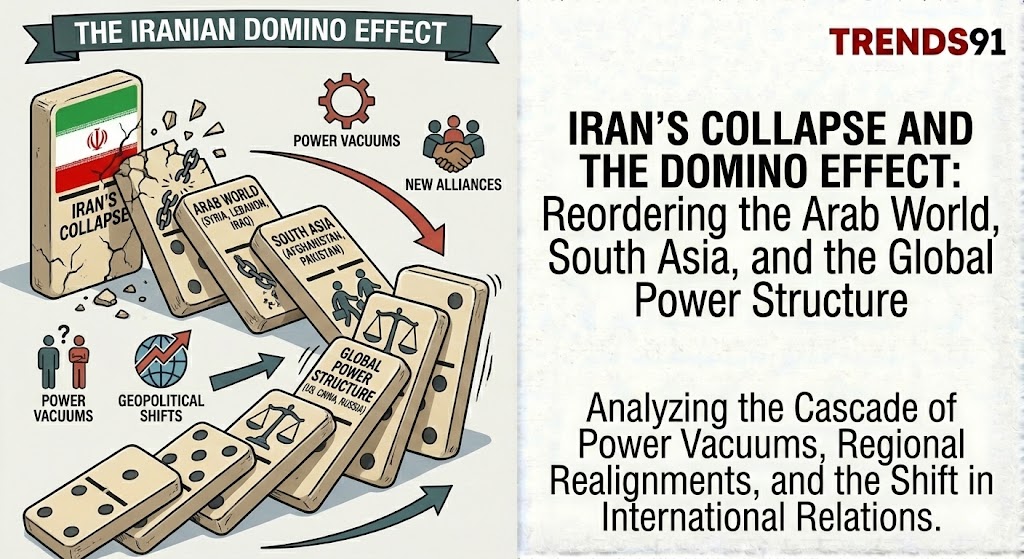
Iran’s potential regime collapse—triggered by cascading internal economic crises, military defeats inflicted by Israel and the United States, and mass anti-government protests beginning December 28, 2025—represents the most consequential geopolitical rupture in the Middle East since the Syrian civil war. However, unlike the Syrian case, Iran’s collapse will generate shockwaves far beyond the Levant, destabilizing South Asia’s connectivity architecture, undermining India’s strategic autonomy, empowering Pakistan’s geopolitical position, and catalyzing a recalibration of Central Asian alignments in China’s favour.
The domino effects operate across three distinct but interconnected regions: the Arab world, where regional powers paradoxically now defend an Iranian regime they have opposed for decades; South Asia, where India faces the loss of its only western gateway to Central Asia and Afghanistan; and the greater Eurasian space, where the collapse of Iran removes the southern anchor from a multipolar order and accelerates China’s regional dominance.
This analysis examines the cascading implications across these regions, identifies second and third-order effects that will reshape international politics for the next decade, and assesses whether regional and global powers can manage Iran’s decline without triggering wider instability or regional fragmentation. The evidence suggests they cannot.
Iran’s Structural Collapse—From “Axis of Resistance” to State Failure
The Perfect Storm: Economic, Military, and Political Convergence
Iran did not collapse from a single cause but rather from a rare convergence of structural failures that undermined the regime’s capacity to govern, defend territory, or maintain domestic legitimacy.
Economic Crisis: The Iranian economy entered freefall following the re-imposition of UN sanctions in September 2025, when the UN Security Council voted against permanently lifting economic restrictions over Iran’s nuclear program. Most of Iran’s oil revenues are now frozen, assets abroad inaccessible, and trade severely limited. Oil prices, central to Iran’s fiscal viability, averaged $57 per barrel in 2025, down from $70 in 2024, compressing government revenues. Domestic fiscal mismanagement and corruption—acknowledged even by regime officials—accelerated capital flight, currency devaluation, and hyperinflation. Unemployment and underemployment, particularly among youth, reached crisis levels.
Military Strategic Defeat: Iran’s “Ring of Fire” strategy—the decades-long effort to build a network of proxy forces (Hamas, Hezbollah, Iraqi militias, Houthis, Palestinian Islamic Jihad) to deter and threaten Israel—collapsed catastrophically between October 2023 and December 2024. Israeli strikes on Iranian nuclear facilities in April 2024 and June 2025 severely damaged Iran’s nuclear program at a cost of billions of dollars in development spending. More critically, Israeli ground operations in Lebanon beginning October 2024 systematically dismantled Hezbollah—the most capable and strategically important Iranian proxy. Hamas was eliminated as a coherent military force. The Syrian regime, upon which Iran’s entire Mediterranean strategy depended, fell in December 2024, severing Iran’s land bridge to the Levantine proxies and eliminating a key source of strategic depth. By January 2026, Iran had lost the operational capacity to threaten Israel regionally, while simultaneously facing a domestic security vacuum it could not fill.
The Arab World Paradox—Defending the Enemy
The Unprecedented Realignment
The most counterintuitive geopolitical development of early 2026 is that Saudi Arabia, the UAE, Turkey, Qatar, and Oman—collectively Iran’s principal regional adversaries—began lobbying the Trump administration to refrain from military intervention in Iran’s internal crisis. This inversion of historical alliances reveals a deeper truth: in the Middle East’s post-Syrian order, fear of chaos exceeds fear of ideological rivals.
Saudi Arabia’s Calculus: Riyadh had only recently engaged in careful rapprochement with Iran, following a Chinese-brokered agreement to stabilize bilateral relations. The prospect of US military intervention—which Saudi officials recognized would almost certainly trigger regional escalation—threatened to undo months of diplomatic progress. More fundamentally, Saudi Arabia feared that regime collapse would create a security vacuum in which Iran fragments along ethnic and sectarian lines, generating refugee flows, civil war, proxy wars between successor factions, and regional spillover effects that would destabilize the Persian Gulf and threaten Saudi territory.
Turkey’s Border Crisis: Turkey faced acute vulnerability to Iranian state collapse. A collapsing Iranian state would create refugee flows across Turkey’s long border with Iran, potentially numbering in the hundreds of thousands. More acutely, Iranian Kurds—currently suppressed by central Tehran—could seize the opportunity to organize independently, creating a contiguous Kurdish zone stretching from Iran through Iraq to Syria and Turkey, fundamentally destabilizing Ankara’s southeastern flank. Turkish Foreign Minister Hakan Fidan’s extraordinary allegation that Israel was orchestrating the protests reflected the depth of Ankara’s anxiety about external manipulation of Iran’s crisis.
The Reza Pahlavi Problem: Saudi Arabia and Turkey harbored a specific fear: that Reza Pahlavi, the exiled Pahlavi heir rallying anti-regime forces, possessed documented ties to Israel and might lead post-regime Iran toward strategic realignment with Tel Aviv and Washington. Such a shift would fundamentally alter the regional balance, potentially encircling Saudi Arabia and Turkey with a new Israeli-Persian axis that neither power could challenge. This existential concern—shared by traditional Iranian adversaries—unified Saudi and Turkish diplomacy in defense of regime stability.
The Sectarian Reckoning and Sunni-Shia Balance
Iran’s potential collapse creates a second-order crisis: the destabilization of Shia communities throughout the Arab world and the rebalancing of sectarian power. For a century, Iran had positioned itself as the patron and protector of Shia populations in Iraq, Lebanon, Syria, and the Gulf states. The collapse of Iranian state capacity means that millions of Shia Muslims lose their historical patron precisely as Sunni movements—emboldened by Israel’s regional dominance—reassert influence in Iraq, Syria, and Yemen.
Iraq’s Fragile Sectarian Equilibrium: Iraq, already fractured along sectarian lines, faces acute danger. Shia militias (the Popular Mobilization Forces/Hashd al-Shabi) that have dominated Iraqi security and politics since 2015 drew their institutional support, weapons, training, and intelligence from Iran. As Iranian capacity evaporates, these militias must choose: attempt autonomous governance (risking Sunni backlash), seek Chinese or Russian patronage (unlikely, given geopolitical constraints), or fragment into competing factions. The most probable scenario involves Iraqi Sunnis, emboldened by Assad’s fall in Syria and Israel’s regional dominance, attempting to reclaim political power lost after Saddam Hussein’s overthrow in 2003. Such a reclamation would require reversing the Shia political ascendancy and likely trigger renewed sectarian conflict.
Yemen’s Houthi Crisis: The Houthis, transformed from a marginal militia in 2009 to a sophisticated fighting force by 2025 through Iranian patronage, face an existential challenge. Iran supplied them with ballistic missiles, drones, naval mines, training, and operational intelligence. Between March and May 2025, Houthis launched 28 ballistic missiles and numerous drones at Israel alone. By 2025, IRGC and Hezbollah commanders were actively deployed in Yemen overseeing operations and maintaining operational integration.
As Iran collapses, this support structure fragments. The Houthis retain already-supplied weapons but lose: ongoing weapons shipments, training, intelligence (particularly maritime intelligence from Iranian radar ships), operational integration with the IRGC, and financial subsidies. The result is likely a Houthi force that retains residual capability to harass maritime shipping in the Red Sea and threaten Saudi Arabia, but loses capacity for coordinated operations or sustained campaigns. Critically, the Houthis may devolve into autonomous actors pursuing independent piracy and maritime disruption rather than following Iranian strategic direction—potentially destabilizing global commerce independent of state control.
Israel’s Uncontested Regional Hegemony
Iran’s collapse removes the final credible counterbalance to Israeli military dominance in the Middle East. Since October 7, 2023, Israel has methodically dismantled Iran’s proxy network and degraded Iran’s military capacity. With Iran’s state structure itself now failing, Israel faces no significant constraint on its pursuit of regional hegemony.
Israeli strategy has evolved beyond reactive defense toward proactive regional reshaping. Israel has launched hundreds of airstrikes in Syria following Assad’s fall, destroying military infrastructure and establishing buffer zones along the ceasefire line, effectively creating permanent Israeli occupation of Syrian territory beyond the 1974 line. Israeli generals have explicitly called for buffer zones along all Israeli borders, particularly in sensitive areas near Mount Hermon and Jabal al-Druze. Simultaneously, Israel is engineering a regional security architecture in which it functions as the hub—integrating UAE, Bahrain, and partially Saudi Arabia into an Israeli-led security network through air defense integration, intelligence sharing, cyber cooperation, and energy projects.
The implications extend beyond military power. Israel is positioning itself as a critical energy node in the Eastern Mediterranean, developing energy corridors to Europe and leveraging energy dominance for diplomatic leverage. It is consolidating technological supremacy (AI, cyber capabilities, unmanned systems, precision strike) that enables influence projection without conventional military deployment.
However, Israel’s uncontested dominance creates a paradoxical instability. With no credible state deterrent, Israel faces pressure to pursue increasingly expansive territorial and strategic objectives—settlement expansion, buffer zone consolidation, preemptive degradation of remaining threats. This dynamic risks overreach: Israeli expansion generates Palestinian desperation and radicalization, creates humanitarian crises that delegitimize Israeli actions internationally, and invites non-state retaliation from Hezbollah remnants, Houthis, and groups operating in ungoverned zones.
South Asia’s Structural Reordering—India’s Retreat, Pakistan’s Ascendance
The Collapse of India’s Western Corridor
India’s strategic architecture rested on a critical assumption: Iran would serve as India’s only viable gateway to Central Asia and Afghanistan, circumventing Pakistan’s overland dominance. This assumption has now collapsed entirely.
Chabahar Port’s Destruction: India invested approximately $120 million in developing Iran’s Chabahar port as the terminus of the International North-South Transport Corridor (INSTC), which was intended to link South Asia to Russia and the resource-rich Central Asian republics while bypassing Pakistan. In September 2025, the Trump administration revoked India’s waiver under the Iran Freedom and Counter-Proliferation Act, immediately exposing Indian companies to secondary sanctions and making further investment financially and diplomatically impossible. The investment became a “stranded asset”—capital lost to geopolitical realities beyond New Delhi’s control.
Chabahar was not merely a port; it was the symbolic and operational anchor of India’s attempt to forge an alternative regional architecture that did not require Pakistani intermediation. Its loss represents a humiliating reversal of India’s strategic positioning in South and Central Asia.
Afghanistan’s Renewed Pakistan Dependence: Afghanistan, which had viewed Chabahar as its escape from exclusive Pakistan dependence, now finds itself more firmly bound to Pakistani transit routes than at any point since 2015. The Taliban government, already tilting toward China-Pakistan alignment under the China-Pakistan-Afghanistan trilateral dialogue, accelerates its consolidation into the Chinese sphere. Pakistan’s Gwadar Port, developed under CPEC (China-Pakistan Economic Corridor), becomes the only viable route for Afghan trade with Central Asia and beyond.
This represents a fundamental reordering of South Asian connectivity. Where India had invested over a decade in developing alternative routes, geography has reasserted its primacy through geopolitical events wholly outside New Delhi’s control.
Strategic Autonomy Undermined: India’s carefully cultivated doctrine of “strategic autonomy”—the attempt to maintain relationships simultaneously with the US, China, and Russia while preserving independent policy formulation—has been shattered by Iran’s collapse. US pressure (withdrawal of the Chabahar waiver) revealed that India’s nominal autonomy is constrained by US strategic primacy. India cannot simultaneously maintain Iranian relationships, balance with China, and cooperate with the US; the Trump administration forced a choice, and India’s dependence on US security cooperation and market access won the decision.
The implications extend beyond Iran. As India’s regional manoeuvring space shrinks—due to Afghanistan’s loss to Chinese-Pakistani orbit, Bangladesh’s regime collapse, Pakistan’s accelerating Chinese alignment, and the US tilting toward India as a counterweight rather than a partner—New Delhi faces increasingly constrained strategic options.
Pakistan’s Geopolitical Vindication
Pakistan’s traditional vulnerability—its geography as a transit zone rather than a destination—has now become a strategic asset. For decades, Pakistan complained that India’s circumventing its overland routes threatened Pakistan’s economic and strategic position. With Chabahar’s collapse, that complaint has been vindicated.
Pakistan now occupies an irreplaceable position in the regional connectivity architecture. Gwadar Port, previously viewed as the junior partner to Chabahar, is now the primary link between South Asia and Central Asia. Afghanistan’s economic survival depends on Pakistani transit. Pakistan’s strategic relationship with China has strengthened. Pakistan’s value to the US (as a border state adjacent to Iran, Afghanistan, and China) has increased, potentially expanding US military and financial assistance. Pakistan’s relationship with Saudi Arabia has deepened—the two states signed a strategic mutual defense agreement described as an “Article 5 pact” where an attack on one triggers the other’s response.
Central Asia and Eurasia’s New Order—China’s Uncontested Dominance
The Death of Multipolarity in Eurasia
The 2021 US withdrawal from Afghanistan was intended to catalyze a multipolar Eurasian order where Russia, China, and Iran would compete for influence in Central Asia and Afghanistan. For brief moment (2021-2024), this appeared to be emerging. Russia engaged Afghanistan and Central Asia despite Ukraine commitments. Iran invested heavily in Afghan stability, particularly through relationships with the Taliban. China pursued Belt and Road integration through CPEC and infrastructure projects.
Iran’s collapse removes this multipolar possibility. With Iran weakened beyond strategic relevance, the US retrenchment from direct military engagement, and Russia consumed by Ukraine, China emerges as the uncontested dominant power in Central Asia and the broader Eurasian space.
Central Asia’s Chinese Integration: Central Asian republics (Tajikistan, Uzbekistan, Kazakhstan, Kyrgyzstan, Turkmenistan) face a simplified choice: align with China or face strategic isolation. Russia, previously a counterbalance through CSTO (Collective Security Treaty Organization) and other institutional frameworks, is demonstrably unable to simultaneously defend Central Asia and sustain Ukraine operations. China’s Belt and Road Initiative, coupled with Shanghai Cooperation Organization (SCO) dominance, provides the only viable development and security framework.
Iran’s collapse accelerates this integration. The southern flank of Central Asia, previously anchored by Iran as a regional power with its own sphere of influence, now offers no friction to Chinese expansion. Afghanistan, previously contested, becomes more fully integrated into the Chinese orbit through Pakistan-Taliban mediation.
The Refugee Crisis Wildcard: However, Iran’s potential fragmentation creates a catastrophic refugee scenario that could destabilize Central Asia. A “large-scale Iranian refugee crisis could send millions eastward through Afghanistan into Tajikistan and Uzbekistan.” If western neighbors (Turkey, Iraq) close borders and Gulf access becomes constrained, the Afghanistan-Tajikistan-Uzbekistan corridor faces overwhelming congestion.
Refugee host countries, already vulnerable to state fragility, may respond by tightening borders, deploying security forces, or restricting humanitarian access. This could trigger humanitarian crises, resentment among local populations, and potential state instability in already fragile Tajikistan and Uzbekistan. China would be forced to manage regional instability and refugee flows—a burden that no great power welcomes but which China’s regional dominance may require it to bear.
Shanghai Cooperation Organization’s Hollow Universality
Iran’s recent accession to the SCO (2025-2026) was framed as a triumph of multipolar institution-building—the anti-US coalition acquiring a key Middle Eastern member. Iran’s collapse renders this membership hollow. The SCO, already dominated by China and Russia, is now comprehensively a Chinese institution, with Russia as a weakened junior partner and Iran as a defunct member.
Global Power Realignment—Winners and Losers
United States: Pyrrhic Strategic Victory
The Trump administration appears positioned for a strategic victory in the Middle East: Iran, the long-standing US adversary, faces potential regime collapse. The region’s oil security is assured. US military presence is minimized. Regional powers (Saudi Arabia, UAE, Israel) function as proxies managing local stability.
However, this victory is potentially unstable. The absence of any credible constraint on Israeli power creates risk of Israeli overreach. The collapse of order in Iran, Syria, and potentially Iraq creates ungoverned spaces that extremist organizations will exploit. Refugee crises in Central Asia and the Turkey-Iran border region will generate humanitarian emergencies that spill into US strategic concerns (refugee pressures on Turkey/NATO, regional destabilization). Most fundamentally, a completely unipolar American order in the Middle East, achieved through military and economic dominance, offers no diplomatic off-ramp should Israel pursue increasingly controversial territorial expansion or humanitarian violations.
Russia: The Elimination of Middle Eastern Relevance
Russia invested heavily in Iran and Syria as its principal Middle Eastern anchors. Both have now been lost to Russian influence. Russia’s previous Comprehensive Strategic Partnership with Iran (signed January 2025) proved worthless when tested—Russia provided no military support during Iran’s twelve-day war with Israel and the US in 2025. Russia cannot defend allies. Russia has no credible regional presence beyond rhetoric.
More strategically, Russia’s broader geopolitical position deteriorates with Iran’s collapse. Russia’s hope for a multipolar Eurasian order, where Russia would balance China and the West, has evaporated. Russia increasingly lacks the capacity and allies necessary to sustain such an order. The withdrawal of Iran as a strategic partner accelerates Russia’s descent to regional power status.
China: The Multipolar Order’s Beneficiary
China’s strategic position in Eurasia strengthens dramatically. With Iran collapsed, Russia enfeebled, and the US maintaining distance from direct continental engagement, China consolidates uncontested dominance over Central Asia and increasingly over the broader Eurasian space.
The collapse of INSTC (via Chabahar) and the reaffirmation of Pakistani geography as the only viable south-to-central-Asia corridor ensures that CPEC remains the paramount connectivity framework. Afghanistan becomes more firmly integrated into the Chinese sphere. Central Asian republics have no alternative to Chinese partnership. Energy and mineral flows from Central Asia are secured within the Chinese sphere.
However, China inherits the burden of managing an increasingly unstable Eurasian periphery—Iran’s civil war, potential Central Asian refugee crises, and a Taliban government whose control over Afghanistan remains contested.
The Extremism Risk—ISIS Redux and Ungoverned Spaces
Historical Precedent and Contemporary Risk
The pattern is well-established. Iraq after 2003, Libya after 2011, and Syria after 2011 each experienced regime collapse followed by the emergence of powerful extremist movements filling the power vacuum. In Syria’s case, the resulting civil war enabled the rise of ISIS as a quasi-state actor that, at its height, controlled territory the size of Belgium, executed sophisticated attacks globally, and required a 66-nation coalition to degrade.
Iran faces similar risk. If the regime collapses and successor governments fail to consolidate authority, ISIS remnants in Iraq and Syria will exploit ungoverned zones in eastern Syria, eastern Iraq, and potentially southwestern Iran. Afghanistan’s Pakistani border region, already awash in extremist organizations, could experience spillover from Iranian instability. Yemen, already anarchic, could become even more ungoverned.
The emergence of a powerful extremist organization in the heart of the Middle East, Central Asia, and South Asia simultaneously would constitute a security threat exceeding any threat posed by the current Iranian regime. Yet paradoxically, the same regional powers opposing regime collapse also lack capacity to prevent post-collapse extremism.
The Scenario Matrix—Regime Survival, Civil War, or Fragmentation?
Scenario A: Regime Consolidation (20% Probability)
The IRGC reasserts control, executes a controlled crackdown eliminating opposition leadership, and stabilizes the regime through violence. Protests subside; the regime survives in degraded but functional form. This scenario requires either Trump abandoning military intervention (likely given costs and ambiguity of outcomes) or the regime successfully surviving a limited military strike.
Implications: Iran remains a regional actor but further weakened. Proxy networks remain devastated. Economic crisis persists. International isolation deepens. Regional powers gradually accommodate the surviving regime. Lowest-risk scenario but requires implicit coordination between Trump administration and regional powers to maintain status quo.
Scenario B: Civil War/Fragmentation (50% Probability)
The regime loses control of peripheral provinces, fragments along factional lines (IRGC hardliners vs. civilian administrators vs. regional factions), and descends into open civil war. Multiple power centers emerge; no single actor consolidates national authority. The result resembles Syria’s civil war—a multifactorial conflict drawing in regional powers and proxy forces.
Implications: Catastrophic refugee crisis (millions fleeing eastward and westward). Ungoverned spaces exploited by extremist organizations. Regional powers intervening on behalf of preferred factions. Humanitarian disaster. Central Asian destabilization. Israel consolidating buffer zones and territorial expansion under cover of regional chaos.
Scenario C: Negotiated Transition (30% Probability)
International actors (particularly the US and possibly China/Russia) broker a managed transition in which the regime is replaced by a successor government (possibly led by Reza Pahlavi or a technocratic council) that maintains territorial integrity and institutional continuity. This requires credible guarantees to successor government and implicit acceptance by regional powers.
Implications: Most orderly outcome. However, successor government likely oriented toward US and Israel (as feared by Saudi Arabia and Turkey), creating new regional alignments. Palestinian cause further marginalized. Iranian Kurds, Azeris, and Baloch minorities potentially assert autonomy. Chabahar could be reopened under new management, partially restoring India’s position. China’s Central Asian dominance potentially contested by a pro-Western Iran.
The Stabilization Challenge—Can Regional Powers Manage This?
The Coordination Problem
Regional powers (Saudi Arabia, Turkey, UAE, Israel, Pakistan, China) lack sufficient shared interests to coordinate a managed transition. Saudi Arabia and Turkey want regime stability with some reform. The UAE and Israel want regime weakness but fear chaos. Pakistan wants Afghanistan stability without Iranian influence. China wants Eurasian stability and market access.
These interests do not align sufficiently for a coordinated solution. Each power will pursue unilateral advantage, resulting in competitive intervention rather than collaborative stabilization.
The International Community’s Paralysis
The UN Security Council is divided. Russia opposes US intervention but lacks capacity to block it. China seeks stability but will not risk confrontation with the US. The Trump administration views Iran’s collapse as acceptable but is uncertain of the path to manage it. Europe has minimal influence and conflicting interests.
The result is likely to be drift toward one of the more chaotic scenarios—not because any power wants chaos, but because coordination failure and competitive positioning prevent proactive stabilization.
A Destabilized Decade
Iran’s collapse, though still evolving as of January 2026, has already triggered cascading effects across regions and power structures that will define international politics for the next decade.
In the Arab world, the paradoxical defense of an Iranian regime by its historical adversaries signals deeper anxiety about order than ideological competition. A Middle East dominated by Israeli military supremacy, without credible state-based deterrence, creates structural instability despite apparent American strategic victory. The Palestinian cause has been marginalized; extremism will likely fill resulting vacuums.
In South Asia, India’s strategic autonomy has been shattered. Pakistan’s geography has been revalidated as irreplaceable. Afghanistan has been more firmly integrated into the Chinese sphere. The balance of power tilts unmistakably toward Pakistan and China, away from India’s long-term interests.
In Central Asia and Eurasia, multipolarity has been replaced by Chinese dominance. Russia’s Middle Eastern pretensions have been definitively ended. The multipolar order that briefly emerged after 2021 has been revealed as temporary, dependent on Iranian strength that no longer exists.
The fundamental irony: regional powers have collectively prevented a US military intervention into Iran’s internal collapse, preferring (collectively) stability under an existing regime to the uncertainty of external intervention. Yet in preventing external intervention, they have only delayed and perhaps worsened internal collapse. The forces generating regime failure—economic exhaustion, military defeat, generational loss of legitimacy—cannot be arrested through regional consensus.
Iran will fall, whether through external intervention or internal failure. The only uncertainty is the timeline and manner of that fall. And when it does, the domino effects will cascade through South Asia, Central Asia, the Arab world, and beyond—reshaping the international system in ways that no regional or global power can fully control.