
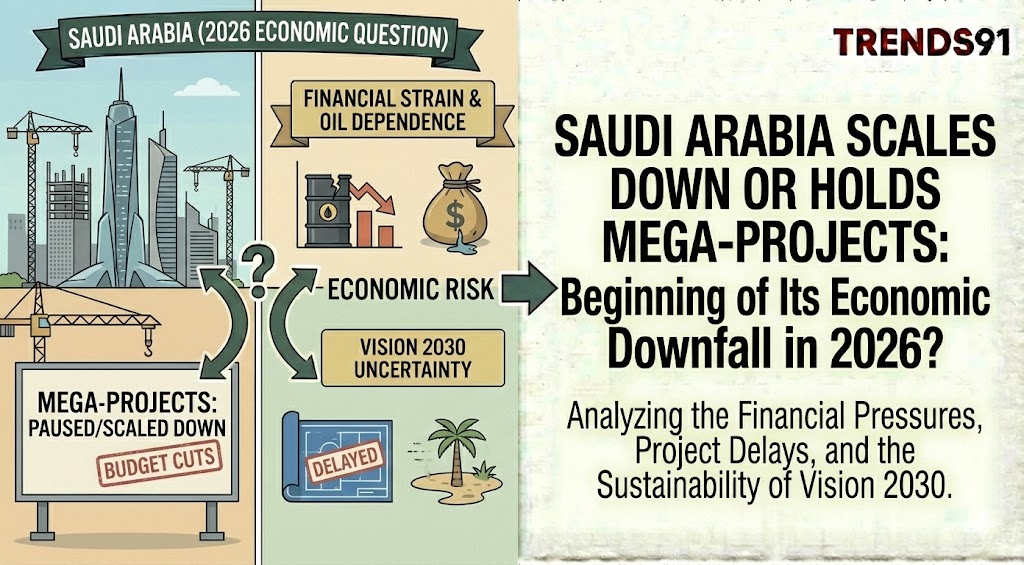
Saudi Arabia’s 2026 Inflection Point: Can Ambition Survive Austerity?
Saudi Arabia faces a deceptively simple decision in 2026 that will reshape the Kingdom’s economic trajectory for a decade. The question appears binary: scale down the mega-projects that define Vision 2030, or double down despite mounting evidence of fiscal strain. Yet beneath this surface tension lies a more complex reality—a choice not about whether to reduce ambition, but which ambitions to prioritize when capital is constrained and execution has proven harder than promised.
The scale of the choice is unmistakable. The NEOM project, originally planned to complete its flagship “Line” section by 2030, now projects full completion to 2045. Only 2.4 kilometers of the 170-kilometer urban structure has been constructed as of late 2025, despite a decade of planning and tens of billions in capital deployment. The Public Investment Fund has taken an $8 billion write-down explicitly linked to project challenges. Meanwhile, Saudi Arabia’s oil revenues have underperformed by 7.8% relative to 2025 budget projections, while government spending overran targets by 4%.
Yet the Kingdom simultaneously announced a $925 billion portfolio pivot away from mega-projects toward logistics, minerals, artificial intelligence, and tourism—sectors with faster returns and lower capital requirements. The government’s 2026 budget explicitly marks a shift from “how much we spend” to “what we spend on,” signaling recognition that the era of unlimited capital deployment has ended.
This is not a story of economic collapse or failure. It is a story of recalibration under constraint—the moment when Vision 2030’s original design (build big, transform fast, position Saudi Arabia as a global investment hub) confronts market reality (capital is finite, execution is slow, fiscal pressures are real). The outcome will determine whether Saudi Arabia successfully pivots to sustainable non-oil growth or enters a period of extended transition where neither mega-projects nor private-sector alternatives deliver sufficiently.
Why Saudi Arabia’s Project Strategy Matters Right Now (2026)
For nearly a decade, Saudi Arabia’s economic narrative has been defined by ambition at scale. Vision 2030 envisioned hundreds of billions in capital deployment transforming the Kingdom from oil-dependent state to diversified global investment hub. NEOM alone was promised as a $500 billion to $8.8 trillion urban transformation—a city designed to hold 1.5 million people by 2030, now extended to 2045.
This strategy was premised on three assumptions: (1) sustained high oil prices or diverse revenue sources to fund projects, (2) rapid construction and project execution capability, and (3) private capital availability to co-invest alongside sovereign wealth. By 2026, all three assumptions are being tested and none are holding as originally planned.
The Fiscal Reality Check
Saudi Arabia’s 2025 budget deficit reached SAR 245 billion (5.3% of GDP), double the projected SAR 101 billion (2.3% of GDP). This occurred not because the government cut spending—spending remained elevated to support Vision 2030—but because revenues collapsed. Oil prices fell below the Kingdom’s breakeven rate of $91-96 per barrel; actual market prices hovered around $63-65 per barrel in early 2026. The 2025 deficit was driven by a 13.3% year-on-year revenue decline while nominal spending only fell 2.8%.
Saudi Arabia responded by running intentional budget deficits (“deficit by design”), projecting continued deficits through 2028. This required increased government borrowing. Financing costs surged 21% year-over-year, reaching SAR 64 billion in the 2026 budget as the government issued bonds, Sukuk, and syndicated loans to cover spending gaps. Public debt rose to 31.7% of GDP in 2025 (revised up from 29.9%) and is projected to reach 32.7% of GDP in 2026, with forecasts suggesting 42% of GDP by 2030 if current trends continue.
These numbers place Saudi Arabia in favorable territory relative to global peers—the Kingdom remains “amongst the lowest indebted nations globally” with net debt at approximately 17% of GDP. But the trajectory is concerning. Saudi Arabia is becoming a larger bond issuer, its financing costs are rising, and its fiscal flexibility is declining.
The Project Execution Reality
The NEOM case is emblematic. When launched in 2016 and expanded in subsequent years, NEOM was promised as a complete urban ecosystem—the Line (170km), Trojena (ski resort), Oxagon (industrial port), plus supporting infrastructure—all reaching initial functionality by 2030. The narrative was one of Saudi Arabia’s unlimited capital and construction capability creating something entirely new.
By 2025, the reality was stark:
- The Line had been reduced from 20 modules to 4
- Only 2.4km of the 170km structure was completed
- Full completion was pushed from 2030 to 2045
- The Trojena ski resort may be postponed to 2033 (from 2029 Asian Winter Games target)
- The PIF took an $8 billion write-down
Similar patterns emerged across major projects. The Red Sea Project and Diriyah Gate—once flagship developments—are now described as “at maturity” and being transferred to private markets because government had delivered on initial phases but wasn’t the right operator for sustained returns. Qiddiya faces similar positioning.
The Finance Minister explicitly acknowledged this shift in October 2025, stating: “We need to signal to the private sector that the government has delivered on its promises and exceeded its targets. It is now appropriate to scale back government and PIF spending and allow private investment to take the lead.” This is diplomatic language for: “Government-led mega-project execution hasn’t worked as promised. We’re stepping back.”
Oil Revenue Uncertainty
The core problem underlying both fiscal and project challenges is oil market dynamics. Saudi Arabia remains heavily dependent on oil revenues for fiscal calculations, even as diversification is underway. The 2026 budget assumes oil production will increase (unwinding OPEC+ cuts) but forecasts 7% oil price declines due to tepid global demand and strong supply growth from U.S., Brazil, and Guyana.
This creates a perverse dynamic: Saudi Arabia increases production to maximize volume, but the market offers declining prices—resulting in absolute revenue decline despite higher barrels. This was evident in early 2026, when Saudi Arabia cut official selling prices to Asian buyers for the third consecutive month, moving to a discount for the first time since 2020.
The fiscal mathematics are inescapable. If the Kingdom’s breakeven oil price is $91-96 per barrel and market prices are $63-65 per barrel, then every additional government spending commitment must be financed through borrowing, asset sales, or revenue diversification—none of which are growing fast enough to bridge the gap.
The Mega-Project Priority: Ambition Deferred Is Not Ambition Abandoned
The Logic: Continue mega-project investment at meaningful scale despite delays and cost overruns. NEOM remains the centerpiece, extended timelines are acceptable because the long-term transformation benefit justifies near-term fiscal strain.
Saudi officials frame this approach as “thinking generationally.” Crown Prince Mohammed bin Salman’s commitment to Vision 2030 and beyond is personal and ideological—the transformation of Saudi Arabia from oil state to diversified economy is a legitimacy foundation for his leadership. Scaling back mega-projects signals failure of the original vision.
This approach accepts that full NEOM completion extends to 2045, but argues that intermediate milestones (2-5km by late 2026, expanded sections by 2030) create real economic activity, attract global attention, and establish Saudi Arabia as a serious long-term investor in its own future. The supporting infrastructure (ports, transport, connectivity) becomes usable by private operators before the full vision is complete.
What it requires: Sustained government and PIF capital deployment despite fiscal constraints. This means continued deficit budgeting, ongoing bond issuance, and acceptance that debt-to-GDP ratios rise toward 40-45% by 2030.
What it sacrifices: Near-term fiscal consolidation, interest savings as borrowing costs remain elevated, and crowding-out of private sector investment as government dominates capital markets. Some Vision 2030 initiatives in healthcare, education, and social development may be deferred.
The Private-Sector Lead Approach: Reposition Government as Enabler, Not Investor
The Logic: Acknowledge that government-led mega-projects underperform, but rather than abandon ambition, restructure it. Transfer completed or mature projects (Red Sea, Diriyah, Qiddiya) to private operators. Establish clear policy frameworks and regulatory environments that attract global capital without requiring direct government investment.
This is the implicit direction of Saudi Arabia’s recent announcements. The PIF’s shift toward AI, logistics, minerals, and tourism represents a partial pivot—these sectors offer faster returns and can be partially privatized or turned into government-enabled private opportunities rather than pure government projects.
The National Privatization Strategy, approved in November 2025, targets 220+ public-private partnership contracts by 2030 with SR 240 billion in private sector capital investment. This framework explicitly transfers infrastructure and service delivery to private operators while government maintains regulatory oversight.
What it requires: Clear reform of regulatory and contractual frameworks, reduced government direct investment, and patience with slower execution as private capital takes leadership. Projects advance at private-sector pace, not government pace.
What it sacrifices: The grand unified vision of Vision 2030. Rather than NEOM as integrated ecosystem, you get fragmented private projects in components—some areas develop, others lag. The “Made in Saudi Arabia” mega-project narrative becomes “Private companies operating in Saudi Arabia.”
The Diversification-First Approach: Deliver Non-Oil Growth Faster Than Mega-Projects
The Logic: The evidence is clear—non-oil PMI exceeded 60 in October 2025 (highest in over a decade), non-oil exports rose 17.1% year-to-date, and non-oil fixed capital formation grew 4.6%. The private sector is moving faster than mega-projects. Instead of competing with private sector capital deployment for government investment, accelerate the sectors that are already working: logistics, minerals, AI, tourism, advanced manufacturing.
This approach is evident in the PIF’s portfolio shift. Rather than persisting with NEOM delays, deploy capital into 10-15 logistics hubs that position Saudi Arabia as a critical node in Asian supply chains. Rather than Trojena ski resort, invest in religious tourism infrastructure around Mecca/Medina that generates immediate and sustained returns. Rather than futuristic cities, invest in AI and data centers where Saudi Arabia ranks fifth globally and first in the Arab world.
The fiscal advantage is significant: these sectors require smaller upfront capital commitments, generate returns within 3-5 years rather than 15+ years, and can be partially privatized or operated as concessions rather than direct government projects.
What it requires: Accepting that NEOM is downscaled, mega-project timelines extend dramatically, and the unified Vision 2030 narrative fragments into portfolio of individual initiatives.
What it sacrifices: Long-term transformation ambition. In 30 years, Saudi Arabia becomes a logistics and tourism hub with strong private sectors in AI and minerals—valuable but less transformative than NEOM’s vision of a futuristic city reshaping global urban models.
The Oil Revenue Maximization Approach: Fund Diversification Through Production, Not Reform
The Logic: Rather than cutting projects or shifting strategy, maximize oil production and revenue to fund the existing agenda. OPEC+ production restraints are ending (the 2.2 million bpd additional cuts phased out through Q1 2026). Saudi Arabia increases production to maximum capacity, captures additional market share before U.S. shale, Brazil, and Guyana production peaks, and uses the revenue to fund both mega-projects and debt reduction.
This approach is tempting because it avoids difficult domestic choices. Rather than cutting mega-projects or reforming labor markets, just produce more oil. The early 2026 Saudi decision to increase production through OPEC+ cuts phase-out reflects partial embrace of this logic.
What it requires: Betting that global oil demand doesn’t decline faster than supply increases, that prices stabilize above $70-75 per barrel, and that the 20-30 year window exists to extract maximum oil revenues before energy transition accelerates.
What it sacrifices: Energy transition credibility and long-term economic diversification. If Saudi Arabia becomes the largest producer during the energy transition, it faces structural decline from 2040 onward as EV adoption and renewable energy mature. The Kingdom stays oil-dependent when the strategy was always to diversify away from dependency.
The Real Trade-Offs: What Saudi Arabia Is Actually Choosing Between
The four approaches are not equally viable. The evidence suggests Saudi Arabia is executing a hybrid strategy—not by design but by default. The government is scaling back mega-project ambition (evidenced by PIF portfolio shift and timeline extensions) while claiming it remains committed to mega-projects (evidenced by continued NEOM construction and 2026 budget allocation). This hybrid creates inefficiencies and delays real decision-making.
The Execution vs. Ambition Tension
NEOM’s delays are not temporary. They reflect fundamental challenges in executing mega-projects of this scale: geological complexity (The Line requires cutting through mountain ranges), technological uncertainty (AI-integrated cities have never been built), and political economy of land acquisition and worker management (over 21,000 workers reportedly died on Vision 2030 projects between 2017-2024, generating international criticism).
The government’s response has been to extend timelines (from 2030 to 2045) while maintaining the ambition. But this creates fiscal strain. Each year of delay costs capital and opportunity. The $8 billion PIF write-down suggests the market believes NEOM economics have deteriorated—costs exceeded projections and/or completion timelines are longer than feasible.
The Fiscal Constraint vs. Investment Requirement Tension
Saudi Arabia faces structural fiscal pressure. Oil breakeven prices ($91-96/barrel) far exceed market prices ($63-65/barrel). The Kingdom is running intentional deficits through 2028, implying 3+ more years of elevated government borrowing. Debt-to-GDP is rising (from 26.2% in 2024 to 32.7% in 2026, projected 42% by 2030).
Yet Vision 2030 implementation still requires capital. Completed projects (Red Sea, Diriyah) need ongoing operational investment. Incomplete projects (NEOM) demand continued capital. New diversification priorities (AI hubs, logistics corridors, renewable energy) need funding.
The government has chosen to limit capital expenditure growth (CAPEX declining 5.8% in 2026) while maintaining operational spending. This works in the short term but hollows out future growth if CAPEX remains constrained.
The Government vs. Private Sector Leadership Tension
The National Privatization Strategy and PIF portfolio shift represent explicit government recognition that private capital must lead. But private capital is risk-averse. Mega-projects like NEOM have execution risk, long payback periods, and uncertain returns—precisely what private capital avoids unless government guarantees returns or absorbs downside.
The government cannot simultaneously say “we’re scaling back and letting private sector lead” while mega-projects require government capital guarantees. This tension is unresolved and will determine execution speed in 2026-2027.
Leading Indicators of Saudi Economic Direction
Government Budget Signals
The 2026 budget reveals government intent through allocation rather than rhetoric:
- Capital expenditure reduced 5.8% despite continued Vision 2030 commitment
- Health and social spending reduced 3.5%, signaling shift away from social welfare expansion
- Financing costs increased 21%, indicating debt burden is rising
- Revenue assumptions moderate (2.5% growth forecast in spending for 2026 vs. historical 3-4%)
The Finance Minister’s statement that Saudi Arabia will run “deficits by design” through 2028 is candid about strategy—government will borrow to maintain spending but won’t increase spending faster than revenues grow. This is implicit budget austerity disguised as intentional deficits.
Oil Market Realities
The evidence is unmistakable:
- Global oil supply exceeds demand by 4.25 million barrels per day
- Saudi official selling prices at discounts for first time since 2020
- IMF forecasts 7% oil price decline in 2026
- Saudi Arabia cutting prices three consecutive months (through January 2026) to maintain market share
This creates a vicious fiscal cycle: lower prices require higher production to maintain revenues, but higher production depresses prices further. Saudi Arabia is caught between quantity and price optimization with no good answer.
Non-Oil Growth Strength
Yet the non-oil economy shows genuine momentum:
- Non-oil PMI exceeded 60 in October (highest in over a decade)
- Non-oil exports rose 17.1% year-to-date
- Non-oil fixed capital formation up 4.6% in H1 2025
- FDI inflows up 29.2% to $12.4 billion in H1 2025
- Private consumption up 3.5% in H1 2025
This data suggests the non-oil transition is actually working. The private sector is investing and growing faster than oil-dependent government spending. This validates the diversification-first logic.
PIF Portfolio Shift Data
The PIF’s explicit strategy change is quantified:
- Reducing international investments from 30% to 18-20% of portfolio
- Annual average returns declining from 8.7% to 7.2%
- New focus: logistics, minerals, religious tourism, AI, data centers
- Mature projects (Red Sea, Diriyah, Qiddiya) being transferred to market
This is not rhetoric—it’s portfolio reallocation reflecting internal assessment that mega-projects underperformed relative to return expectations.
External Validation
International assessments support Saudi economic resilience despite mega-project challenges:
- IMF raised 2026 growth forecast to 4.5% (up 0.5pp from October)
- World Bank forecasts 4.3% growth in 2026
- Fitch affirmed A+ rating with stable outlook
- Moody’s maintained A1 rating
- GCC GDP growth expected at 4.4% in 2026, with Saudi Arabia leading
These ratings and forecasts come with caveats about oil price assumptions and geopolitical risks, but they signal that credit markets believe Saudi Arabia’s economy is resilient despite mega-project delays.
The Hidden Costs of Strategic Commitment
Mega-Project Priority Sacrifices:
✓ Gains: Long-term transformation narrative; global positioning; infrastructure for future growth; employment during construction
✗ Loses: Fiscal flexibility; ability to respond to shocks; crowding out of other government priorities; political credibility if timelines continue extending
The cost is hidden in compound interest. Every year that mega-projects take longer increases total financial burden. A project costing $100B over 10 years costs approximately $110-120B over 15 years (accounting for inflation, cost escalation, and financing costs). NEOM’s extension from 2030 to 2045 (15-year shift) adds tens of billions in ultimate cost while providing no additional benefit.
Private-Sector Lead Sacrifices:
✓ Gains: Reduced government burden; faster execution on some projects; risk transfer to private operators
✗ Loses: Unified Vision 2030 narrative; government control over strategic priorities; coherence of transformation agenda
The danger is fragmentation. If government retreats from mega-project leadership and private capital only funds projects with 3-5 year payback horizons, then infrastructure gaps emerge. Sectors with long-term but essential returns (education, research, basic science) get underfunded because they don’t fit private capital return requirements. Saudi Arabia becomes a portfolio of ad-hoc private projects rather than a coordinated national transformation.
Diversification-First Sacrifices:
✓ Gains: Faster non-oil growth; quicker returns on capital; demonstrated effectiveness; investor confidence
✗ Loses: Long-term strategic vision; “aspirational” projects that define national identity; first-mover advantage in future urban models
NEOM’s value is partly symbolic. Whether the city ever houses 1.5 million people is less important than the signal it sends: Saudi Arabia is serious about post-oil future. If mega-projects are deferred indefinitely, that signal weakens. Younger Saudis wondering if Vision 2030 is real or rhetorical look to mega-project progress as proof.
Oil Revenue Maximization Sacrifices:
✓ Gains: Strongest near-term fiscal position; ability to fund diversification; maintains Saudi diplomatic leverage
✗ Loses: Energy transition credibility; long-term economic viability; alignment with global climate commitments
This approach requires Saudi Arabia to maximize oil extraction during the energy transition—a structurally doomed strategy. Every barrel produced today is a barrel not available in 2040 when demand has shifted to EVs. The Kingdom speeds decline rather than preventing it.
Scenario 1: Implicit Hybrid (Most Likely – 70% Probability)
What Unfolds: Saudi Arabia muddles forward. NEOM and mega-projects continue at reduced pace, with timelines extended and phases delayed. PIF reallocates capital toward quick-return sectors (AI, logistics, minerals, religious tourism) while maintaining token mega-project investment. Government spending remains elevated to support Vision 2030 narrative, but capital discipline prevents new mega-projects. Private sector fills some gaps but not at scale government expects.
By 2028: NEOM is 5-8% complete (vs. 20% if original timeline held). Non-oil growth accelerates to 5-6% annually. Debt rises to 36-38% of GDP. International observers declare Vision 2030 “shifted focus” rather than “slowing down.” Private sector engagement improves but doesn’t fully replace government capital.
Probability: Highest. This is the path of least resistance for every stakeholder. Government saves face, private sector gets opportunities, foreign investors see reform, but nothing changes decisively. It’s the most likely outcome because it requires no major decisions—just continuation of current trajectory.
Scenario 2: Mega-Project Acceleration (Low Probability – 15%)
What Unfolds: Saudi Arabia commits additional capital to mega-projects despite fiscal constraints. Government sees NEOM delays as temporary setbacks, not structural problems. Capital expenditure increases, deficits widen, and PIF commits fully to completion of flagship projects. This requires either: (1) oil prices recovering above $80/barrel, (2) significant new revenue sources (e.g., large Aramco IPO secondary offering), or (3) willingness to accept debt-to-GDP above 40%.
By 2028: NEOM progresses faster, but debt rises to 40-42% of GDP. Saudi Arabia becomes largest emerging market debt issuer. Interest costs consume larger budget share. Non-oil growth slower because private sector capital is crowded out. Eventually, a credit rating downgrade forces reassessment.
Probability: Lower. Requires either external shock (oil price spike) or political decision to accept high debt. Neither is assured.
Scenario 3: Rapid Diversification Pivot (Moderate Probability – 20%)
What Unfolds: Saudi Arabia accelerates private sector handoff and diversification toward AI, logistics, minerals. NEOM is explicitly downscaled—reduced from 170km to 50-70km, completion pushed to 2050s, or portions spun off as private ventures. Government focuses entirely on regulatory framework and enablement rather than capital deployment. Non-oil sectors grow 6-7% annually, becoming primary growth driver by 2028.
By 2028: Debt at 32-34% of GDP. Non-oil economy contributes 45%+ of growth. Private sector dominates new investment. Mega-projects become private concessions rather than government commitments. NEOM brand continues but as fragmented private developments rather than unified ecosystem.
Probability: Moderate. Requires more decisive pivot than implicit hybrid but aligns with actual government signals (PIF portfolio shift, privatization strategy). Could accelerate if oil prices remain weak.
Scenario 4: Fiscal Crisis & Forced Restructuring (Low Probability – 10%)
What Unfolds: Oil prices remain at $50-60/barrel, non-oil growth slows due to global recession, and Saudi Arabia faces unexpected fiscal pressure. Government forced to cut mega-projects significantly, implement austerity, or seek IMF program. Deficits widen beyond plan, foreign exchange reserves decline, and credit ratings face review.
By 2028: Sharp cuts to government spending, mega-projects abandoned or transferred to private sector by necessity, not choice. Non-oil growth stalls due to private sector contraction during crisis. Debt at 38-40% but rapidly rising. Political instability increases.
Probability: Lower. Would require combination of multiple negative shocks (oil+recession+geopolitical). But not impossible if global conditions deteriorate.
The Genuine Uncertainties
Can Private Capital Actually Replace Government Leadership in Mega-Projects?
The fundamental question is whether $925 billion in government capital (PIF) plus incremental private investment can deliver Vision 2030 if government retreats. Optimists note that proven projects (Red Sea, Diriyah) are moving to private operators and seeing progress. Pessimists note that private operators focus on commercial returns, not strategic transformation, and won’t undertake infrastructure of purely public benefit.
The evidence is mixed. Private operators are eager to invest in logistics hubs, tourism resorts, and data centers—profitable assets. But schools, hospitals, research universities, and strategic reserves? Private capital is scarce for these. If government steps back from mega-project leadership entirely, these sectors might be underfunded.
Will Non-Oil Growth Sustain Fast Enough to Replace Oil Revenues?
Current data shows non-oil PMI exceeding 60 and exports rising 17%—impressive short-term metrics. But the historical challenge remains: non-oil growth has been weaker post-Vision 2030 (2017-24) than pre-Vision 2030 (2007-15). The question is whether current momentum is structural or cyclical.[20]
Experts disagree on sustainability. Optimists argue that AI, logistics, minerals, and tourism offer genuine long-term demand—Saudi Arabia is positioned well in each. Pessimists note that these sectors are competitive globally, and Saudi Arabia hasn’t demonstrated competitive advantage in any except tourism (due to Mecca/Medina). The Kingdom can invest capital but cannot guarantee returns if it lacks competitive differentiation.
Does Oil Price Recovery Resolve the Dilemma or Delay Decision-Making?
If oil prices recover to $75-80/barrel, Saudi fiscal constraints ease and all four strategic approaches become more viable. But would price recovery prevent needed reforms? Historically, commodity booms delay difficult transitions (labor market reform, regulatory streamlining, private sector development) because temporary wealth cushions the need for change.
Experts disagree on whether price recovery would be beneficial (giving Saudi Arabia capital to fund transformation) or harmful (removing urgency for structural change). Current IMF forecasts assume continued price pressure ($70/barrel or lower through 2026), but commodity prices are notoriously unpredictable.
Can Saudi Arabia Actually Execute Megaprojects of NEOM’s Scale, or Are Timelines Fundamentally Unrealistic?
The NEOM delays reflect not just capital constraints but execution challenges. Building a 170km integrated city with advanced AI systems and autonomous infrastructure has never been done anywhere. The technical challenges are real, not just financial. Some experts argue that NEOM timelines were never realistic—that pushing to 2045 is honest reassessment, not failure.
Others argue that the delays reveal deeper problems with Saudi Arabia’s project management: weak local construction expertise, reliance on imported labor and expertise, and governance challenges (land acquisition, worker management) that aren’t solvable with more capital.
This is genuinely unresolved and affects whether mega-projects can ever succeed at Saudi scale.
For the General Reader: Why Saudi Arabia’s Mega-Project Choices Matter Globally
If Saudi Arabia scales back mega-projects significantly, it signals that the grand vision of transformative government investment in Middle Eastern cities is encountering reality. For decades, the region’s model was: oil wealth + government capital + grand plans = transformation. If that model breaks down, expectations across the region adjust downward.
This affects you if you’re considering work, investment, or business in the Middle East. Saudi Arabia’s success or failure with Vision 2030 influences whether the entire region invests in infrastructure and diversification or retreats to slower growth. It also affects global energy markets—if Saudi Arabia is financially constrained, its production policy shifts, influencing oil prices.
Beyond economics: Saudi Arabia’s ability to execute on mega-projects is a test of whether centralized, capital-rich states can actually use that capital effectively. If Saudi Arabia can’t, it raises questions about sovereignty wealth funds globally and their actual deployment effectiveness.
For the Business Leader: Strategic Implications
If you’re a supplier, contractor, or investor in Saudi projects, the implicit hybrid scenario is the realistic baseline. Assume projects progress slower than announced timelines and budget allocations are tighter than promised. Build contracts with milestone-based payments tied to actual completion, not projected completion.
If you’re in privatization/PPP space, Saudi Arabia is accelerating your opportunity. The government is explicitly seeking private partners for mature projects and infrastructure. This is the moment to position for Red Sea expanded development, logistics concessions, and tourism PPPs.
If you’re competing for FDI with Saudi Arabia, the mega-project delays represent opportunity. Foreign capital that would have invested in NEOM or Trojena now searches for alternative markets. However, Saudi Arabia’s non-oil growth (PMI >60, exports +17%) suggests mainstream business environment is strengthening, so don’t assume collapse.
For the Policymaker: Decision Framework
You face a choice that reveals fundamental priorities.
If mega-projects remain symbolic priority: Accept higher deficits, debt at 40%+, and continued crowding out of private investment. This preserves transformation narrative but delays fiscal consolidation.
If private sector lead is genuine priority: Scale back government capital, create regulatory frameworks for privatization/PPP, accept slower but potentially more efficient execution.
If diversification-first is priority: Accelerate non-oil sector investment, allow mega-projects to extend indefinitely, let private sector determine sequencing of completion.
The critical variable is clarity. Continued ambiguity (saying all approaches simultaneously) prevents both government and private sector from allocating capital efficiently. Markets need clear signal to deploy capital.
For the Military/Strategic Analyst: Geopolitical Implications
Saudi Arabia’s fiscal constraints affect its strategic capacity. If oil revenues decline permanently and government must reduce spending, available capital for regional influence, military buildup, and proxy operations decreases. Saudi Arabia’s ability to fund allies (Egypt, Gulf states, regional stabilization efforts) depends on fiscal capacity.
The mega-project delays also signal that Saudi Arabia’s transformation will be slower than initially projected. The vision of NEOM as global hub attracting talent and capital away from Western cities is being deferred 15 years. This affects Saudi Arabia’s soft power and geopolitical positioning.
The Most Likely Trajectory
Taken as whole, the evidence points toward implicit hybrid with gradual diversification-first shift. Here’s why:
The mega-project priority is already off the table. The government is explicitly cutting mega-project capital spending (CAPEX down 5.8%), extending timelines dramatically (NEOM to 2045), and transferring projects to private operators. These are not temporary adjustments—they’re structural pivots. If mega-projects remained priority, CAPEX would increase, not decrease.
Pure private-sector lead is unlikely to deliver at sufficient scale. Private capital is eager for 3-5 year return investments (logistics, tourism, data centers) but avoids 15+ year projects with execution risk. This mismatch prevents private capital from replacing government leadership on major infrastructure.
Diversification-first is actually happening. The data shows it clearly: non-oil PMI >60, exports +17%, FDI +29%, non-oil growth sustaining. This isn’t theory—it’s occurring in real time. The government’s PIF portfolio shift is explicitly toward diversification.
Oil revenue maximization is not a viable long-term strategy. Saudi Arabia is cutting prices and losing fiscal revenue even as production increases. This is unsustainable as a primary strategy. The government recognizes this, which is why it’s diversifying.
The actual trajectory: Saudi Arabia will implicitly pursue diversification-first while maintaining symbolic mega-project commitment. Non-oil sectors will grow 5-6% annually. Mega-projects will progress slowly (NEOM reaches 10-15% complete by 2030 rather than 50%+). Government will transfer mature projects to private operators and explicitly frame this as “strategic pivot” not “scaling back.” Debt will stabilize at 34-36% of GDP. By 2030, the economy will be measurably more diversified but less transformative than Vision 2030’s original vision promised.
What could challenge this view:
- Oil price spike above $80/barrel: Would preserve fiscal space for mega-projects, allowing parallel pursuit of both mega-projects and diversification
- Successful mega-project completion: If NEOM reaches 50km by 2028 (vs. current 5-10km trajectory), timeline credibility improves
- Private capital mobilization at scale: If foreign investors commit $50B+ to Saudi mega-project co-investment, government capital constraints ease
- Regional crisis requiring government spending surge: Geopolitical shock could force different priorities
None of these are assured, so the implicit hybrid trajectory remains most likely.
Critical Open Questions
Question 1: Can Private Operators Successfully Manage Complex Infrastructure at Saudi Scale?
Red Sea and Diriyah offer early test cases, but neither is as complex as NEOM. If private operators struggle to maintain quality, generate returns, or complete projects on timeline, it will discredit the privatization strategy and force government retreat.
This will be tested in 2026-2027 as Red Sea Phase II and Diriyah Phase II progress under private management. If these succeed, private-sector lead becomes more viable. If they underperform, government will reassess.
Question 2: Will Global Energy Transition Accelerate or Decelerate Saudi Oil Dependency?
If EV adoption accelerates faster than expected, oil demand drops sharply before 2030, and Saudi Arabia faces structural revenue crisis earlier than models predict. If energy transition slows (EV adoption lags, battery technology improves slower, demand for oil persists), Saudi Arabia has more time to diversify.
The IMF assumes gradual transition (oil at $70/barrel through 2026, then slower decline). But this is conservative relative to recent acceleration in EV adoption globally. If transition accelerates, Saudi Arabia faces harder fiscal choices sooner.
Question 3: Will the Government’s “Deficit by Design” Strategy Maintain Credibility With Investors?
Saudi Arabia is intentionally running large deficits through 2028, justifying them as investment in transformation. This requires investor confidence that deficits are temporary and will narrow afterward. If investors lose confidence, borrowing costs spike and fiscal situation deteriorates rapidly.
The government’s strong FX reserves and PIF balance sheet provide buffer, but if conditions persist, credit ratings could be reviewed. This is the critical vulnerability.
Question 4: Can Saudi Arabia Develop Non-Oil Sectors That Genuinely Compete Globally?
Current non-oil growth is partly driven by government spending supporting construction, services, and administrative activities. This is cyclical growth, not structural transformation. True diversification requires private sectors that compete globally and generate returns without government support.
Saudi Arabia’s AI ranking (5th globally, 1st Arab) is encouraging. But execution matters. Can Saudi companies actually build world-class AI capabilities and products? Or is ranking based on government investment without commercial viability?
This will be tested over next 3-5 years as AI, logistics, and minerals ventures mature. If they generate sustainable profits without government subsidy, diversification is real. If they require ongoing government support, the model is fragile.
Key Indicators of Saudi Economic Direction
Watch for These Signals:
Q1-Q2 2026: CAPEX Execution Data
Monitor whether government capital spending remains at forecasted levels (down 5.8%) or accelerates if oil prices recover. If CAPEX continues declining despite price recovery, commitment to spending restraint is genuine. If CAPEX rises, mega-project priority is reasserting itself.
Q2 2026: Private Sector Investment Acceleration
Track FDI inflows and private sector capex announcements. If FDI continues growing >20% annually and private companies announce new projects in logistics, minerals, AI, the diversification strategy is working. If FDI plateaus or declines, private capital isn’t replacing government capital.
Q3 2026: Mega-Project Progress Milestones
NEOM should complete 2-5km of The Line by late 2026. Trojena should begin major construction if 2029 Asian Winter Games target is credible (it likely isn’t, but watch for official timeline adjustments). Red Sea and Diriyah should show private operator progress. Track these carefully—they’re the most visible signal of government commitment.
Q4 2026: Government Debt & Borrowing Plans
If Saudi Arabia increases 2027 borrowing plans or extends debt maturity, fiscal pressure is rising. If borrowing plans remain stable, situation is manageable. The financing cost increase (21% YoY) is already concerning—watch for acceleration.
Throughout 2026: Oil Price Movements
Every $5/barrel decline in oil prices costs Saudi Arabia ~SAR 30-40 billion in annual revenue (~0.3-0.4% of GDP). Track oil prices relative to government breakeven (~$91/barrel). If prices fall below $60/barrel, fiscal situation becomes urgent.
Key Dates & Announcements:
- January 2026: Saudi Arabia likely announces new NEOM timeline officially; watch for 2045 becoming official language (vs. current 2030 hope)
- March 2026: First OPEC+ meeting post-production-cut unwinding; Saudi production policy becomes clearer
- May-June 2026: PIF’s new strategy formally rolls out with capital deployment schedule; signals real commitment to diversification
- July-August 2026: Q2 GDP and sectoral data released; non-oil growth trajectory becomes clear
- September-October 2026: Investment conference season (Saudi Arabia typically hosts large events); confidence levels evident from participant commitments
- November 2026: 2027 budget announced; reveals government spending intentions for next year