
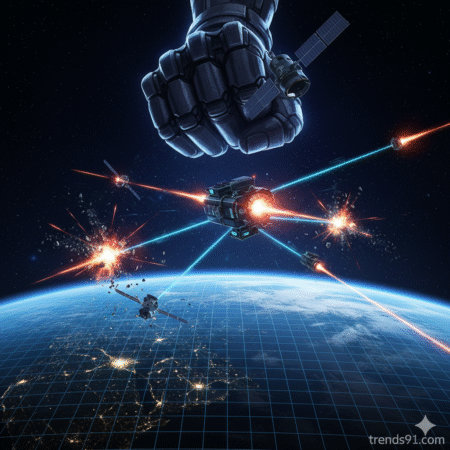
Why space militarization matters now
Space militarization has shifted from background enabler to front-line domain as great powers race to protect and threaten military satellites that underpin communications, navigation, missile warning, and command and control. China, Russia, the United States, and India have all tested anti-satellite weapons, raising the prospect that future space warfare will directly target satellites rather than just using them as passive support. The global “space militarization” market is projected to grow from roughly USD 49–62 billion around 2025 to well over USD 100 billion by the early 2030s, reflecting how states now treat orbital infrastructure as strategic high ground comparable to early airpower.
For deeper threat detail, defense planners increasingly rely on open analyses such as the CSIS Space Threat Assessment 2025 and Secure World Foundation’s 2025 Global Counterspace Capabilities report, which catalog real anti-satellite weapons capabilities and trends.
The space militarization transformation
Speed/Capability Priority
Some defense agencies prioritize rapid deployment of counterspace capabilities. Their logic: “If adversaries are building ASAT weapons, we need matching capabilities now. Speed matters.”
Investment focus: Direct-ascent missiles, ground-based lasers, electronic warfare systems, co-orbital platforms.
Latest 2025 data: US Space Force now acknowledges at least one offensive counterspace system deployed (Counter Communications System jammer) and is developing “low-debris-causing” offensive options. China conducted 5 satellite rendezvous/proximity operations in 2024 alone, demonstrating advanced orbital warfare maneuvering.
Their stakes: If you don’t have counterspace capability, adversaries can attack your military satellites with impunity. Capability creates deterrence.
Debris Mitigation Priority
Other agencies prioritize reducing space debris from weapons. Their logic: “Destroying satellites creates debris that threatens everyone’s space access. We need rules and alternatives.”
Investment focus: Non-kinetic options (jamming, cyber, directed energy), voluntary test moratoria, debris-tracking systems.
Evidence: ASAT tests by US, Russia, China, and India have created ~6,851 cataloged debris fragments, with ~2,920 still in orbit as of early 2025. Single test can pollute critical orbital regions for decades.
Their stakes: Uncontrolled debris generation makes space superiority meaningless if orbit becomes unusable for everyone.
Deterrence Priority
Some strategists emphasize signaling and norms. Their logic: “We need to show we can attack satellites without actually destroying them. Deterrence through demonstration.”
Investment focus: Reversible effects (jamming, temporary blinding), announced tests, diplomatic positioning.
Latest 2025 data: Russia’s GPS jamming now routinely affects civil aviation and Starlink, showing “soft-kill” satellite warfare is already normalized. US shifting public messaging to acknowledge offensive counterspace work.
Their stakes: If you can threaten satellites without debris, you gain space dominance strategy options below threshold of war.
Commercial Integration Priority
Some agencies leverage private sector space capabilities. Their logic: “Commercial satellites are proliferating fast. Integrate them into military architecture for resilience.”
Investment focus: Partnerships with Starlink, Planet, Maxar. Using commercial constellations for military communications and ISR.
Latest 2025 data: Defense sector projected to anchor exploding satellite market though only ~9% of satellites launched 2024-2035. Commercial proliferation makes targeting harder.
Their stakes: More military satellites distributed across commercial platforms increases satellite vulnerability military challenges for adversaries.
Restriction/Governance Priority
Other actors push for arms control. Their logic: “We need international rules limiting ASAT weapons before arms race escalates.”
Investment focus: Diplomatic initiatives, test ban proposals, export controls on counterspace technology.
Evidence: Multiple UN discussions, but no binding treaty. Outer Space Treaty bans WMD in space but not conventional ASATs.
Their stakes: Without governance, space warfare capabilities proliferate uncontrollably, increasing miscalculation risk.
Alliance Coordination Priority
NATO and allies face coordination challenges. Their logic: “If alliance members have different counterspace strategies, we’re not interoperable.”
Investment focus: Common standards, shared space domain awareness, coordinated procurement.
Latest 2025 data: NATO adopted Commercial Space Strategy in February 2025. Working to integrate allies’ space capabilities.
Their stakes: Alliance space superiority requires coordinated space force military doctrine, not fragmented national approaches.
Real conflicts show the tensions
Ukraine demonstrates satellite warfare normalization
Russia’s extensive GPS jamming and Starlink interference in Ukraine shows satellite warfare is no longer theoretical. Electronic attacks on military satellites and commercial constellations are routine.
Speed priority perspective: Russia’s rapid deployment of jamming demonstrates capability advantage. They can disrupt space services without kinetic attacks.
Debris mitigation priority perspective: Russia’s approach avoids debris, showing non-kinetic anti-satellite weapons capabilities can be effective.
Deterrence priority perspective: Jamming signals willingness to attack space systems while staying below threshold of open space warfare.
Commercial integration priority perspective: Ukraine’s use of Starlink shows commercial satellites are now military targets, blurring lines.
Restriction/governance priority perspective: Lack of international response to jamming shows governance gaps. No rules of engagement for satellite warfare.
Alliance coordination priority perspective: NATO members experienced different jamming effects, showing coordination challenges.
All perspectives valid. All show space militarization is already here.
The debris dilemma
China’s 2007 ASAT test created >3,000 debris pieces. India’s 2019 Mission Shakti created hundreds more. Russia’s 2021 test created 1,500+ fragments.
Speed priority view: Tests necessary to demonstrate anti-satellite weapons capabilities. Can’t deter without proving capability.
Debris mitigation view: Tests irresponsible. Threaten all space operations. Should ban destructive tests entirely.
Deterrence view: Tests send message but create long-term hazards. Better to develop non-destructive methods.
Governance view: Tests show need for binding treaty. But major powers won’t sign.
Commercial view: Debris threatens commercial constellations. Insurance costs rising. Market may force restraint.
Alliance view: Debris affects all allies equally. Should coordinate response.
No consensus. Space militarization continues despite debris risks.
2025 space militarization data
Anti-satellite weapons capabilities
Kinetic interceptors:
- US: Capability exists, no recent tests. Acknowledged offensive counterspace systems deployed (jammers).
- China: Tested 2007, capability mature. Developing improved interceptors.
- Russia: Tested 2021, capability operational. Developing nuclear-armed ASAT concept.
- India: Tested 2019, capability demonstrated. Continuing development.
Non-kinetic systems:
- China: Ground-based lasers operational. Electronic warfare extensive. Cyber capabilities.
- Russia: GPS jamming routine. Laser development. Co-orbital systems.
- US: Counter Communications System deployed. RMT system believed deployed. Laser development.
Co-orbital systems:
- China: 5 RPO missions 2024. Advanced proximity operations.
- Russia: Luch satellites conducting RPO since 2017. Testing ASAT components.
- US: GSSAP satellites conducting surveillance. PAN, MENTOR programs.
Space debris from weapons
Total debris from ASAT tests: ~6,851 cataloged fragments
Still in orbit: ~2,920 fragments
Most debris: From Chinese 2007 test (~3,000+ pieces)
Recent addition: Russian 2021 test (~1,500 pieces)
Debris generation space is cumulative threat. Each test adds to long-term hazard.
Satellite vulnerability military assessment
Missile warning satellites: Russia developing nuclear ASAT specifically to target these. Would blind US nuclear early warning.
GPS constellation: Routinely jammed by Russia. Spoofing attacks increasing. Demonstrates satellite vulnerability military systems face.
ISR satellites: Chinese laser dazzling capabilities could blind optical sensors. Russian co-orbital systems could physically approach.
Commercial constellations: Starlink jammed in Ukraine. Shows commercial military satellites are targets.
Space superiority is contested. No nation has assured dominance.
Space dominance strategy investments
US Space Force budget: ~$30B (2025)
China military space spending: Estimated $15-20B (2025, uncertain)
Russia space defense: Estimated $5-8B (2025, uncertain)
Global counterspace market: $49-62B (2025) → $100B+ (2030s)
Growth drivers: ASAT development, satellite protection, debris mitigation, commercial integration.
Orbital warfare scenarios being wargamed extensively. No real space warfare yet, but preparation intense.
What strategists actually disagree on
Professionals agree
- Space militarization is accelerating
- Anti-satellite weapons capabilities exist in multiple nations
- Military satellites are vulnerable
- Space warfare is now planned domain, not just niche
- Debris is serious long-term concern
- Commercial satellites are now military targets
Professionals disagree
- Whether kinetic or non-kinetic satellite warfare will dominate
- How serious debris generation space risk actually is (some say catastrophic, others manageable)
- Whether space superiority is achievable or meaningful
- If arms control possible or desirable
- Whether commercial integration strengthens or weakens security
- How to respond to jamming and “soft-kill” attacks
- Whether space dominance strategy should be offensive or defensive
- If orbital warfare scenarios are realistic or exaggerated
These are genuine strategic uncertainties, not knowledge gaps.
Space militarization scenario analysis
Scenario 1: Kinetic warfare
Nations deploy destructive ASAT weapons. Tests continue. Crisis escalates to satellite destruction.
Short-term: Demonstrated anti-satellite weapons capabilities deter attacks.
Medium-term: Debris accumulates, threatens all space operations. Insurance costs skyrocket.
Long-term: Key orbital regions become unusable. Space militarization leads to “tragedy of commons.”
Favors: Nations with robust ground-based alternatives, those willing to accept debris risks.
Scenario 2: Non-kinetic dominance
Nations rely on jamming, cyber, lasers. No destructive tests. Reversible effects.
Short-term: Satellite warfare becomes routine but stays below threshold of war.
Medium-term: Space superiority measured by electronic warfare capability, not kinetic destruction.
Long-term: Space remains usable but constantly contested. Commercial satellites suffer collateral damage.
Favors: Nations with advanced electronic warfare, commercial space sectors.
Scenario 3: Governance success
International treaty bans destructive ASAT tests. Limits anti-satellite weapons capabilities.
Short-term: Tests stop. Debris generation slows.
Medium-term: Norms against space warfare strengthen. Verification mechanisms developed.
Long-term: Space militarization continues but constrained. Focus shifts to protection.
Favors: Nations with strong diplomatic capacity, commercial interests, environmental concerns.
Scenario 4: Fragmented (most likely)
Different nations pursue different strategies. No coordination. Mixed kinetic/non-kinetic approaches.
Short-term: Capabilities proliferate unevenly.
Medium-term: Space dominance strategy varies by nation. Alliance coordination difficult.
Long-term: Uneven vulnerabilities. Some nations more exposed than others.
This most likely because: No consensus on governance, threat assessment varies, capabilities diffuse naturally.
What to watch for (next 6-12 months)
- ASAT test moratorium: Will US, China, Russia announce test bans? Monitor diplomatic statements.
- Non-kinetic attacks: How much jamming/spoofing in next conflict? Track reports from Ukraine, Middle East.
- Co-orbital operations: Will Chinese/Russian inspector satellites conduct provocative maneuvers? Watch USSF announcements.
- Space Force budget: Will US increase offensive counterspace funding? Track NDAA.
- NATO coordination: Will allies adopt common counterspace doctrine? Monitor NATO space meetings.
- Commercial impacts: Will insurance costs force commercial satellites to harden? Watch market responses.
- Debris incidents: Will major debris collision occur? Would shift debate dramatically.
Space militarization is accelerating. Anti-satellite weapons capabilities spreading. Space warfare planning intensifying. But actual orbital warfare remains taboo—for now.
Key takeaway
Space militarization is transforming space from sanctuary to contested domain. Nations face choice: develop anti-satellite weapons capabilities rapidly (risk debris and escalation) or pursue governance (risk falling behind). Different agencies choosing different paths. This divergence, playing out in 2025, will shape whether space becomes battlefield or remains usable commons.
The transformation is real. The outcome is uncertain.