
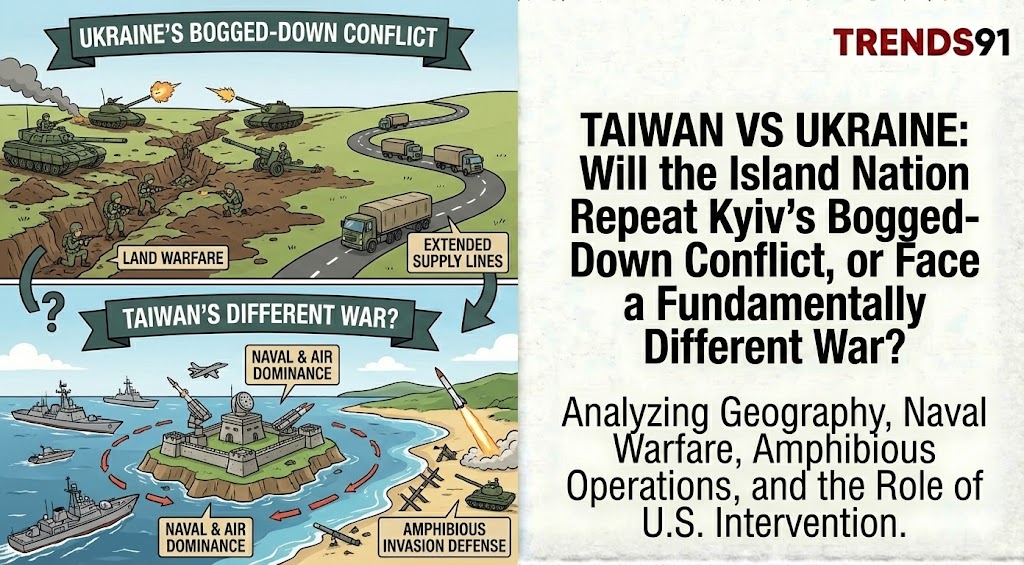
Taiwan does not face the prospect of becoming another Ukraine—a nation locked in a grinding, years-long land war of attrition. Instead, Taiwan faces something more precarious: a conflict that will be decided in weeks, not years, and will hinge on phenomena that Ukraine never experienced: naval blockade, amphibious assault, and the absence of contiguous alliance support. While Ukraine’s success in resisting Russian invasion offers critical tactical lessons for Taiwan’s defense, the strategic contexts differ so profoundly that Ukraine’s model of protracted resistance may be impossible for Taiwan to replicate.
The fundamental divergence: Ukraine could trade space for time. Taiwan cannot. Ukraine received continuous NATO supply overland. Taiwan will be cut off by sea blockade. Ukraine dispersed across 603,000 square kilometers. Taiwan confines its entire existence to 36,000 square kilometers with 90% of its population concentrated on the coast facing China. A Chinese invasion, if attempted, will be won or lost at the beaches within weeks. A Chinese blockade, more likely than invasion, will collapse Taiwan’s economy in months and force political surrender without any possibility of military resistance.
This analysis examines the structural similarities and critical differences between Ukraine and Taiwan, assesses whether Taiwan can successfully emulate Ukraine’s defensive strategy, and concludes that Taiwan’s survival depends not on mimicking Ukrainian tactics but on deterring China’s attempt entirely—a challenge that requires deterrence more than defense.
The Critical Difference—Blockade vs. Land War
Ukraine’s Strategic Fortune: The Land War
Russia’s invasion of Ukraine was fundamentally a land-based campaign. Russian forces attacked across a contiguous border, advanced through relatively flat terrain, and became vulnerable to Ukraine’s ability to retreat, regroup, disperse forces, and receive continuous supplies through NATO partners (Poland, Romania). Even in Russia’s most aggressive operations—the siege of Kyiv, the assault on eastern cities—Ukraine could retreat inland, deplete Russian supply lines through distance, and maintain contact with external support networks.
Most critically: Ukraine was never blockaded. Russia seized the Black Sea and disrupted grain exports, but Ukraine maintained access to overland routes through NATO territories. Weapons, ammunition, intelligence, and food could flow to Ukrainian forces indefinitely through Poland. This logistical connectivity was the single most important factor enabling Ukraine’s three-year resistance.
Taiwan’s Geostrategic Curse: The Blockade Threat
Taiwan’s geography inverts this advantage. Surrounded by water, Taiwan can be blockaded completely with no overland NATO escape routes. A Chinese blockade—described as a 60% probability among expert assessments, more likely than full invasion—would isolate Taiwan from all external supply within days. Taiwan’s economy is fundamentally dependent on maritime trade: 99% of energy imports, critical food imports, semiconductor inputs, and export revenues flow through Taiwan’s ports. A complete blockade would force economic surrender within 3-6 months absent US naval intervention to break the blockade.
Critically, a blockade requires no ground invasion. China can paralyze Taiwan economically without risking the logistical nightmare and casualties of an amphibious assault. Taiwan cannot apply Ukraine’s model (retreat, disperse, maintain supplies) because blockade leaves nowhere to retreat and no supplies to maintain.
Taiwan’s Strategic Challenge: Taiwan’s greatest vulnerability is not military defeat but economic asphyxiation.
Geography as Destiny—How Physical Space Determines Strategic Options
Ukraine’s Massive Territory
Ukraine’s territory covers 603,000 square kilometers. This size offers critical strategic advantages:
- Space for Maneuver: Russia’s initial blitzkrieg toward Kyiv was blunted as Russian forces overextended across flat but vast territory. Ukraine conducted retreats and counterattacks across hundreds of kilometers, using space as a time-buying mechanism.
- Dispersal Capacity: Ukrainian forces could disperse across multiple defensive lines, concentrating forces at critical points while maintaining reserves elsewhere.
- Supply Line Vulnerability: Russian supply lines became stretched over 500+ kilometers, making them vulnerable to Ukrainian strikes. Ukraine exploited this by attacking logistics hubs and forcing Russia to extend supply operations.
- Civilian Refuge: Ukraine’s civilian population could evacuate eastward, reducing collateral casualties and concentrating defender populations.
- Terrain Diversity: Mountains in the west, forests in the north, steppes in the south—multiple terrain types requiring different Russian operational approaches.
Taiwan’s Constrained Territory
Taiwan covers only 36,000 square kilometers—1.6% of Ukraine’s size. This creates strategic problems that no amount of military sophistication can fully overcome:
- Vulnerable Concentration: 90% of Taiwan’s population lives on the west coast facing China. A 15-minute drive separates Taiwan’s western beaches from Taipei, the capital. Loss of beach defensibility = loss of country.
- No Strategic Depth: Ukraine could trade 100 kilometers of territory for 100 kilometers of time. Taiwan trades a few kilometers for existential defeat. The Wugu district (15 minutes from beach) is Taiwan’s critical chokepoint; once China controls the beaches there, Taiwan proper falls.
- Complete Missile Coverage: China’s 1,300 medium-range missiles cover every square inch of Taiwan. Ukraine could position forces beyond Russian missile range in the east and south. Taiwan cannot hide from missile coverage anywhere on the island.
- No Civilian Evacuation: Taiwan’s 23 million people have nowhere to evacuate. Ukraine’s eastern regions (beyond Russian reach) provided refuge. Taiwan’s mountains could theoretically provide refuge, but mountains lack supplies, fuel, modern medicine, and connectivity. Resistance from mountains without logistics would be “futile,” according to defense analysts.
- Airpower Dominance Required: Ukraine could operate where Russian airpower was degraded. Taiwan must establish air superiority over the Taiwan Strait or lose immediately. Chinese air bases 100 kilometers away provide continuous air presence; Taiwan has no equivalent offset.
The Geographic Verdict: Taiwan’s territory cannot support the dispersal-and-retreat strategy that enabled Ukraine’s three-year resistance. Taiwan must win at the beaches or lose entirely.
Strategic Timelines—The Window of Vulnerability
China’s “Capability Window” (2027-2035)
US intelligence assessments, which Taiwan’s own military accepts, place the critical timeline as follows:
- 2027: Xi Jinping ordered the PLA to be “capable” of conducting an invasion by 2027. This is a capability deadline, not necessarily an invasion deadline, but it represents a strategic inflection point.
- 2024-2028: Expert consensus places an “open window” for Chinese military action during this period. Taiwan’s military predicted China could be ready to invade by 2026 (already underway).
- 2030: Taiwan President Lai Ching-te stated the military objective is to achieve a “high level” of joint combat capability against China by 2030—implying this is when Taiwan expects China’s window to fully open.
- 2035: Secondary deadline: China’s aim to “basically complete the modernization of national defense and the military” by 2035. Beijing announced plans for a high-speed railway connecting Taiwan to China by 2035.
- 2049: Symbolic date—100th anniversary of the PRC. Some analysts view this as China’s ultimate deadline for “resolution.”
Ukraine Never Had This Warning
Ukraine’s advantage was not superiority but surprise mitigation. Even when warned in late 2021 that Russia was preparing invasion, Ukraine’s leadership did not fully mobilize defenses. On February 24, 2022, Russian forces attacked with tactical surprise.
Taiwan has no such surprise risk. Taiwan’s entire strategic planning assumes China will not achieve tactical surprise. Taiwan has years, not weeks, to prepare. This is Taiwan’s single greatest advantage: Taiwan has time to deter, while Russia caught Ukraine in a pre-mobilized state.
The Amphibious Invasion Problem—Why Taiwan Differs from Normandy or D-Day
The Logistical Nightmare
An amphibious invasion of Taiwan would be “the most complex military operation in modern history, dwarfing even the D-Day landing of World War II.” Why?
Scale of Operation:
- D-Day (1944): 156,000 troops landed on June 6; required 7,000 ships and craft
- Taiwan invasion estimate: 300,000-500,000 troops required over weeks; requires 1,000s of ships; vulnerable to mines, missiles, submarines
Vulnerable Transit Window:
- Taiwan Strait is only navigable for amphibious operations May-October (2 months)
- Weather, currents, mudflats, and tidal conditions create bottleneck effects
- Russia’s 1-2 day advantage in unopposed logistics; China would need weeks of sustained logistics with Taiwan opposing every landing
Limited Beachheads:
- Taiwan has only ~20 viable beaches for amphibious landing
- All are identified, defended, and pre-targeted by Taiwan’s military
- Unlike Ukraine (multiple fronts, dispersed), Taiwan can concentrate defenses on known approaches
Attrition in Transit:
- Ships crossing Taiwan Strait vulnerable to Taiwanese missiles, naval mines, submarines
- Taiwan’s navy (though small) has trained extensively on coastal defense
- US submarines (if available) pose catastrophic threat to Chinese invasion fleet
- Chinese landing craft slow, cumbersome, impossible to protect from sea-based threats
China’s Improving but Insufficient Amphibious Capability
Recent evidence suggests China is improving amphibious capability but remains constrained:
Recent Developments (December 2025):
- First deployment of “Shuiqiao” barge-like ships capable of linking together to form loading docks 500+ meters offshore
- This innovation boosts amphibious assault potency by allowing cargo transfer from slow ships to faster assault craft at sea
- First deployment of amphibious landing ships in recent exercises
Remaining Constraints:
- These Shuiqiao ships are still vulnerable to missile attack while loading/transferring cargo
- Amphibious landing ships deployed in exercises but insufficient numbers for actual invasion
- Amphibious ships incapable of countering US nuclear submarines or aircraft carrier battle groups
- Overall amphibious capacity still inadequate for 300,000+ troop assault requiring weeks of logistics
Historical Precedent:
- Imperial Japan built resolutely on Taiwan’s geographic defensibility to deter US Operation Causeway in WWII
- France’s attempted invasion of Taiwan (1884-85) was repulsed by Chinese forces defending similar fortifications
- Neither Japan nor France had to face modern air defense, missiles, or submarines
The Invasion Problem Crystallized: A full-scale invasion of Taiwan remains logistically possible but operationally catastrophic in cost. China would need to sacrifice hundreds of thousands of troops and assume 50%+ casualties. For Xi Jinping, the political cost of such losses (publically acknowledged) may be prohibitive.
Taiwan’s Defense Strategy—Can It Replicate Ukraine?
Taiwan’s Asymmetric Approach
Taiwan’s defense strategy, articulated in its 2025 National Defense Report and recent budget allocations, explicitly adopts Ukraine’s asymmetric approach: acquire cheap, mobile, precision-guided weapons to destroy expensive Chinese platforms.
Acquiring Ukrainian-Proven Weapons:
- Anti-ship missiles (Taiwan’s version of naval Javelins)
- Short-range air defense systems (Stinger equivalents)
- Loitering munitions and reconnaissance drones
- Sea mines and coastal fortifications
- Pre-targeted artillery
Doctrine Shift:
Taiwan’s 2025 report reframes deterrence as “national resistance,” emphasizing:
- Coastal defense and beachhead combat
- “Comprehensive inland defenses”
- Rapid response protocols to PLA ADIZ intrusions
- Integration of civilian population into defense-in-depth
- Standard operating procedures for every conceivable attack scenario
Can Taiwan Sustain Ukrainian-Style Resistance?
The Optimistic Case:
Taiwan’s geographic advantages (fortifiable coastline, mountainous interior, preparation time) combined with asymmetric weapons could blunt a Chinese invasion. Ukraine proved that integrated air defense prevents air superiority; motivated defenders with modern weapons destroy expensive armor. Taiwan’s situation is similar: defend territory against materially superior invader.
The Pessimistic Case:
Taiwan lacks Ukraine’s critical advantages:
- Logistics: Ukraine received NATO supplies overland indefinitely. Taiwan’s supplies would be cut by blockade.
- Strategic Depth: Ukraine retreated eastward. Taiwan retreats to mountains with no logistics.
- Duration: Ukraine resisted for 3+ years. Taiwan must win in weeks.
- Reserve Forces: Taiwan’s reserve system is weak compared to Ukraine’s. Ukraine mobilized 6+ million civilians; Taiwan has much smaller reserve capacity.
The Expert Assessment:
Taiwan’s asymmetric strategy can delay a Chinese invasion and impose costs. But Taiwan cannot sustain indefinite resistance without US intervention. Taiwan must deter, not defend. Deterrence requires credible US commitment + rapid defense capability + offensive cost imposition on China.
The Blockade Strategy—Why Invasion May Never Come
Why Blockade Is More Likely Than Invasion
Expert consensus estimates: 35% probability of all-out invasion; 60% probability of limited conflict (blockade or seizing outlying islands); 5% probability of diplomatic solution.
The blockade scenario is vastly more probable because it:
- Avoids Amphibious Assault Costs: No catastrophic invasion casualties; no political domestic shock
- Forces Economic Surrender: Taiwan’s economy collapses in 3-6 months without seaborne trade
- Isolates Taiwan from Allies: Blockade denies Taiwan any foreign support; creates fait accompli for international community
- Tests US Commitment: If US does not break blockade within weeks, blockade becomes permanent de facto
- Offers Off-Ramp: China can declare victory (“Taiwan capitulated economically”) without formal invasion
Taiwan’s Vulnerability to Blockade
Taiwan’s economy is entirely maritime dependent:
- 99% of energy imports seaborne
- Food imports critical for 23 million population
- Semiconductor inputs require supply chains
- Export revenues depend on shipping (Taiwan is 5th largest semiconductor exporter globally)
A complete PLA naval blockade, enforced by 370+ Chinese warships vs Taiwan’s 40-50 combat-capable vessels, would force economic capitulation in months. Taiwan’s military cannot break a blockade alone; only US Navy intervention can do so.
The Implication: Taiwan’s greatest vulnerability is not military but economic. China’s optimal strategy is blockade, not invasion. Taiwan can prepare for invasion; Taiwan cannot prepare for blockade except through US commitment.
The US Commitment Question—The Irreducible Uncertainty
Congressional Codification (Recent)
The Trump administration and Congress have embedded Taiwan support in institutional structures:
- Porcupine Act (December 2025): Streamlines arms transfers, elevates Taiwan’s status in US export control framework
- FY2026 NDAA: Authorizes Taiwan Security Cooperation Initiative, joint training, uncrewed systems development
- Bipartisan Support: 13 congressional delegations to Taiwan in 2018-2024; overwhelming bipartisan support for arms sales
Congressional Message: Taiwan’s defense is a US interest; support is embedded in law and institutions.
Trump Administration Ambiguity
Yet the Trump administration, despite authorizing an $11 billion arms package in December 2025, has created strategic uncertainty:
- Trump proposed Taiwan increase defense spending to 10% of GDP (higher than US or allies)—implying US commitment is conditional on Taiwan bearing more burden
- Trump expressed reservations about NDAA provisions constraining executive authority, suggesting preference for negotiating flexibility with China
- Trump scheduled April 2026 meeting with Xi Jinping, signaling potential for US-China deal-making on Taiwan
The Uncertainty: Would Trump actually intervene militarily if China blockaded or invaded Taiwan? Congressional codification suggests yes; Trump’s negotiating preference suggests conditional commitment.
The Biden Precedent
Biden administration support for Taiwan was clear: $619 million+ in military aid annually; frequent congressional visits; explicit statements that US would defend Taiwan militarily.
Trump’s first administration (2017-2021) was more transactional but ultimately supportive. Trump’s second administration (2025-) has been ambiguous.
The Taiwan Problem: Taiwan’s defense cannot be credible if the US commitment is uncertain. If Taiwan believes US will not intervene, Taiwan capitulates during blockade (3-6 months). If China believes US will intervene, China may not attempt blockade/invasion. The entire deterrence structure depends on credible US commitment—and that commitment is now uncertain under Trump.
Taiwan’s Defensive Buildup—Necessary but Not Sufficient
Recent Mobilization (2025-2026)
Taiwan’s defense spending is escalating rapidly:
- 2026 Main Budget: NT$949.5 billion (~$31.27 billion), a 22.9% year-on-year increase
- Special 8-Year Budget: $40 billion over 2025-2033 (NT$1.25 trillion)
- Target: 5% of GDP by 2030; Trump suggests 10% possible
- First Time: Coast Guard included in defense budget accounting (integrated homeland defense approach)
Investment Priorities:
- New fighter jets (F-16 variants)
- Air defense systems (T-Dome integrated network)
- Unmanned systems and counter-unmanned systems
- Asymmetric weapons (anti-ship, anti-air, loitering munitions)
- Electronic warfare and cyber capabilities
The Capability Gap Problem
Despite this buildup, Taiwan faces a structural problem: China’s defense spending exceeds Taiwan’s by 7-8x and is growing 5x faster.
| Year | China Spending | Taiwan Spending | Ratio |
|---|---|---|---|
| 2024 | $222 billion | $19.7 billion | 11.3x |
| 2025 | $248 billion (7.2% increase) | $21.8 billion (est) | 11.4x |
| 2026 | $265+ billion (est) | $31.27 billion | 8.5x |
| 2030 | $350+ billion (est) | $70+ billion (if 5% of GDP achieved) | 5x |
China’s military spending is growing 7-8x faster than Taiwan’s, meaning the gap will widen unless Taiwan reaches 10% of GDP (politically unlikely) or China’s growth slows (unlikely under Xi’s military-first doctrine).
The Asymmetry Problem: Taiwan is racing to catch up while falling behind. Taiwan’s buildup is strategically necessary but arithmetically insufficient to overcome China’s material advantage.
However: The calculus is not purely quantitative. Taiwan’s asymmetric strategy assumes quality can offset quantity. 1 anti-ship missile ($2-5 million) can destroy 1 Chinese destroyer ($500-800 million). Taiwan can inflict attrition costs that exceed China’s willingness to bear them.
Why Taiwan Is Not Ukraine (And Why That Matters)
Ukraine’s Advantages That Taiwan Lacks
- NATO Commitment: NATO members activated Article 5 implicitly; continuous weapons, intelligence, advisers. Taiwan has no equivalent collective defense commitment.
- Contiguous Supply: NATO supplies overland through Poland, Romania. Taiwan’s supplies must cross Pacific through blockade or carrier task forces.
- Diplomatic Unity: West unified; sanctions on Russia coordinated. Taiwan situation features Trump’s April 2026 meeting with Xi, suggesting US-China negotiation potential.
- Land War Model: Ukraine defended linear frontline against land invasion. Taiwan must prevent amphibious assault (different operational requirements).
- Strategic Depth: Ukraine retreated eastward. Taiwan has nowhere to retreat.
- Casualty Tolerance: Ukraine’s mobilization of 6+ million created reserve depth. Taiwan’s small population limits reserve mobilization.
Taiwan’s Advantages That Ukraine Lacked
- Warning Time: Taiwan has years to prepare; Ukraine had weeks.
- Geographic Defensibility: Island fortress; limited beaches; mountains. Russia had flat land and multiple frontlines.
- Technology Advantage: Taiwan (semiconductor leader) has better electronics, sensors, and AI integration than Ukraine had.
- US Commitment (Ambiguous): US support for Taiwan is deeper (though less institutionalized) than NATO support was for Ukraine pre-invasion.
- Deterrence Possibility: Taiwan can deter through capability + cost imposition. Ukraine faced surprise invasion; Taiwan can make invasion impossible.
The Verdict: Taiwan is not Ukraine. Taiwan’s war, if it comes, will be decided in weeks not years, in ocean/air not land, and will hinge on whether China attempts invasion (difficult, low probability) or blockade (easy, high probability). Taiwan cannot replicate Ukraine’s resistance model; Taiwan must prevent conflict entirely through deterrence.
The Probable Scenarios (2026-2035)
Scenario A: Successful Deterrence (30% Probability)
Taiwan’s defensive buildup + credible US commitment + rising cost of invasion convinces Xi that military conquest is not feasible. China accepts permanent division; Taiwan remains independent. Military exercises continue but no actual invasion/blockade attempt.
Indicator: Trump-Xi April 2026 meeting results in explicit understanding that US-China competition will not extend to military challenge on Taiwan.
Scenario B: Limited Conflict—Seizing Outlying Islands (40% Probability)
China seizes Taiwan’s outlying island groups (Kinmen, Matsu, Penghu) as demonstration of capability and test of US response. These islands are vulnerable (unlike Taiwan proper) and seizure would be symbolic blow to Taiwan’s sovereignty while avoiding full invasion. This “nibbling” strategy tests US commitment without triggering catastrophic costs.
Indicator: 2027-2029 sees Chinese military operations on isolated island groups; Taiwan and US respond but do not escalate to full regional war.
Scenario C: Economic Blockade (20% Probability)
China implements “quarantine” blockade, closing Taiwan’s ports through PLA naval cordon. Taiwan’s economy begins contracting immediately; international pressure mounts on Taiwan to negotiate. If US does not break blockade within weeks, blockade becomes permanent.
Indicator: 2027-2030 period sees Chinese naval exercises escalate to actual blockade enforcement; Taiwan appeals to UN and US; US faces domestic pressure regarding intervention costs.
Scenario D: Full Invasion (10% Probability)
Xi Jinping concludes US commitment is hollow and orders full-scale amphibious invasion. China accepts 200,000+ casualties to conquer Taiwan. US must decide whether to intervene militarily, risking potential nuclear escalation.
Indicator: Trump administration signals unwillingness to intervene; China interprets this as green light and orders invasion 2028-2030.
Deterrence, Not Defense
Taiwan faces a fundamentally different conflict architecture than Ukraine. Ukraine’s advantage was land; Taiwan’s curse is ocean and concentration. Ukraine could disperse and survive; Taiwan must prevent the invasion from happening at all.
The critical insight: Taiwan cannot win a war. Taiwan can only deter one.
Ukraine succeeded by resisting invasion after it happened. Taiwan must succeed by preventing invasion from happening. This requires:
- Credible US Commitment: Taiwan’s defenses are meaningless if China believes US will not intervene. Congressional codification helps, but Trump’s ambiguity creates risk.
- Rising Cost Imposition: Taiwan’s asymmetric weapons must raise the cost of invasion beyond China’s tolerance. Current trajectory suggests this is achievable by 2027-2030.
- Deterrent Messaging: Taiwan must convince China that invasion will be unwinnable, not that it can be won but at high cost.
- Blockade Preparation: Taiwan’s greatest vulnerability is not invasion but blockade. Taiwan cannot prepare for blockade militarily; only US commitment to break blockade matters.
Taiwan will not be another Ukraine because Taiwan cannot be another Ukraine. Taiwan’s geography, economic structure, and strategic context make protracted resistance impossible. Taiwan’s only path to survival is credible deterrence—convincing China that military conquest is impossible, blockade would trigger US intervention, and the cost of attempting either exceeds any benefit.
Whether Taiwan achieves this deterrence depends not on Taiwan’s defense budget or military modernization—though these help—but on US strategic commitment remaining credible and unwavering through 2027-2035, the critical window of vulnerability. If that commitment wavers, Taiwan faces not Ukraine’s grinding resistance but a swift, catastrophic resolution.