
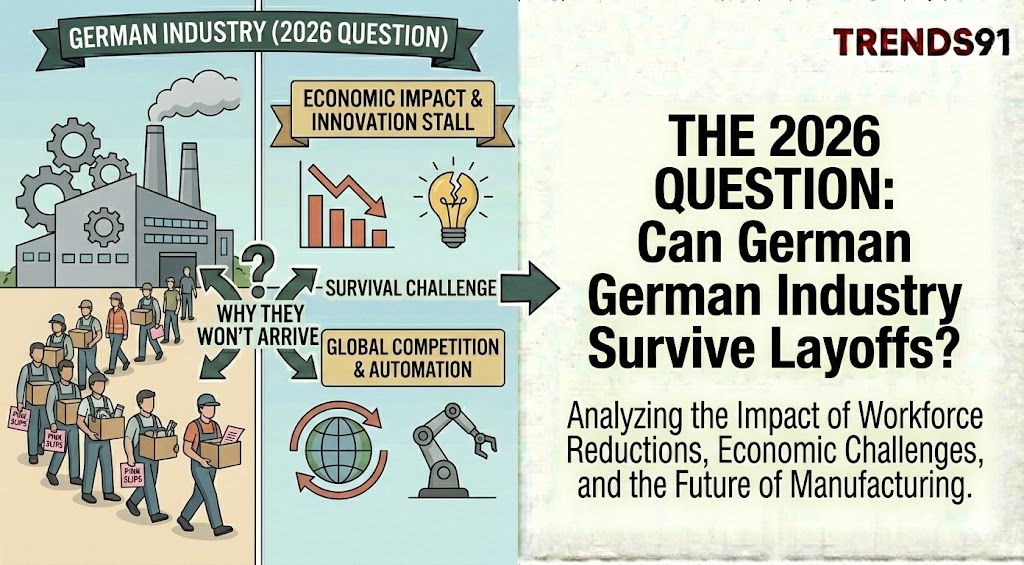
Germany’s Industrial Reckoning: Is Restructuring Survival or Slow Extinction?
Germany’s industrial base is contracting at a pace not seen since the 2008 financial crisis—but with one critical difference. This time, the decline is structural, not cyclical. Over the past nine months, German manufacturers have eliminated 120,000 jobs, with automotive suppliers bearing the heaviest blow. The Federal Association of German Industry (BDI) has declared this “the deepest crisis in the history of the Federal Republic,” explicitly rejecting claims that recovery will be swift. Yet beneath this bleak headline lies a fundamental strategic question that will define Germany’s economic trajectory for the next decade: Can aggressive workforce reductions actually preserve industrial viability, or do they accelerate the very deindustrialization policymakers fear?
The tension is unmistakable. On one side, companies argue that rapid cost-cutting—through mass layoffs, wage restructuring, and operational consolidation—is the only path to remaining globally competitive as Chinese manufacturers flood the market with cheaper electric vehicles and battery technology. On the other side, labor economists and industrial strategists warn that every factory closure and worker exodus chips away at the ecosystem of skills, supply chains, and institutional knowledge that once made “Made in Germany” a global standard.
The data reveals a sector in genuine distress. Four out of ten industrial companies plan additional layoffs in 2026. A survey of 46 major German business associations found that 22 expect workforce reductions this year, while only nine anticipate hiring. These aren’t rumors or cautious projections—they reflect decisions already made and announcements already issued by companies that employ millions.
What makes this moment critical is that the question “Can German industry survive layoffs?” is not rhetorical. The answer determines whether Germany experiences a managed industrial transition or enters a period of permanent economic decline.
Why 2025-2026 Is the Inflection Point for German Manufacturing
For decades, German industrial strength rested on three foundational advantages: premium manufacturing reputation, technological sophistication, and a highly skilled, stable workforce. All three are now under simultaneous pressure, and 2026 represents a critical fork in the road.
The Scale of the Collapse
The numbers are stark. Between the second quarter of 2024 and second quarter of 2025, German automotive industry employment fell by 51,500 workers—approximately 6.7% of the sector’s total workforce. But automotive is only the visible symptom. Across all industrial sectors, employment has contracted for 21 consecutive months. By September 2025, industrial production had declined for nine consecutive quarters.
These are not recession-level job losses distributed across years. These are announced, contractually-binding layoffs happening in real time. Volkswagen has already eliminated 15,000 of its planned 35,000 positions, with 10,000 more “already signed away.” Bosch, Europe’s largest automotive supplier, announced 13,000 redundancies. ZF Friedrichshafen is cutting 7,600 positions and explicitly retreating from electric drivetrain manufacturing. Aumovio, spun from Continental, is eliminating 4,000 jobs globally. These are not small adjustments—they represent the systematic rightsizing of Germany’s industrial foundation.
The unemployment impact is compounding monthly. Germany lost 160,000 workers from the labor force in 2025 alone, bringing total unemployment to 2.95 million. Bankruptcy rates reached their highest levels in 11 years, with 23,900 company insolvencies filed in 2025. Industrial capacity utilization stands at 78%—significantly below the long-term average of 83%—meaning machinery sits idle across the country.
The Structural Cost Problem
What distinguishes 2026 from previous downturns is that German manufacturers face not a demand shortage, but a structural cost disadvantage that recovery won’t fix. Unit labor costs in German industry are 22% higher than the average of 27 industrialized countries. Germany pays €62 per hour in labor costs compared to €29 in Spain and €20 in Portugal. Non-wage labor costs—employer contributions to social security, pensions, healthcare—have risen faster than actual wages, now consuming 42.5% of salaries and projected to reach 50% within a decade.
Energy costs compound the problem. German manufacturers pay electricity prices roughly five times higher than competitors in the United States or China. When the government shut down nuclear plants and lost cheap Russian gas simultaneously, it created a cost structure that makes energy-intensive manufacturing economically irrational compared to alternatives.
The result: German automakers can no longer compete on price in the mass market. Chinese EV manufacturers like BYD now offer advanced electric vehicles at half the cost. In Germany’s own home market, Chinese-branded vehicles already command 8% of the electric vehicle market, compared to only 3% of overall new car sales. German manufacturers capture only 41% of their home EV market, while commanding just 7% of China’s EV market.
Why Government Action Matters Now
Chancellor Friedrich Merz’s government has recognized the emergency. A €500 billion infrastructure fund was approved, supplemented by exemptions to Germany’s constitutional debt brake to enable defense spending. Energy cost subsidies have been announced. Yet implementation has been glacially slow—by year-end 2025, only €24 billion of the €500 billion fund had been allocated.
This timing is critical because the government’s response will determine whether companies execute cost-cutting as a temporary measure or as a permanent reset. If businesses see credible government action on energy costs, regulatory streamlining, and R&D support, layoffs might represent controlled restructuring. If government action stalls, companies will conclude that deindustrialization is inevitable and accelerate their exit from higher-cost manufacturing.
The Speed-First Approach: Accept the Restructuring, Embrace the Decline
The Logic: If German manufacturers cannot compete on cost, they should accelerate the exodus. Close low-margin plants, cut production staff aggressively, and redeploy capital to higher-margin segments—luxury EVs, specialized components, software—where German brands retain advantage.
The speed-first camp argues that prolonging the agony only deepens losses. Every month a factory remains open at full capacity while competitors operate at 40% lower cost is a month of unrecovered losses. Better to cut decisively, absorb the social cost in 2026, and rebuild a leaner, more specialized industrial base around premium segments and intellectual property rather than mass manufacturing.
This approach would mean accepting 150,000+ additional job losses in 2026-2027 as the price of rapid adjustment. Volkswagen’s trajectory reflects this logic: sacrifice the volume game to China, focus on luxury and software, shed workers who worked on combustion engines and mass-market assembly.
What it sacrifices: Depth of manufacturing ecosystem. Once a factory closes and workers find employment elsewhere, reconstituting that production capacity takes years and billions in new investment. Germany would cede mass-market manufacturing to China entirely, reducing itself to a supplier of premium vehicles and components. This creates vulnerability—China could compete in premium segments too, as Tesla and BYD are demonstrating.
The Cost-First Approach: Reduce Labor Costs, Reestablish Competitiveness
The Logic: Germany’s fundamental problem is not innovation capacity but price competitiveness. Reduce labor costs through wage restraint, automation, relocation of lower-value-add production to lower-cost EU countries (Poland, Czech Republic), and extract government subsidies for energy and R&D.
Industry associations are explicitly calling for this approach: 73% of automotive suppliers surveyed demand government action on energy and production costs; 68% demand tax cuts; 62% want reduced bureaucracy. The implicit strategy is: use government support to buy time while companies automate and restructure internally, stabilizing at a lower employment level but one that remains viable within Germany.
This would mean job losses of 80,000-100,000 in 2026-2027, but stabilization thereafter. Companies would retain core manufacturing and skilled worker bases while pushing lower-value production to Eastern Europe or accepting lower profitability.
What it sacrifices: Speed of transformation. This approach extends the pain over 18-24 months rather than compressing it into 6-12 months. Competitors move faster. The EV transition window—where German manufacturers might still recapture mass-market share if they moved quickly—could close before cost-reduction alone improves competitiveness sufficiently. Also, if energy prices don’t fall as expected or government subsidies don’t materialize, companies find themselves midway through restructuring without the cost improvement they wagered on.
The Innovation-First Approach: Massive R&D Investment in EVs and AI
The Logic: German manufacturing has always competed on technology, not cost. Rather than trying to match China on battery cost or labor cost, Germany should invest heavily in the next generation of EV technology, autonomous driving systems, manufacturing AI, and specialized components where cost-per-unit matters less than capability.
This approach would require government and corporate capital deployment of 50-100 billion euros over three to five years, accepting 50,000+ initial job losses while building new capability centers that create different (and often higher-skilled) employment within five to seven years.
The intellectual argument is strong: Germany has deep expertise in precision engineering, software, and industrial automation. These are the competitive advantages that still matter. Chinese competitors dominate battery production and basic EV assembly, but German companies could dominate in electric motor efficiency, autonomous driving architecture, and software-hardware integration for premium vehicles.
What it sacrifices: Near-term stability. Companies would need to weather continued losses while making R&D investments whose returns are uncertain. Shareholders revolt. Workers face years of uncertainty during the transition. Government would need to sustain support through an 18-30 month window before new products generate revenue. If the innovations don’t succeed (which is always possible in R&D), the losses compound.
The Control-First Approach: Strategic Autonomy, Supply Chain Resilience
The Logic: Germany’s real crisis is not economic competition but geopolitical vulnerability. Dependent on Chinese battery suppliers, American chip designs, and Russian energy (now cut off), German manufacturers have limited strategic autonomy. Rather than optimize for cost or innovation alone, Germany should prioritize supply chain resilience, domestic capability in critical technologies, and European partnerships that reduce external dependencies.
This means government picking strategic sectors (batteries, semiconductors, critical minerals processing) and supporting vertical integration even if it’s not the most cost-efficient path. It accepts slower implementation but builds a more resilient industrial base.
Examples: The European Chips Act (€20 billion), Pandemic Preparedness Contracts for pharmaceutical production, support for critical raw materials access. The logic is that strategic autonomy is worth paying a cost premium for.[11]
What it sacrifices: Market efficiency. Government-picked technologies and supply chains often underperform market alternatives. The Chips Act subsidies attracted Intel and TSMC commitments, but both are now pausing or postponing German factory construction, suggesting that even with subsidies, market forces favor alternative locations. Control-first approaches move slowly and require sustained government commitment—a challenge in democracies where political will fluctuates.
The Volkswagen Laboratory: How Strategic Choices Play Out in Real Time
Volkswagen’s restructuring offers a case study in these competing priorities and their real costs. The company announced 35,000 positions to be eliminated by 2030 in Germany alone, but the deeper story reveals the tension between strategies.
VW initially pursued speed-first: aggressive plant closures, production line shutdowns, immediate dismissals. This yielded fast cost reduction but triggered a social and political backlash. German labor unions fought back through strikes and collective bargaining, forcing VW into hybrid arrangements—accepting slower workforce reductions in exchange for accepting wage restraint and productivity targets.
The result is a blended approach: speed in some areas, cost-first in others. But this hybrid creates its own inefficiencies. Factories operate at partial capacity longer than efficient restructuring would require, prolonging losses. But full-speed closures would trigger social instability and union resistance that makes production even harder.
Similarly, ZF Friedrichshafen’s decision to cease developing electric powertrains internally and instead purchase electric motors from external suppliers (potentially Chinese) reflects a shift toward cost-first logic: outsourcing what you can’t do efficiently and focusing capital on what remains competitive. This reduces headcount faster but cedes vertical integration that once represented German industrial strength.
The trade-off is transparent: every dollar saved through cost-cutting is a dollar not invested in innovation. Every month spent restructuring is a month where Chinese competitors, with lower cost bases and patient capital, advance their technology position.
How German Industry Views 2026: Survey Data & Forward Indicators
Employment Intentions
A December 2025 survey by the German Economic Institute (IW) found that:
- 38% of companies plan to cut jobs in 2026
- Only 18% plan to create new positions
- 33% plan to reduce investments
- 32% plan to produce less
By sector, the picture is darkest in manufacturing and automotive:
- 41% of manufacturing companies expect to cut jobs (vs. 38% overall)
- Only 14% of manufacturing firms expect to hire
Business Confidence
The survey of 46 major German business associations showed:
- 22 anticipate workforce reductions (47%)
- 9 anticipate hiring increases (20%)
- 15 expect stable employment levels (33%)
Industries expecting the sharpest declines: automotive, paper, textiles—all facing rising protectionism, weak exports, and high domestic costs.
Capacity & Production Outlook
Industrial capacity utilization stands at 78%, well below the 83% long-term average. This idle capacity represents 40,000+ manufacturing jobs that could be eliminated without new equipment or investment—they simply reflect current oversupply.
Industrial orders surged 5% month-over-month in December 2025 and private business activity expanded at its fastest pace in three years in January 2026, suggesting some cautious optimism. But the BDI warned that industrial growth will likely lag broader economic growth in 2026, meaning manufacturing employment may continue contracting even as the overall economy stabilizes.
The Competitiveness Gap
A Baker Tilly survey of automotive industry executives in January 2026 provided the most sobering assessment:
- 51% of executives say Asian competitors have an “uncatchable lead” in key EV technologies
- Only 6% say Germany is currently a “vanguard” in global automotive
- 28% say Germany is “in arrears” technologically
- 67% expect a “significant number” of companies to go out of business
This assessment matters because it comes from executives managing the transition. They are signaling that they do not believe German companies can catch up through either speed-first cost cutting or innovation-first R&D. Their view: the technological gap is too wide.
The Hidden Costs of Each Approach
Speed-First Strategy Sacrifices:
✓ Gains: Rapid cost adjustment; prevents further losses
✗ Loses: Manufacturing ecosystem resilience; re-entry barriers; skilled worker departure; supply chain depth; bargaining power with component suppliers
Once Volkswagen closes a plant that made transmissions for 20 years, and 8,000 workers move into different industries, reconstituting that production requires not just new capital but rebuilding human expertise that took decades to develop. China’s EV supply chains are now ahead partly because they were built from scratch with scale and modern processes, not inherited from internal combustion engine manufacturing. Germany’s advantage came from accumulated knowledge; speed-first erases that knowledge.
Cost-First Strategy Sacrifices:
✓ Gains: Maintains core manufacturing; preserves workforce base; reduces shock
✗ Loses: Investment capacity; innovation speed; market share during transition; may still be insufficient if global cost structure shifts further
The danger here is halfway adjustment. If Germany reduces labor costs by 10% but competitors reduce by 15%, the competition intensifies. The strategy only works if: (1) energy costs actually fall significantly, (2) government subsidies materialize, and (3) competitors don’t restructure faster. If any of these fails, companies find themselves smaller but not more competitive.
Innovation-First Strategy Sacrifices:
✓ Gains: Potential technological leadership; job creation in new sectors; premium market positioning
✗ Loses: Short-term profitability; shareholder confidence; worker security during transition; depends on successful innovation (not guaranteed)
R&D-intensive strategies work when you have capital patience and time. German companies don’t have either right now. Stock markets demand quarterly earnings. Workers need income stability. And innovation-first only succeeds if innovations actually work. Germany’s automobile history includes failed bets (remember the Hydrogen fuel cell initiative that consumed billions with little result?).
Control-First Strategy Sacrifices:
✓ Gains: Reduced geopolitical dependency; resilient supply chains; long-term security
✗ Loses: Cost competitiveness; speed; efficiency; depends on sustained government support and European coordination
The Chips Act committed €20 billion but Intel and TSMC postponed German factories. The Pandemic Preparedness Contracts are effective but limited in scope. Sustained control-first policies require 10-15 year government commitment and European-wide coordination—both historically difficult for Germany to maintain.
Scenario 1: Speed-First Dominates (2026-2028)
What Unfolds: VW, Bosch, ZF, and mid-tier suppliers execute aggressive plant closures. Workforce falls by 200,000+ positions. Unemployment rises to 3.2-3.4 million. Regional economies in Baden-Württemberg and Bavaria experience significant distress. However, remaining companies operate at higher capacity utilization (85%+) with lower unit costs, allowing some price competition with Chinese EVs.
By 2028: German automotive sector is 30% smaller but profitable on premium vehicles and software. Mass manufacturing is permanently gone to China. German companies focus on EV motors, autonomous driving, and battery management systems—lower volume, higher margin. Government faces massive social welfare costs but avoids extended industrial support.
Probability: Moderate. Happens if energy costs remain high and government fails to deliver subsidies; companies lose patience with hybrid arrangements and execute full restructuring.
Scenario 2: Cost-First Becomes Default (2026-2028)
What Unfolds: Companies reduce wages 5-8% in real terms, accelerate automation, and shift lower-value production to Poland/Czech Republic. German factories focus on assembly and specialty production. Unemployment rises to 3.0-3.1 million but stabilizes there. Government delivers partial energy subsidies and tax relief. Companies muddle through with 30-40% profitability, neither growing nor collapsing.
By 2028: German industry is smaller but stabilized. Innovation lags Chinese and American competitors. Market share erodes gradually. Companies remain viable but do not recover lost ground. Regional unemployment remains elevated but not catastrophic. Social stability is maintained.
Probability: Highest. This is the path of least resistance. Not optimal for any stakeholder but acceptable to all. Most likely outcome given German consensus-seeking politics and labor co-determination.
Scenario 3: Innovation-First Investment Succeeds (2026-2030)
What Unfolds: German government and companies commit €60-80 billion to EV innovation, autonomous driving, and AI-based manufacturing. Job losses accelerate in 2026-2027 (150,000+) but new research centers and manufacturing plants open in 2028-2030. By 2029-2030, German companies introduce next-generation EVs with superior range, efficiency, and software.
By 2030: German automotive regains 15-20% of global EV market through superior technology. Employment rebounds. Germany positions itself as technology leader, not cost leader. Premium segments strengthen. Government investment generates positive ROI by 2033-2035.
Probability: Moderate-Low. Requires sustained capital, successful innovation, and political consensus over 4+ years. Historically, German companies struggle with innovation-first transitions (Diesel emissions scandal shows risk-taking culture is weak).
Scenario 4: Fragmented Adoption (Most Likely for Reality)
What Unfolds: Different companies pursue different strategies. VW emphasizes innovation and software (innovation-first). Bosch focuses on cost reduction and automation (cost-first). ZF pursues strategic partnerships and control-first autonomy. Medium-sized suppliers are bought out or consolidate. Result is sectoral fragmentation with no coherent industrial strategy.
By 2028: Some companies adapt successfully (those pursuing innovation-first with adequate capital), others stagnate (cost-first without sufficient subsidies), others disappear (unable to execute any strategy effectively). Overall employment is 25-30% lower than 2024. Regional winners (Bavaria’s tech hubs) and losers (industrial towns dependent on auto suppliers) diverge sharply.
Probability: Highest. Real-world industrial transitions rarely follow neat scenarios. Fragmentation is default.
The Honest Uncertainties
Does Germany’s Cost Structure Ever Become Competitive Again Without Wage Reduction?
The IW study showed that non-wage labor costs are rising faster than wages, now at 42.5% of salary and projected to reach 50% in a decade. This is driven by aging population and rising pension/healthcare obligations. Some experts argue that no amount of wage restraint fixes this without fundamental reform to social security contributions. Others contend that energy price relief and automation can offset labor cost disadvantages. There is no consensus—it depends on political willingness to reform social insurance systems, which remains uncertain.
Can Government Subsidies Actually Improve Competitiveness, or Do They Just Delay Adjustment?
Goldman Sachs argues that €500 billion in infrastructure spending could boost growth to 1.4% in 2026, creating space for productive investment. But the IMF notes that Europe’s track record on implementing fiscal plans is poor—the €500 billion fund allocated only €24 billion in its first eight months. Some economists contend subsidies delay necessary restructuring and create moral hazard. Others argue that without bridge subsidies, the adjustment is so severe it triggers permanent demand destruction. The debate is genuine and unresolved.
Is Chinese EV Dominance Inevitable, or Can Germany Regain Ground?
Automotive executives surveyed by Baker Tilly believe China has an “uncatchable lead” in EV technology. Yet Goldman Sachs and the IMF suggest that with rapid innovation investment and structural reform, Germany could reposition in premium segments and software. The disagreement reflects different assumptions about innovation speed, capital availability, and market segmentation. There’s no empirical way to resolve this until companies actually release new products.
Does Strategic Autonomy (Control-First) Create Resilience or Inefficiency?
The Chips Act offers a test case. €20 billion committed, but Intel and TSMC postponed factories, suggesting subsidies alone don’t drive location decisions. Some experts see this as evidence that control-first approaches fail. Others contend that strategic autonomy requires longer time horizons and that short-term delays don’t invalidate the concept. The debate is ideological—pro-market efficiency vs. pro-resilience security—and will remain contested.
These uncertainties matter because they affect policy decisions happening now. If government believes subsidies work, it commits capital. If it believes they delay necessary adjustment, it lets companies restructure. Each choice has multi-year consequences.
For the General Reader: Why German Layoffs Matter to You
Germany represents 20% of the European economy. If German industry fails to adapt, European growth stagnates, affecting jobs, wages, and opportunities across the continent. German automotive and machinery are integrated into global supply chains—a collapse in German production reverberates into suppliers in Spain, Poland, Czech Republic, and further afield. If you work in European manufacturing, logistics, or services, German industrial decline directly affects your employer’s prospects.
Beyond economics: Germany’s post-war model of balancing worker welfare, corporate profitability, and social stability is being tested. If Germany solves this crisis, it demonstrates that high-wage, high-security economies can adapt to automation and global competition. If Germany fails, it signals that advanced economies can’t sustain worker-friendly models in competitive global markets—a conclusion with political consequences across Europe and beyond.
For the Business Leader: Strategic Implications
If you supply components to German manufacturers, you face supplier concentration risk. As Bosch, Volkswagen, and ZF restructure, their procurement will contract. This means lower volumes and likely lower prices as suppliers compete for remaining orders. Diversification away from German customers is prudent. Alternatively, if you have capital, German restructuring creates acquisition opportunities—distressed suppliers, specialized assets, and engineering talent at attractive valuations.
If you’re in related sectors (energy, logistics, business services), German industrial contraction reduces demand for your services. However, if Germany’s government actually delivers on infrastructure spending and industrial support, these sectors could see countercyclical investment. Timing your exposure matters.
If you compete with German companies: Chinese and American competitors should be accelerating product development now, as German competitors are distracted by restructuring. The next 12-24 months is a window to capture market share, particularly in mass-market segments where German companies are exiting.
For the Policymaker: Decision Framework
You face a choice that cannot be optimized—only navigated. Speed-first restructuring is economically logical but politically costly (unemployment, regional distress, social instability). Cost-first approaches preserve stability but may not restore competitiveness. Innovation-first requires sustained capital and patience. Control-first builds resilience but reduces efficiency.
The data suggests that pure strategies fail. Hybrid approaches—combining moderate cost reduction with targeted innovation investment and strategic autonomy in critical technologies—are messier but more realistic. However, hybrid approaches require coordination across companies, unions, government, and international partners. Germany’s strength has been social consensus, but this crisis may exceed consensus capacity.
The critical variable you control: government implementation speed. If you announce €500 billion but deliver €24 billion in eight months, companies lose faith in subsidies and accelerate independent restructuring. If you deliver decisively on energy cost relief and regulatory streamlining, companies moderate layoffs and invest. Implementation credibility matters as much as policy design.
For the Military/Defense Strategist: Strategic Autonomy Implications
German industrial decline has security implications. Europe’s defense industrial base depends on German suppliers (Rheinmetall, Diehl, MBDA partnerships). If German industry contracts too severely, Europe’s capacity to sustain defense production is compromised. This is why the Merz government has explicitly linked industrial policy to defense spending and strategic autonomy.
The decision to exempt defense spending from Germany’s debt brake (allowing unlimited defense borrowing) reflects recognition that industrial decline has security costs. However, defense spending alone cannot save German manufacturing—it can only preserve critical capability in selected sectors. The broader industrial question remains unresolved.
What the Data Actually Suggests
Taken as a whole, the evidence points toward a modified cost-first approach with selective innovation and control-first elements. Here’s why:
Pure speed-first fails because it creates permanent capacity loss and social instability that ultimately undermines remaining industry through political backlash and workforce demoralization.
Pure cost-first is insufficient because even aggressive wage restraint and automation cannot overcome the structural disadvantage of 22% higher unit labor costs and 5x higher energy costs relative to competitors. Without energy cost relief (government action), cost-first alone doesn’t restore competitiveness.
Pure innovation-first is too risky given the capital requirements (€60-80 billion+), innovation uncertainty, and the reality that Chinese competitors have first-mover advantage in EV platforms and are moving into premium segments. Germany’s historical advantage in innovation came from incremental improvements to existing platforms, not leapfrog technology creation.
Pure control-first is too slow for an industry in crisis. Strategic autonomy is valuable, but it cannot be the primary focus when companies are hemorrhaging cash and workers are uncertain about employment.
The viable path: Germany pursues a layered strategy. Cost-First for Implementation (aggressive cost reduction in legacy segments, automation, production relocation to lower-cost EU countries) combined with Innovation-First for Premium Segments (concentrated R&D investment in EV technology, autonomous driving, software) and Control-First for Critical Technologies (government support for battery production, semiconductor manufacturing, critical materials). This spreads the burden across different stakeholder groups and sector segments.
Why this matters: It suggests that German industrial employment will fall by 80,000-120,000 in 2026-2027—significant pain but not catastrophic. Some regional economies will suffer (industrial towns dependent on single suppliers), but others will benefit from innovation investment. The overall industrial base shrinks but remains viable, particularly in premium and specialized segments.
What could challenge this view: If energy prices don’t fall, government subsidies don’t materialize, or Chinese competitors move aggressively into premium segments faster than expected, this path fails and Germany accelerates toward speed-first restructuring by necessity. The contingency is government execution.
Critical Open Questions That Will Determine Outcomes
Question 1: Will Government Actually Deliver Infrastructure Spending?
The €500 billion fund exists, but only €24 billion was allocated in eight months. At this pace, Germany will spend €36 billion/year. The full fund takes 14 years to deploy—far too slow to address the current crisis. If government accelerates to €50-80 billion/year over the next 3-5 years, it could meaningfully support industrial recovery. If it stays at current pace, the fund amounts to background noise. This is the most critical uncertainty because it’s entirely within government control.
Question 2: Can Merz Coalition Sustain Reform Momentum?
The Merz government promised a “Fall of reforms” but has faced opposition from SPD coalition partners cautious about labor and pension changes. The most politically difficult reforms (raising retirement age, cutting social security, streamlining regulations) are being postponed to commissions reporting by year-end 2026. If these commissions deliver implementable reforms, the government can credibly pursue a long-term strategy. If they produce watered-down proposals or stall, strategic uncertainty increases and companies accelerate independent restructuring.
Question 3: Can German Companies Execute Innovation Fast Enough?
Chinese EV manufacturers (BYD, NIO) are releasing new models every 12-18 months. German companies’ development cycles are 3-5 years. Even if German companies make innovation-first investments now, the time-to-market disadvantage is substantial. The question is whether German companies can accelerate development cycles (reducing time to market by 30-50%) through different organizational models, more external partnerships, or modular design approaches. Some evidence (Tesla’s pace, BYD’s release cycle) suggests it’s possible, but German companies’ track record is mixed.
Question 4: Will China Move Aggressively Into Premium Segments?
German industry’s residual competitive advantage is in premium vehicles and specialized components. If Chinese manufacturers successfully move upmarket (as Tesla did, and as BYD’s Denza brand is attempting), Germany’s final bastion erodes. Current evidence suggests this is possible but not yet achieved at scale. The next 2-3 years will show whether Chinese premium EV competition emerges. If it does, Germany’s strategic options narrow significantly.
How to Monitor German Industrial Recovery or Decline
Q1-Q2 2026: Government Implementation Speed
Watch for actual spending from the €500 billion infrastructure fund. If allocations reach €40-60 billion in first half-year, government is serious. If they stall at current €24 billion/year pace, the policy is theater.
Q2 2026: Employment Report
The second quarter employment report (published August 2026) will show whether job losses accelerated, stabilized, or moderated. If losses are <60,000 in Q2, cost-first strategies are beginning to work. If they exceed 100,000, companies are accelerating restructuring independent of government support.
Q3 2026: Corporate Earnings
When German automotive and industrial companies report Q2 earnings (July-August 2026), watch for profit margins and capex. If margins improve (suggesting cost-cutting is working), support the cost-first thesis. If capex increases (suggesting innovation investment), support innovation-first thesis. If both contract, suggest speed-first acceleration.
Q4 2026: Energy Price Signals
Government energy subsidies should deliver measurable cost relief by Q4 2026. If industrial electricity prices fall 10-15% below 2025 levels, subsidies are working. If they remain flat or rise, subsidies are insufficient and companies will continue cost-cutting independent of government support.
2026-2027: Chinese Competitive Movement
Watch for Chinese EV launches in premium segments (>€50,000) in European market. If Chinese manufacturers gain 5%+ of premium EV market share, German competitive position is eroding. If they remain <2%, German premium strategy remains viable.
Merz Coalition Stability
Watch for reform proposals from government commissions (due Dec 2026). If they include substantive pension reform, raising retirement age, or cutting social insurance contributions, the government has political room to pursue structural change. If they are symbolic gestures, underlying structural problems remain.
What Industrial Stakeholders Should Do in 2026
For Companies:
- Execute scenario planning around energy costs (assume both subsidy success and failure)
- Accelerate automation investment in legacy segments to improve cost position
- Begin partnerships with EV technology providers (even Chinese if necessary) rather than building solely in-house
- Invest in workforce retraining for workers displaced by restructuring—this smooths social tensions and preserves talent for future recovery
- Build supply chain redundancy, particularly for critical components currently sourced from single suppliers
For Government:
- Accelerate infrastructure fund deployment to €50-80 billion/year
- Deliver measurable energy cost relief by Q3 2026
- Streamline permitting and licensing for manufacturing investment
- Make structural reform (pension, labor market, social insurance) decisions by mid-2026, not end-2026—delay reduces credibility
For Workers & Unions:
- Demand training support and income protection during restructuring, not just severance
- Negotiate for shorter work hours (30-32 hour weeks) that preserve employment instead of pure layoffs
- Secure commitments to reinvestment in German locations rather than accepting pure cost-cutting
For Investors:
- German industrial stocks are pricing in moderate restructuring. Significant upside if government delivers; downside if restructuring accelerates
- Supply chain diversification from German auto/industrial exposure is prudent
- Chinese EV and battery manufacturers offer asymmetric opportunity if German market share continues eroding