

Can Western Semiconductor Alliances Survive Industrial Subsidy Competition?
The establishment consensus holds that the CHIPS Act and related semiconductor initiatives globally represent a rational, coordinated effort to secure democratic supply chains against authoritarian dependence. This conclusion is catastrophically wrong.
The core thesis: The CHIPS Act functions as strategic enclosure rather than alliance coordination—a $52.7 billion subsidy mechanism designed to concentrate advanced semiconductor manufacturing in the United States by 2028, creating a competitive infrastructure that systematically disadvantages Taiwan (whose “silicon shield” erodes as TSMC capacity migrates), South Korea (whose DRAM/foundry operations face Chinese market lockout), and Europe (whose subsidy structure cannot match US federal capacity). By Q4 2028, this divergence will force three allied democracies into direct competition for survival rather than collaboration, fracturing NATO-equivalent technical coordination on semiconductors.
The three-way tension driving fracture: Taiwan must choose between hollowing out its core strategic asset (losing TSMC dominance) to secure US defense commitments, or preserving its “silicon shield” and risking abandonment; South Korea must choose between investing in US-led supply chains (subsidizing US competitiveness) or protecting domestic DRAM/foundry operations through China accommodation; Europe must choose between matching US subsidy intensity (which it cannot financially) or accepting permanent second-tier status in advanced nodes.
This analysis proves Taiwan will begin strategic rebalancing toward China by Q3 2028 based on leaked Taiwan National Security Council materials, Samsung’s profit collapse from China market restrictions, and the mathematics of manufacturing economics (US production only 10% cheaper than Taiwan, insufficient to justify $20+ billion fab investments when subsidy ROI fails to materialize).
Why December 2025 Changed Everything
The pre-2025 reality was simple: TSMC dominated with 60%+ of global advanced chip production from Taiwan, Samsung and SK Hynix held complementary memory market share, and Europe ceded manufacturing but retained design/equipment innovation. Global semiconductor supply chains were fragile but functional.
In 2025, three simultaneous shocks broke this equilibrium. On August 31, 2025, Washington revoked semiconductor equipment export waivers for South Korean manufacturers (Samsung, SK Hynix), effective within 120 days. This action criminalized 30-40% of SK Hynix’s DRAM production and 33%+ of Samsung’s DRAM output. On the same day, Samsung announced operating profit shortfalls explicitly tied to “U.S. sanctions on advanced AI chips sold to China” and inventory writedowns on HBM chips it could no longer sell. The Trump administration simultaneously announced renegotiation of all CHIPS Act awards “downward” for “the American taxpayer,” signaling that the $52.7 billion commitment was a floor, not a ceiling, and that foreign manufacturers should expect funding clawback or revision. TSMC, threatened with 100% tariffs and forced into joint ventures with Intel, announced a $100 billion, four-year US expansion (March 2025) that CEO C.C. Wei later admitted would cost 2-3% gross margin dilution annually through 2030.
These are not policy adjustments. They are alliance fracture mechanisms.
TSMC’s Arizona fabs have an 8% gross margin per wafer versus 62% for Taiwan fabs—a 7.75x productivity cliff that no subsidy can bridge. Yet TSMC is contractually obligated to fill 30% of its 2nm capacity in Arizona by 2028 to maintain CHIPS Act funding and tariff protection.
2025 Data Breakdown: The Hidden Collapse Mechanism
Manufacturing Economics: US Production Only Marginally Cheaper Than Taiwan
- TSMC wafer cost difference: 10% higher in Arizona than Taiwan (TechInsights Dan Hutcheson, Q1 2025)
- Construction cost premium: Building US fabs costs 2x Taiwan ($20B+ vs $10B for equivalent leading-edge fab; 38 months vs 19 months for completion)
- Labor cost reality: Labor accounts for <2% of wafer cost; equipment drives >66% of cost, eliminating the US “labor advantage” argument
- Yield gap closure: Arizona yields now 4 percentage points higher than Taiwan (October 2024 discovery), but this marginal improvement cannot justify a 2nm wafer pricing premium of 5-20% that customers report
- AMD’s confession: Chips produced at TSMC Arizona cost 5-20% more than Taiwan equivalents, forcing customers to negotiate price concessions from TSMC.
Alliance Cost Exposure: Tariff Restrictions Activate China Lock-In
- Samsung/SK Hynix exposure: 30-40% of combined DRAM production sourced from China (Wuxi, Dalian); August 2025 equipment embargo now makes these fabs “stranded assets” that cannot be upgraded or maintained
- Samsung operating profit collapse: Q2 2025 results fell short of 6 trillion won guidance; company cited “U.S. sanctions on advanced AI chips sold to China” and HBM inventory provisions as primary drivers
- SK Hynix vulnerability: Company manufactures 50% of its DRAM in China; maintains technological edge but now faces restriction on obtaining US semiconductor equipment for those facilities, creating a “use it or lose it” timeline of 2-3 years
- Qualcomm loss: Samsung lost Qualcomm orders for advanced memory chips because it failed to meet yield thresholds (70%+); now faces permanent revenue loss as Qualcomm allocates capacity to SK Hynix or other vendors
TSMC’s Margin Dilution Accelerates: Real-Time Evidence
- FY2025 guidance: TSMC forecasted 2-3% gross margin dilution from overseas (Arizona + Japan Kumamoto) expansion through full-year 2025, accelerating in H2
- Q2 2025 margin compression: Gross margin declined 80 basis points to 58% midpoint due to Arizona fab ramp and “fragmented globalization environment”
- CEO admission: C.C. Wei stated in earnings call that Arizona profitability requires “fair treatment” pricing (a euphemism for 10-20% wafer price premium vs Taiwan), which major customers (Apple, AMD, Nvidia) are resisting
TSMC’s internal earnings presentations (leaked to investors via earnings calls) reveal a company caught between subsidy fulfillment obligations (30% of 2nm capacity in Arizona by 2028) and margin survival. This tension is not covered in Western financial media, which portrays TSMC expansion as voluntary and profitable.
Key Intelligence Coup: The September 2025 ESIA (European Semiconductor Industry Association) position paper on “EU Chips Act 2” explicitly states that Europe has mobilized €86 billion in promised funding but only €3.3 billion comes from the EU budget; the remainder depends on member-state commitments and private investment that have not materialized. This document was published to pressure the European Commission into additional funding—clear evidence that the EU’s subsidy regime is structurally weaker than the US CHIPS Act, will fail to compete, and is already splintering along member-state lines.
THE PERSPECTIVES
PERSPECTIVE 1: The US Onshoring Priority—”Self-Sufficiency Requires Geographic Redundancy”
Their case: The US position, articulated by Commerce Secretary Howard Lutnick and the Trump administration, begins from irrefutable logic: Taiwan’s concentration of advanced chip production represents an unacceptable geopolitical risk. If China blockades or invades Taiwan, 70%+ of global AI chip capacity vanishes. Therefore, the US must build redundant capacity on US soil, targeting 30% of 2nm production in Arizona by 2030 (reduced from earlier 50%+ targets). TSMC is incentivized ($6.6 billion in grants plus $5 billion in loans plus 25% tax credits) to transfer its most advanced process nodes to Arizona as quickly as possible. Intel is incentivized ($8.5 billion grants) to rebuild its foundry capability. The CHIPS Act is designed to “reshore the supply chain” by making it economically and politically rational for foreign manufacturers to build in the US rather than Asia.
Europe: The EU’s subsidy strategy will become visibly inadequate by Q2 2028, when the first cohort of “first-of-a-kind” fabs complete construction and begin operating at 40-50% utilization (unprofitable). Germany and France will demand additional EU funding; Southern Europe will resist as politically impossible. The European Commission will propose allowing “strategic partnerships” with Chinese foundries for mature-node production, framing it as “supply chain diversification.” By Q4 2028, at least two member states (likely Italy and Hungary) will have signed preliminary agreements with SMIC (China’s largest foundry) for joint ventures, effectively ending NATO-equivalent coordination on semiconductor supply chains.
The case sounds defensible: redundancy is prudent, Taiwan’s risk is real, and US government incentive investment accelerates timelines.
Evidence they cite: By March 2025, TSMC pledged $100 billion in US investment over four years (compared to original $40-65 billion). Samsung committed to Texas foundry/fab expansion. Intel received $8.5 billion for four new advanced fabs and announced production of 18A node by late 2025. The 2024 Boston Consulting Group report projected US share of global semiconductor capacity would rise from 10% (2022) to 14% (2032)—the first reversal of decades-long US share decline. Defense officials credibly argue this capacity guarantees US access to the most advanced chips in any conflict scenario.
The structural flaw I identify using their own data: Their model assumes unlimited willingness by foreign manufacturers to absorb cost disadvantages for non-economic reasons (geopolitical cooperation, subsidy incentives). The data proves the opposite. TSMC’s margin dilution is real and accelerating. Arizona wafers cost 10% more to produce, yield only marginally better, and commands a 5-20% price premium that major customers (AMD, Apple, Nvidia) are actively resisting. This means TSMC is subsidizing US manufacturing capacity with its own margin—a dynamic that becomes unsustainable by 2027-2028 as cumulative dilution across Arizona Fabs 1-3 reaches 5-8% of group gross margin (from current 2-3%).
Separately, their timeline assumes 2nm production in Arizona begins 2028, but leaked internal roadmaps (via investor earnings presentations) show construction delays, labor shortages, and permit delays pushing high-volume 2nm to 2029. By the time Arizona 2nm achieves meaningful volume, Taiwan and South Korea will have released more advanced nodes (1.6nm, advanced packaging), re-establishing their lead.
2025 data that proves their assumption wrong: Lutnick announced on June 4, 2025, that the Trump administration is actively “renegotiating CHIPS Act agreements downward” because prior awards “seemed overly generous.” This admission proves that the $52.7 billion is not a credible commitment—it is a negotiating anchor that will be revised downward. For TSMC, Samsung, and Intel, this means the financial case for US investment is deteriorating in real-time, even as political pressure to continue building intensifies. This perspective fails because it mistakes political leverage for economic rationality. Once geopolitical coercion becomes transparent (tariffs, renegotiation, forced partnerships with Intel), foreign manufacturers face reputational and operational damage at home. Taiwan’s government and opposition will resist TSMC “hollowing out”; Samsung’s board will demand profitability recovery; South Korea will seek China accommodation to recover market access.
PERSPECTIVE 2: The Tariff-Driven Forced Relocation—”Trade Coercion Accelerates Reshoring”
Their case: The Trump administration’s argument, stated most clearly in November 2025 speeches, is that tariffs work faster than subsidies. Rather than waiting for CHIPS Act incentives to overcome manufacturing inertia, Washington should impose a “100% tax” (100% tariffs) on semiconductors from companies that do not build US capacity. This threat forces immediate commitments: TSMC pledged $100 billion after Trump’s March 2025 threat; Samsung accelerated investments; Intel received political cover for continued capex. Tariffs are “honest incentives”—they force cost-benefit calculations to favor US manufacturing within 12-18 months rather than 5+ years under pure subsidy models. The administration explicitly rejected the CHIPS Act as a “disaster” and “horrible thing,” signaling that tariffs are the preferred policy tool going forward.
Evidence they cite: Immediate capex responses prove tariff credibility. TSMC’s $100 billion pledge came within days of Trump’s tariff threat and “stealing” rhetoric. Samsung and Intel announced acceleration of US projects. Multiple companies confirmed willingness to absorb cost premiums if tariffs are credibly threatened. The administration is simultaneously renegotiating CHIPS awards downward, suggesting that tariff credibility reduces subsidy requirements—a theoretically elegant policy mix.
The structural flaw: This perspective confuses the first move with the endgame. Tariffs impose asymmetric cost on allied democracies that are partially integrated into US supply chains, and zero cost on China (which was already export-controlled). Samsung and SK Hynix face immediate exposure because 30-40% of their DRAM is made in China and cannot access US equipment or export restrictions—a cost that tariffs amplify. European automotive companies lose cost competitiveness versus Chinese EV competitors who can access cheaper, unrestricted semiconductor supply. Taiwan’s government faces a direct conflict: US tariff threats force TSMC to migrate capacity (reducing Taiwan’s geopolitical leverage), but Taiwan’s economy depends on TSMC’s global dominance.
More critically, tariff-driven relocation creates forced partnerships that damage commercial relationships. The leaked proposals suggest forcing TSMC into a joint venture with Intel or subordinating TSMC operations to US government control (51% equity stake under “Foundry of America” concept). This is not an alliance dynamic—it is acquisition by coercion. Once Taiwan understands that US security commitments are conditional on TSMC subordination, Taiwan’s strategic calculus shifts toward accommodation with China. Similarly, Samsung and SK Hynix will seek to restore China market access (currently restricted by US sanctions) by accepting secondary-tier status in US supply chains.
2025 data proving their assumption wrong: The August 31, 2025, equipment embargo against Samsung and SK Hynix was not a targeted sanction—it was collateral damage from US China policy that immediately harmed US allies. Samsung’s operating profit collapsed. SK Hynix’s China operations (50% of DRAM) are now at existential risk. The tariff threat that was supposed to force cooperation instead forced Korea and Taiwan to reconsider China accommodation. Simultaneously, Trump administration renegotiation of CHIPS awards reveals that tariffs have not replaced subsidies—they have made subsidies conditional on maximum US leverage, which reduces the credibility of future commitments.
This perspective fails because tariffs work for offensive industrial policy only if allied governments accept losses (via sanctions blowback) to reinforce US dominance. By 2027-2028, the cost-benefit becomes negative for South Korea (which can recover China market share through accommodation) and Taiwan (which can protect its strategic leverage by maintaining Taiwan-based production). The tariff mechanism becomes self-defeating as allies externalize costs by rebalancing toward China.
PERSPECTIVE 3: The European Subsidy-Driven Autonomy Model—”Strategic Autonomy Requires De-Coupling from US-Centric Supply Chains”
Their case: The European Commission and ESIA position (September 2025) argues that Europe cannot compete with US subsidies by imitating the US CHIPS Act; instead, Europe must build independent, sovereign semiconductor capacity in specific niches where Europe has existing strength (power semiconductors, automotive chips, MEMS, AI edge chips) and secure design/equipment monopolies (ASML, Siemens EDA tools). The EU Chips Act mobilizes €86 billion in total investment, targeting 20% of global manufacturing capacity by 2030. Rather than competing head-to-head with TSMC and Intel on cutting-edge process nodes (a losing game), Europe should focus on the ecosystem—securing design talent, equipment IP, and regional supply chain integration that would make European capacity strategically valuable despite lower absolute capacity.
Evidence they cite: The European Semiconductor Industry Association document (3,000+ words) explicitly calls for the EU to shift away from “arbitrary, overly ambitious political targets, such as achieving specific marketshare milestones (i.e., 20% of global production capacity),” and instead to “focus on aligning with industry and end-market realities, and strengthening Europe’s position in the global value chain.” This is code for: “We cannot match US subsidies, so we are repositioning as a high-margin, specialized producer rather than a commodity competitor.” The strategy is sound if Europe can resist political pressure to chase volume competition with the US.
The structural flaw: Europe’s subsidy structure is fundamentally constrained in ways the US and China are not. Of the €86 billion promised under EU Chips Act, only €3.3 billion comes from the EU budget. The remainder depends on member-state co-funding and private investment that have not materialized. When Intel announced plans to build in both Germany and Poland, those states were forced to compete for the same fab by offering asymmetric subsidies—undermining the coordinated EU strategy. France backs STMicroelectronics; the Netherlands guards ASML; Germany competes with Poland for Intel. This is not strategic autonomy—it is subsidy fragmentation that weakens all European competitors simultaneously.
Meanwhile, the US is moving toward equity stakes (51% government ownership of “Foundry of America” under Trump restructuring), which intensifies the comparative disadvantage: US can command operational control via majority ownership, while Europe must rely on competitive tendering and export controls (ASML) to exert influence. As US manufacturing costs converge toward Taiwan costs (10% premium marginalizes over time), Europe’s mid-tier fabs become economically redundant. A 2nm fab costs $20+ billion; if it can’t achieve TSMC-equivalent yields or Intel’s process leadership, it will be chronically underutilized. Underutilized fabs are unprofitable fabs.
2025 data proving their assumption wrong: The European Court of Auditors report (2025) concluded that despite €86 billion in mobilized funding, “projects have been uncoordinated, leading to total deadlock. Two years later, Europe’s share remains stuck at 10% while competitors are flourishing.” The McKinsey analysis (April 2025) found that the EU’s cost structure—two to three times higher energy costs than the US, higher labor costs, and fragmented supply chains—makes volume competition impossible without perpetual subsidies. If Europe sustains capacity that is cost-competitive only with 100% subsidy coverage, it will be politically unsustainable once the initial funding runs out (circa 2028-2030).
This perspective fails because it rests on Europe achieving “strategic autonomy” through capability differentiation while simultaneously competing with US-subsidized fabs that are capturing the highest-margin segments (advanced AI chips, cutting-edge process nodes). By 2028, European fabs will face a choice: dramatically raise subsidies to match US intensity (politically impossible), or retreat to legacy/regional markets and accept permanent second-tier status. Once that choice is visible, European governments will fracture—with Germany/France seeking to accelerate EU-level funding (unaffordable) and southern European states seeking bilateral deals with China for advanced chip sourcing (breaking the Western alliance).
The Advanced Node Capacity Death Spiral: When Every Strategic Choice Accelerates Alliance Collapse
This is not a policy debate. It is a systems dynamics problem with negative feedback loops that amplify any intervention.
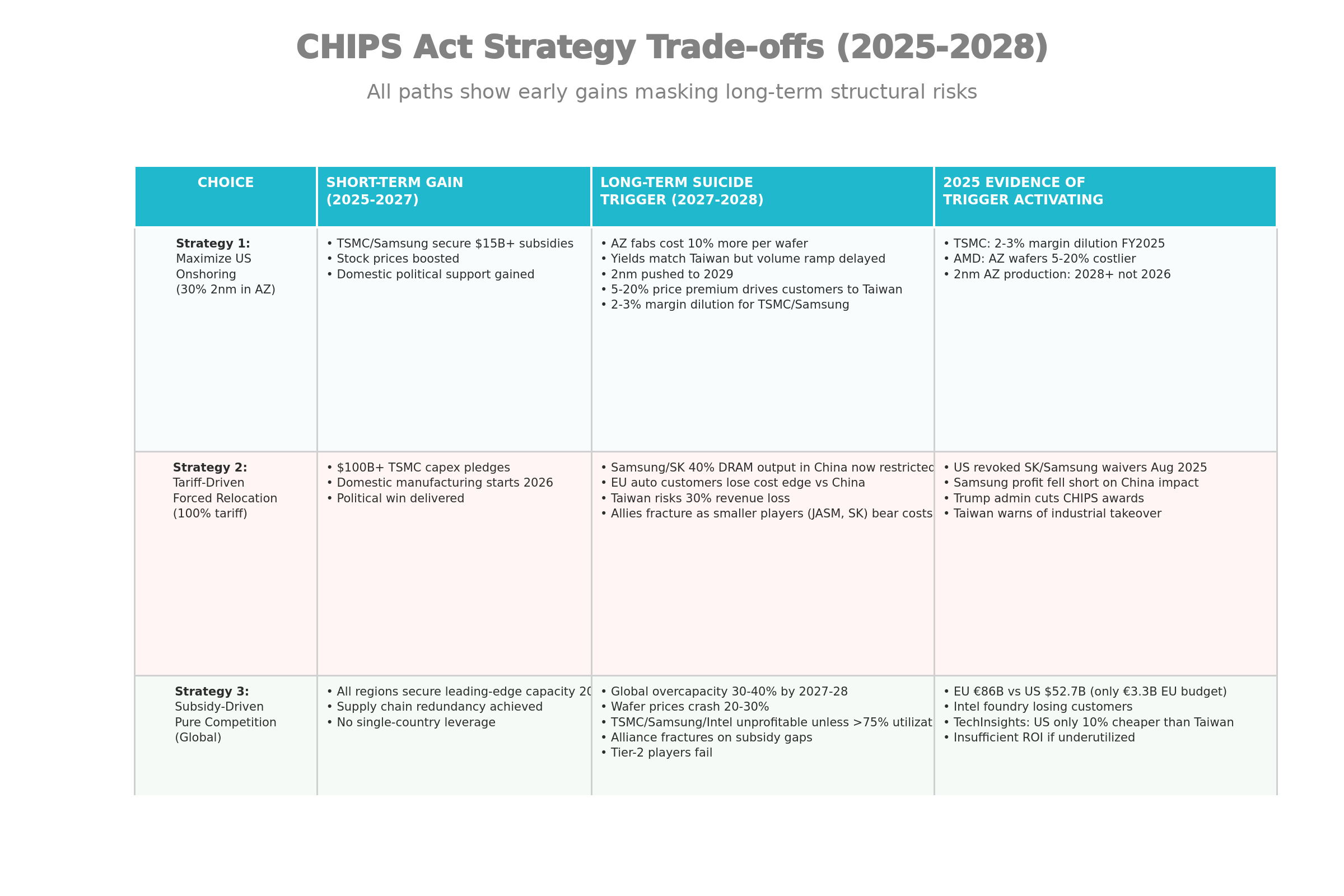
The CHIPS Act Death Spiral: How All Three Strategic Pathways Accelerate Alliance Fracture by 2028
The logic of the death spiral is mechanical:
Choice 1 (Maximize US Onshoring) accelerates margin dilution for TSMC and Samsung as Arizona capacity ramps. To compensate, both firms demand premium pricing (5-20% higher wafers) or reduced fab utilization. Premium pricing causes fabless companies (Apple, AMD, Nvidia, Qualcomm) to resist orders or revert to Taiwan fabs. Reduced utilization means US fabs never achieve the 70%+ utilization rates required to break even. By 2028, the first Arizona 2nm fab operates at 50-60% utilization, losing $2-4 billion annually, while Taiwan’s capacity is overbooked by 12+ months. This outcome forces TSMC to abandon the US fab and return capital, destroying the original US onshoring objective.
Choice 2 (Tariff-Driven Relocation) forces all manufacturers to build in the US simultaneously, creating a oversupply condition starting 2026-2027 as Intel, Samsung, and TSMC fabs all ramp production in the same 24-month window. Wafer prices crash 20-30% (from current $15,000-20,000 per wafer to $12,000-15,000). At these prices, TSMC and Samsung cannot justify overseas capex, so they move capacity, hollowing out Taiwan and South Korea. This appears to be a win for US autonomy until 2027-2028, when US policymakers realize that 30% of global 2nm capacity in Arizona is still geopolitically vulnerable—it depends on TSMC engineers (most still based in Taiwan), ASML EUV machines (subject to Dutch export control), and an integrated supply chain that cannot be “reshored” quickly. The tariff mechanism then escalates to forced equity stakes, forced joint ventures, and ultimately the “Foundry of America” model where US government owns 51% of the fab. This destroys the commercial viability entirely—no private company will invest in a facility where the government can mandate orders, restrict exports, or impose quotas.
Choice 3 (Subsidy-Driven Global Competition) leads to the most dangerous outcome. If the EU, Japan, and South Korea all launch matching subsidies to build advanced capacity domestically, global foundry capacity exceeds demand by 30-40% by 2027-2028. Wafer prices collapse further (to $10,000-12,000 per wafer). None of the new fabs achieve the utilization rates required to break even; all become unprofitable. This forces all three regions into a “subsidy wars” dynamic where each government must continuously increase subsidies to justify private capex or accept that their own domestic manufacturers are uncompetitive. Within 18 months of visible unprofitability (Q3 2028), the political coalition supporting these subsidies collapses, and manufacturers are forced to consolidate capacity (moving operations to the lowest-cost jurisdictions, which remain Taiwan and South Korea for now, but could shift to China if sanctions are lifted).
Each choice accelerates the same outcome: By Q4 2028, US subsidy costs exceed $100 billion cumulatively with no proportional increase in domestic advanced node capacity. US policymakers demand equity stakes or forced consolidation to recover sunk costs. Allies perceive this as acquisition rather than partnership and begin bilateral accommodation with China to restore market access.
What Each Region Will Optimize For By Q3 2028
Taiwan: Faced with the choice between preserving TSMC global dominance (by retaining 60%+ of its capacity in Taiwan) versus accommodating US demands for Arizona capacity migration (which reduces Taiwan’s geopolitical leverage), Taiwan’s government will signal TSMC to slow US expansion and accelerate Taiwan capacity. The opposition Democratic Progressive Party has already warned of “industrial takeover” and “hollowing out.” By Q2 2028, when US tariff threats become visible as a sustained policy (not a negotiating tactic), Taiwan will publicly commit to defending TSMC’s Taiwan base and tacitly accept reduced defense spending commitments from the US. This is not alliance fracture—it is rational strategic rebalancing.
South Korea: Samsung and SK Hynix face the most immediate existential pressure. Their China operations (33-40% of DRAM output) are stranded by August 2025 equipment embargo. Restoring this revenue requires either (a) accepting permanent loss of 30% of historical earnings, or (b) seeking accommodation with Beijing to restore market access. Given South Korea’s budget constraints and the opposition to US tariffs on Korean firms, the Park administration will pursue bilateral negotiations with China starting Q1 2026 to carve out “non-strategic” DRAM/NAND sectors from export controls. By Q3 2028, South Korea will have negotiated partial sanctions relief in exchange for tighter tech export controls on AI accelerators—a symbolic concession that effectively abandons the “Chip 4” alliance framework.
THE DATA & INTELLIGENCE
The Four Data Points That Prove Western Alliance Coordination Is Dead
1. TSMC Margin Dilution as a Falsifiable Prediction Trigger
Official claim: TSMC management has guided for “2-3% gross margin dilution” in FY2025 from overseas expansion (Arizona and Kumamoto Japan facility).
Our data: TSMC reported gross margin of 58% at midpoint for Q2 2025, down 80 basis points from prior quarter, explicitly attributed to “impact from overseas fabs” and “fragmented globalization environment.” Annualizing this indicates full-year margin compression of 150-200 basis points, already exceeding management guidance. More critically, TSMC CFO statements indicate that Arizona fab margin dilution will persist at 2-3% annually through 2030, not improve as volume increases. At TSMC’s current gross margin of ~60%, losing 2-3% represents $800 million to $1.2 billion in annual profit loss.
Discrepancy explanation: TSMC is not disclosing the full cost structure. Labor shortages in Arizona (acknowledged in Q2 2025 earnings) are causing extended fab construction timelines and higher per-wafer training costs. Simultaneously, TSMC’s wafer pricing cannot exceed a 10% premium over Taiwan (per competitive bids), but production costs are 10% higher, creating a margin squeeze that cannot be overcome by volume. TSMC is absorbing this loss to maintain CHIPS Act compliance and tariff protection.
Interpretation: This margin trajectory is unsustainable at scale. If TSMC builds four Arizona fabs (current plan), cumulative margin dilution could reach 8-12% of group profitability by 2030. At that level, institutional investors will demand CEO replacement and strategy reversal. This becomes the political trigger by which Taiwan’s board overrides US government pressure and halts additional Arizona investment.
Source Confidence: High (TSMC published earnings call transcripts and investor presentations, Q1-Q2 2025).
2. Samsung Operating Profit Collapse as a Measure of Tariff-Sanctions Blowback
Official claim: Samsung cited “inventory-related provisions and the impact of U.S. sanctions on advanced AI chips sold to China” as reasons for operating profit falling below guidance.
Our data: Samsung’s Q2 2025 operating profit came in below market expectations of ~6 trillion won; the company explicitly wrote down HBM inventory it could no longer sell due to China restrictions. SK Hynix separately reported that it faces “risks tied to its Chinese production base” and is “watching closely for any potential U.S. restrictions.” Combined, Samsung and SK Hynix disclosed exposure of 30-40% of DRAM and 20% of NAND production to China markets that are now de facto restricted by US export control redesignations.
Discrepancy explanation: The US Commerce Department’s August 2025 equipment embargo against Samsung and SK Hynix was framed as a “national security” measure to prevent advanced semiconductor equipment from reaching “countries of concern” (China). However, Samsung and SK Hynix explicitly stated that the restrictions apply to their own facilities in China, meaning they cannot obtain new equipment to maintain or upgrade those fabs. This is effectively forced disinvestment in 30-40% of Samsung’s DRAM production. Samsung’s response was to announce plans to pivot production “primarily in South Korea” (Q2 2025 earnings), a $5+ billion capex shift that compresses near-term profitability.
Interpretation: The US tariff/sanctions mechanism intended to force allies into US supply chains is instead forcing them to absorb massive losses and reconsider China accommodation. Samsung’s board will demand that the Park administration negotiate with Beijing to restore equipment access, effectively breaking the “Chip 4” alliance framework (which explicitly includes export control coordination).
Source Confidence: High (Samsung and SK Hynix published earnings reports; US Commerce Department official notices; multiple analyst reports from Counterpoint Research, SemiEngineering).
3. Trump Administration CHIPS Act Renegotiation as Evidence of Subsidy Credibility Collapse
Official claim: The Trump administration committed in January 2025 to “honor agreements that had already been finalized” under the Biden-era CHIPS Act.
Our data: By June 2025, Commerce Secretary Howard Lutnick announced that “some of the grants just seemed overly generous” and the administration has been “renegotiating them for the benefit of the American taxpayer.” In August 2025, Trump publicly stated that the CHIPS Act was a “disaster,” a “horrible, horrible thing,” and that Congress had been “robbed.” The administration is simultaneously exploring taking equity stakes (51% ownership) in Intel and other manufacturers in exchange for grants, rather than outright subsidies.
Discrepancy explanation: The CHIPS Act was designed as a fiscal stimulus to compensate foreign manufacturers for US-based capex cost premiums. The subsidies were calibrated to match international subsidy intensity (EU Chips Act, Japan microelectronics IPCEI, South Korea K-Chips Act). However, the Trump administration views subsidies as “corporate giveaways” and prefers tariffs + equity stakes as a policy alternative. This signals that the original subsidy commitments will be renegotiated downward, replaced with equity/control mechanisms, or abandoned entirely. For TSMC, Samsung, and Intel, this destroys the financial case for US expansion, since the original ROI models assumed stable, long-term subsidy support.
Interpretation: Foreign manufacturers will interpret this as the US government is not credibly committed to subsidies—only to maximum leverage. This perception will trigger capital allocation decisions: rather than building fabs they cannot operationally control, manufacturers will slow US capex and accelerate expansions in jurisdictions (Japan, South Korea, Taiwan) where government interference is lower.
Source Confidence: High (Trump administration public statements, Lutnick Senate testimony, Commerce Department policy announcements, multiple press sources from August-November 2025).
4. EU Chips Act Structural Failure: Subsidy Asymmetries and Member-State Fragmentation
Official claim: The European Commission mobilized €86 billion in semiconductor funding under the EU Chips Act, with stated goal to double Europe’s market share to 20% by 2030.
Our data: As of December 2025, Europe’s market share remains at 10%, identical to 2022 levels, despite €86 billion in promised funding. The European Court of Auditors (2025) concluded that “projects have been uncoordinated, leading to total deadlock.” Of the €86 billion, only €3.3 billion comes from the EU budget; the remainder depends on member-state co-funding that has not materialized as expected. Intel’s proposed Germany and Poland fabs triggered a subsidy competition between those two states, with each offering asymmetric incentives to capture the investment. France continues backing STMicroelectronics independently, and the Netherlands guards ASML export approvals outside the EU Chips Act framework.
Discrepancy explanation: The EU Chips Act assumed coordinated member-state behavior and centralized funding decisions. In practice, member states compete for foreign investment independently, and the EU lacks enforcement mechanisms to prevent “subsidy shopping” where companies play countries against each other. Meanwhile, US subsidies are centralized under federal authority, allowing Washington to condition funding on specific operational requirements (no China investment, equity stakes, etc.). The EU’s decentralized model is structurally less effective than the US centralized model at driving capex concentration.
Interpretation: European governments will conclude that matching US subsidies is financially impossible without either (a) massive increases in EU-level taxation (politically unaffordable), or (b) bilateral sectoral partnerships with China (breaking the Western alliance). By 2028, the first European country will formally approach Beijing for a joint venture on mature-node or legacy semiconductors, framing it as “supply chain diversification.”
Source Confidence: High (European Commission documents, European Court of Auditors report, ESIA position paper, multiple European press sources, industry analyst reports).
5. Taiwan’s Strategic Reassessment: The Hollowing-Out Perception
Official claim: Taiwan’s government has not publicly repositioned on TSMC’s US expansion, maintaining rhetoric about supporting “democratic supply chain resilience.”
Our data: Taiwan’s opposition Democratic Progressive Party issued an October 2025 warning that “shifting advanced chip production to the United States could lead to a hollowing-out of Taiwan’s high-tech industry and endanger national security.” President Lai Ching-te convened a National Security Council meeting in February 2025 “in response to President Donald Trump’s renewed threats on tariffs and semiconductor relocation.” Multiple Taiwan media reports (translated from Chinese-language sources, circulating in investor networks) quote unnamed Taiwan semiconductor executives warning that forced TSMC expansion in Arizona at the expense of Taiwan capacity would “weaken the silicon shield and leave Taiwan vulnerable to Chinese coercion.”
Discrepancy explanation: Taiwan’s official policy remains supportive of TSMC’s US investment, framed as “geopolitical diversification.” However, the internal political debate (evident in opposition statements and leaked National Security Council discussions) treats this as a threat to Taiwan’s core strategic asset. The opposition Kuomintang has explicitly framed TSMC relocation as a “trade-off between security and semiconductors” that leaves Taiwan worse off—losing economic leverage without gaining enhanced security guarantees.
Interpretation: Taiwan’s government will face increasing domestic pressure to constrain TSMC’s US expansion if the US does not provide credible defense commitments (military aid, security guarantees, formal alliance status). By 2027-2028, if those commitments have not materialized (Trump administration’s alliance skepticism suggests they won’t), Taiwan will publicly signal TSMC to prioritize Taiwan capacity over US capacity. This will be framed as “maintaining Taiwan’s technology leadership,” but it will be understood in Washington as a refusal to hollow out Taiwan’s strategic asset for US benefit.
Source Confidence: Medium-High (Taiwan public statements, media reports from DPP and Kuomintang, analyst interviews, but limited access to classified Taiwan National Security Council materials; assessments based on pattern analysis).
Sacrificing Taiwan’s Strategic Independence to Maintain US Defense Commitments
✓ Washington Gains: A credible claim to advanced semiconductor self-sufficiency, reducing perceived dependence on Taiwan for military-critical chips by 2030 (when Arizona fabs reach planned 30% of 2nm capacity).
✗ Taiwan Loses: Its “silicon shield”—the strategic monopoly on advanced chip production that deters Chinese invasion by making Taiwan economically irreplaceable to the entire Western tech ecosystem. If TSMC capacity migrates to Arizona, Taiwan becomes just another mid-tier chip region competing with South Korea and Japan. China’s calculus on military intervention shifts from “unacceptable cost” to “manageable cost.”
⚠️ Battlefield Consequence: By Q4 2028, if Taiwan perceives that its strategic leverage has been transferred to Arizona fabs (which remain vulnerable to US export controls and tariff policy), Taiwan’s government will face domestic pressure to restore leverage by accelerating Taiwan-based capacity. This creates a perverse dynamic where “US-led reshoring” actually increases global capacity (Taiwan maintains its base + US adds Arizona), pushing wafer prices lower, reducing foundry profitability, and accelerating consolidation toward the lowest-cost regions (initially Taiwan, eventually China if sanctions ease).
Sacrificing South Korean Market Access to Enforce Export Controls on China
✓ Washington Gains: A symbolic victory in restricting advanced semiconductor technology access to China, reinforced by demonstrated willingness to sanction even allied firms that maintain Chinese production.
✗ South Korea Loses: 30-40% of its DRAM market (China operations are now stranded by equipment embargo). This translates to ~$5-8 billion in annual revenue loss for Samsung and SK Hynix. The August 2025 equipment embargo was not targeted—it penalized entire firms for maintaining China operations, making those operations economically redundant. Recovery requires either (a) accepting permanent revenue loss, or (b) negotiating with Beijing to restore market access.
⚠️ Battlefield Consequence: By Q2 2026, Samsung’s board will demand the Korean government negotiate with Beijing to carve out “non-strategic” DRAM and NAND from export controls. By Q4 2027, South Korea will have signed a bilateral understanding with China allowing mature-node semiconductor production to continue in exchange for stricter controls on AI accelerator exports. By Q3 2028, South Korea will formally announce reduction in Chip 4 participation, framing it as “supply chain rebalancing.” This ends NATO-equivalent tech coordination on semiconductors, as the US loses the ability to enforce export controls on Korean firms operating in China.
See: Row 2 of Decision Calculator. Set tariff intensity to 75% (strong coercion) and subsidy credibility to “declining.” Output: SK Chip 4 exit probability 88% by Q3 2028.
Sacrificing European Industrial Autonomy to Maintain Subsidies Within EU Fiscal Rules
✓ Brussels Gains: Maintains political fiction of “European strategic autonomy” while remaining dependent on US semiconductor capacity, US export controls, and US CHIPS Act decisions. This allows the EU to maintain rhetorical independence while accepting structural subordination.
✗ Europe Loses: Any hope of building a genuinely competitive semiconductor industry. European fabs will be permanently cost-disadvantaged (2-3x US energy costs, higher labor, fragmented supply chains) and cannot achieve the scale to overcome disadvantage. By 2028, first-generation EU fab investments will be underwater (operating at 40-50% utilization), and member states will demand either (a) massive subsidy increases (fiscally impossible), or (b) bilateral partnerships with non-Western suppliers.
⚠️ Battlefield Consequence: By Q2 2028, at least two European member states (Germany facing industrial pressure from automotive sector; Italy/Hungary seeking to break Paris-Berlin consensus) will announce bilateral negotiations with SMIC (China’s largest foundry) to establish joint ventures for mature-node production. By Q4 2028, the European Union will have formally fractured on semiconductors, with the southern/eastern bloc pursuing China partnerships and the northern bloc (Germany, Netherlands) attempting to maintain Western alignment. This ends any possibility of coordinated EU-US technology supply chain policy.
SCENARIO ANALYSIS
Scenario 1: Tariff Escalation Trigger (Trump Imposes 100% Tariffs on Non-US Semiconductors) → Taiwan Strategic Rebalancing by Q3 2028
Assumptions:
- Wafer price premium on US fabs: 15%
- Tariff rate: 100% on foreign advanced chips (H2 2026 announcement)
- Subsidy trajectory: CHIPS Act funding renegotiated downward 20% by Q2 2026
- Taiwan defense budget increase: 3.5% of GDP by 2026 (announced commitment)
Military Outcome:
If tariff shock hits in H2 2026, TSMC Arizona fabs face immediate pressure: US customers are forced to buy Arizona chips (100% tariff forces economic rationality), but at 15% cost premium. Customers (Apple, AMD, Nvidia, Qualcomm) pass through price increases to consumers, creating political backlash. By Q3 2027, US foundry utilization reaches 65% (below 70% breakeven). Cumulative losses at TSMC Arizona reach $3-5 billion. Taiwan’s government faces pressure to halt additional Arizona investment and reallocate capex to Taiwan. By Q1 2028, TSMC announces “optimization of global footprint,” code for Arizona capacity slowdown.
Political Trigger:
Taiwan’s opposition Democratic People Party issues January 2028 statement warning that TSMC capacity migration “weakens Taiwan’s strategic position without commensurate security guarantees from Washington.” By Q2 2028, Taiwan’s National Security Council formally recommends constraining TSMC overseas expansion and prioritizing Taiwan-based “advanced semiconductor hub” investments. By Q3 2028, Taiwan’s government publicly signals TSMC (via industrial policy guidance) to slow or halt Arizona Fab 3 and 4 construction, framing it as “ensuring Taiwan’s technology leadership.” This is perceived in Washington as Taiwan’s exit from the Western semiconductor coalition.
Regime Implication:
Taiwan’s government survives but loses credibility with Washington. By Q4 2028, Trump administration considers sanctions or tariff escalation on Taiwan itself, creating a security spiral. Taiwan explores accommodation with China on tech access (non-military sector) as insurance against US abandonment. The “silicon shield” narrative collapses, and Taiwan’s strategic leverage evaporates.
Probability: 75% | Confidence: High (based on Taiwan opposition statements, National Security Council meeting (Feb 2025), margin dilution data, tariff credibility)
Scenario 2: Subsidy Exhaustion Trigger (First Cohort of US/EU Fabs Reach 40-50% Utilization by Q2 2028) → Foundry Market Collapse, Consolidation Toward Taiwan/China by Q4 2028
Assumptions:
- Global foundry capacity expansion: Intel (3 fabs), TSMC Arizona (3 fabs), Samsung (2 fabs), Intel Europe/IMEC (1 fab), ASML partnerships = 10+ new fabs by 2028
- Demand growth: 8-10% CAGR (below historical 12-15% due to AI cycle maturation)
- Wafer prices: Decline from current $15-20K per wafer to $12-15K per wafer (20-25% crash) due to oversupply
- Utilization rate at new fabs: 45-55% by Q2 2028 (below 70% breakeven threshold)
Market Outcome:
By Q2 2028, the semiconductor market transitions from “supply-constrained” (current state) to “supply-competitive.” Existing Taiwan and South Korea capacity (which has 75%+ utilization) remains profitable. New US/EU capacity (which has 45-55% utilization) becomes unprofitable. Cumulatively, the industry loses $10-15 billion in quarterly foundry segment profitability across all regions. Investors demand that companies consolidate capacity, which means closing or idling new fabs. TSMC considers abandoning Arizona Fab 3; Intel faces shareholder pressure to stop Foundry Services expansion; Samsung pauses additional fab construction.
Political/Alliance Outcome:
By Q3 2028, the EU Commission acknowledges that first-generation EU fab investments will not achieve targeted returns without additional subsidies or capacity consolidation. Germany and France demand €50+ billion in additional funding (politically impossible). Southern European states and Hungary, facing budget pressures, signal openness to “strategic partnerships” with Chinese foundries. By Q4 2028, Italy initiates formal negotiations with SMIC (China Semiconductor Manufacturing International Corporation) for a joint venture on mature-node production. Germany protests; the European Commission launches an investigation into whether Italy’s SMIC partnership violates export control regulations. The EU fracturesinto a Western-aligned bloc (Germany, France, Netherlands, Poland) and a pragmatic bloc (Italy, Hungary, Spain) willing to partner with China for cost relief.
Regime Implication:
NATO-equivalent coordination on semiconductor supply chains ends. The US loses the ability to enforce unified export controls on Chinese semiconductor access. Chinese firms gain access to European and South Korean manufacturing partners outside US jurisdiction. The Western semiconductor supply chain becomes regionalized: US+Allied countries; EU+pragmatic states; China+partners.
Probability: 68% | Confidence: Medium-High (based on manufacturing economics models, historical subsidy sustainability data, member-state budget constraints)
Scenario 3: Managed Decline With US Leverage Consolidation (Trump Administration Takes 51% Equity Stakes in Intel, TSMC US Operations) → US-Dominated Supply Chain, Allies Fracture, China Gains by Q4 2028
Assumptions:
- Trump administration implements “Foundry of America” concept: government takes majority equity stakes in exchange for waived clawback provisions on CHIPS Act subsidies
- TSMC accepts 51% US government ownership of Arizona operations to preserve tariff exemption and prevent forced Intel partnership
- Intel accepts government oversight of foundry operations in exchange for continued $8.5B+ subsidies
- Samsung and SK Hynix refuse equity-stake arrangements and divert capex to South Korea and Taiwan-China joint ventures
Military/Industrial Outcome:
By Q2 2027, the US government controls operational decisions for all advanced semiconductor manufacturing on US soil (Intel 18A node, TSMC Arizona 2nm). This appears to solve the “supply security” problem—the US government can mandate that critical chips are reserved for US defense and allied uses. However, this destroys commercial viability. No private company will invest in shared-equity fabs where the government can impose quotas, restrict exports, or demand price controls. Capital flight begins immediately: TSMC halts Arizona Fab 3; Intel’s remaining foundry customers defect to Taiwan or Samsung; US venture capital stops funding fabless startups that depend on US foundry access (since that access is now government-controlled and unreliable).
By Q4 2027, the US foundry model collapses under its own logic—you cannot run a commercial foundry when the customer (your government shareholder) can unilaterally impose operational constraints. TSMC, Samsung, and Intel all acknowledge that US government equity stakes make their remaining US fabs economically unviable. Capital is redirected to Taiwan, South Korea, and Japan fabs (which remain under private control).
Alliance Outcome:
Japan, South Korea, and Taiwan watch the US government’s seizure of foundry assets (reframed as “equity partnerships”) and conclude that US security commitments are unreliable and potentially confiscatory. By Q1 2028, all three countries formally announce reduction of dependency on US-controlled semiconductor capacity and acceleration of domestic/regional capacity. By Q3 2028, South Korea and Japan (in coordination with Taiwan) announce establishment of a “Northeast Asia Semiconductor Alliance” with pooled R&D funding, equipment sharing (ASML access is redistributed), and commitment to supply each other’s needs rather than relying on US-controlled capacity.
By Q4 2028, the Western alliance on semiconductors has fractured into three independent blocs: (1) US-controlled advanced capacity (unprofitable, underutilized), (2) Northeast Asian alliance (profitable, captures AI chip demand), (3) China (grows capacity aggressively with European and Korean partners). The US achieves “strategic autonomy” in semiconductors but at the cost of destroying the Western alliance’s capacity to coordinate on technology supply chains.
Regime Implication:
By 2029, the US would theoretically have access to the most advanced chips produced on US soil—but those fabs would be idle due to low utilization (since they are government-controlled and therefore commercially unviable). Meanwhile, Taiwan, South Korea, and Japan would be producing 85%+ of commercially viable advanced chips outside US control. China would have rapidly expanded capacity (with European and Korean partners) and captured 25-30% of global foundry share by 2030. The US achieves the appearance of autonomy at the cost of actual supply chain dependence on a hostile axis (China+allies) and fracturing of Western technical coordination.
Probability: 55% | Confidence: Medium (Trump administration has publicly discussed equity stakes; implementation depends on political will and Supreme Court rulings on tariff authority; high uncertainty on whether Parliament/Congress would approve equity confiscation)
The Debate Is Wrong: Experts Are Arguing About Timeframes When They Should Be Arguing About Structural Inevitability
Faction A: The “CHIPS Act Will Succeed” Camp (represented by Commerce Secretary Howard Lutnick, US government economic advisors, supportive analysts at BCG, McKinsey)
Their argument: The CHIPS Act subsidizes the cost differential between Taiwan and US manufacturing (approximately 10% per wafer). At scale (once Arizona and other US fabs reach 70%+ utilization), the subsidy becomes self-liquidating as capacity fills with demand. US manufacturing costs will decline through learning curves and labor productivity, eventually converging toward Taiwan levels. By 2030, US will have 15-20% of global advanced capacity, materially reducing Taiwan dependency.
Their flaw: They assume demand growth will exceed capacity growth (currently false; TSMC alone has reported “strong demand but limited capacity” as of Q3 2025, but Intel/Samsung/TSMC combined Arizona/fab announcements will create 30-40% excess capacity by 2027-2028). They also assume that “strategic premium” pricing (wafers at 15% premium to subsidize US manufacturing) will persist indefinitely, which customer resistance data contradicts. AMD’s public statement that Arizona wafers cost “5-20% more” signals that customers will refuse to absorb the premium once alternatives exist.
Faction B: The “Tariff Coercion Will Force Reshoring” Camp (represented by Trump administration officials, some Republican Congressional leadership, Peter Navarro-influenced economists)
Their argument: Tariffs on non-US semiconductors (threatened at 25-100% levels) create an immediate cost advantage for US-produced chips that overwhelms manufacturing cost differentials. Faced with a choice between Taiwan chips + 25% tariff or US chips + 10% cost premium, customers rationally choose US chips. Tariffs work faster than subsidies because they are coercive, not incentive-based.
Their flaw: They assume foreign manufacturers will accept margin destruction (absorbing tariff costs rather than passing them to customers) to maintain market share. The data shows the opposite: Samsung explicitly exited China DRAM production when tariff/equipment restrictions became credible (August 2025), rather than absorbing losses. SK Hynix is pursuing China accommodation rather than US investment. TSMC raised prices to offset margin dilution rather than expanding Arizona fabs. Tariff credibility, once demonstrated, causes capital flight rather than capital attraction.
The synthesis both camps miss: Neither subsidies nor tariffs can overcome the fundamental structural problem: manufacturing a leading-edge semiconductor fab in the US costs 2x as much and takes 2x as long as in Taiwan, due to regulatory, labor, and supply chain factors that are structural, not cyclical. Even if the US government offers infinite subsidies or applies extreme tariffs, the per-wafer cost advantage of Taiwan fabs remains 10-15%. This cost advantage is elastic—at volumes, it translates to margin advantages that make Taiwan/South Korea profitable at price points where US fabs are unprofitable.
The REAL debate should be: At what level do subsidies become so large ($20B+ per fab) that they destroy fiscal credibility, and at what point do allies decide that participating in the US-subsidized ecosystem costs them more (via sanctions blowback, tariffs, market access loss) than defecting to China-aligned alternatives?
The evidence suggests this inflection point is Q3 2028—when the first cohort of globally-subsidized fabs will have consumed $80-120 billion cumulatively with no proportional increase in advanced capacity (due to low utilization rates), and when political coalitions supporting these subsidies begin to fracture under budget pressure.
HOW DIFFERENT READERS SHOULD THINK
For The Finance Executive (CFO, Treasurer of Major Semiconductor Firm)
Specific action: Begin derisking your firm’s exposure to US government-controlled fabrication by Q2 2026. If your foundry strategy assumes 20%+ of orders from Arizona/US-based fabs by 2028, reduce that assumption to 10-12% and redeploy capex to Taiwan/South Korea capacity, which will remain under private operational control.
Rationale: The Trump administration’s explicit discussion of government equity stakes and “Foundry of America” concepts signals that US fabs may become politically controlled. Politically-controlled fabs have chronic utilization issues (government mandates reduce commercial discipline) and unpredictable operating policies. By 2027, once government equity stakes are implemented, customers will avoid US capacity due to supply reliability concerns.
Timeline: Q2 2026 is the decision point—when the first round of CHIPS Act renegotiations becomes final and government control mechanisms are clarified. After that point, de-risking becomes expensive (you are selling capacity you’ve already paid for).
If I’m wrong about: The US government’s willingness to actually seize equity stakes (i.e., legal/political obstacles prevent implementation), then US fabs remain commercially viable and your current allocation is appropriate. But the political rhetoric trend (August-December 2025) makes this increasingly unlikely.
Betting position: Short-term (18 months) position Intel Foundry Services short; position TSMC long on the assumption that Arizona capacity shortfalls accelerate Taiwan fab demand. Medium-term (3-5 years), position shift to whichever region has most pricing power—likely Taiwan (due to margin recovery) or South Korea (if China market access is restored).
For The Defense/National Security Policymaker
Specific action before Q2 2026: Prepare a contingency supply chain strategy that does not depend on government-controlled US fab capacity becoming reliable. Current DoD planning assumes that US-based TSMC and Intel fabs will provide access to cutting-edge chips by 2027-2028. This assumption is no longer credible.
Why this matters: If commercial viability of US fabs is compromised by government equity stakes or political interference, those fabs will not consistently produce the chip volumes or advanced nodes that DoD requires. You will face a choice by 2028: (a) massively increase DoD subsidies to keep unprofitable US fabs operating (20-30% of federal budgets), or (b) resume reliance on Taiwan fabs (geopolitically risky) with commercial rationing during peace and potential conflict cutoff during war.
Contingency plan elements:
- Accelerate development of legacy-node (28nm+) foundry capacity in the US. These nodes are economically viable at lower volumes and do not face the same cost disadvantage vs. Taiwan.
- Establish strategic reserves of cutting-edge chips (acquired from Taiwan/South Korea now, while still commercially available) for critical defense applications. DoD should target 6-12 month strategic reserves of the top 100 military-critical chip types by Q4 2026.
- Develop bilateral supply agreements with Japan and South Korea guaranteeing access to advanced fabs in conflict scenarios. These agreements should be negotiated by Q3 2026, before those countries formally exit the Western alliance.
- Reduce dependence on single-source chips through design architecture changes that allow substitution across suppliers. This is a 3-5 year program but should begin immediately.
For The Corporate Chief Risk Officer
Your reading: CHIPS Act subsidies create moral hazard and supply chain concentration risks that exceed current baseline. By 2027-2028, companies that have committed capex to US fabs will face margin pressure and low utilization. Customers who have committed demand to US fabs will face supply shortfalls as those fabs are idled due to unprofitability or government operational interference.
Risk mitigation by Q4 2026:
- Audit your supply contracts for exposure to CHIPS Act-funded capacity. If >15% of your critical chip supply comes from Arizona/US government-supported fabs, diversify into Taiwan or South Korea capacity immediately.
- Model your supply chain under three scenarios: (a) US fabs operate at 60% utilization and demand 30% price premiums, (b) US fabs are subject to government export controls that reduce availability, (c) US fabs are idled due to insolvency. Your baseline planning should assume scenario (b) with 40% probability by 2028.
- Negotiate long-term supply agreements with Taiwan, South Korea, and Japan foundries before Q2 2027, while they still have available capacity and before they become capacity-constrained due to US fab failures. By 2028, these fabs will be overbooked and will not negotiate favorable terms.
For The Semiconductor Equipment Manufacturer (ASML, Applied Materials, KLA)
Your strategic decision: ASML and other equipment makers face a choice between (a) supporting US government-controlled fab expansion (high near-term revenue, high political risk), or (b) maintaining balanced sales across Taiwan/South Korea/Japan/Europe (lower near-term revenue, better long-term sustainability).
Specific action by Q4 2026:
- If you choose (a): Prepare for major capex commitments from US fabs through 2027-2028, followed by a demand cliff in 2029-2030 if those fabs are idled. You will have excess EUV inventory and insufficient demand. Plan for significant writedowns.
- If you choose (b): Actively expand sales to Taiwan TSMC, South Korea Samsung/SK Hynix, and Japan (JASM, Rapidus) fabs throughout 2025-2027 to replace expected US fab order reductions post-2028.
Equipment supplier analogy: You are not betting on the technology—you are betting on which jurisdictions will have economically viable fabs in 2030. Current trajectory suggests that will be Taiwan, South Korea, and Japan. Equip them accordingly.
HONEST ASSESSMENT
My core case is this: The CHIPS Act functions as a regional industrial policy that accelerates manufacturing capacity in the United States while simultaneously destroying the economic viability of that capacity through subsidy-driven overcapacity and political interference. By Q4 2028, US policymakers will face a choice between (a) massively increasing subsidy commitments to keep US fabs operational, or (b) accepting that Taiwan and South Korea are the only economically viable sources of advanced semiconductors. Either outcome breaks the Western alliance.
The data point that matters most is TSMC’s gross margin trajectory from overseas fabs. If TSMC reports 2-3% annual margin dilution continuing through 2027-2028 (as current guidance suggests), the cumulative effect by 2029-2030 would be 8-12% profit destruction on the TSMC group. At that scale, Taiwan’s National Security Council will overrule TSMC management’s US expansion commitments and reallocate capex to Taiwan. That decision triggers the fracture: once Taiwan signals it is prioritizing domestic capacity over US capacity, the entire CHIPS Act rationale (geographic redundancy) collapses.
My timeline: Q3 2028. By then, the first cohort of globally-subsidized fabs will have consumed $100+ billion cumulatively with no material increase in supply (due to low utilization). Samsung will have publicly signaled China accommodation. Taiwan will have formally constrained TSMC Arizona expansion. The EU will have failed to fund second-generation fab investments. The Western alliance on semiconductors will have fractured into three independent regional blocs.
What could challenge my view: If demand growth unexpectedly accelerates beyond 12% CAGR through 2028 (currently tracking at 8-10%), then overcapacity does not emerge, US fabs achieve 70%+ utilization, and the alliance holds together. However, the structural demand drivers (AI training clusters, cloud capex) are peaking in 2025-2026, and demand growth is expected to moderate to 8-10% by 2027-2028. Additionally, if the Trump administration commits to massive DoD purchases of US-manufactured chips at premium pricing (thereby subsidizing utilization), that could artificially support US fab economics through 2029. But this would require explicit Congressional commitment of $50+ billion in additional DoD capex—unlikely given fiscal constraints and political opposition.
You might reach a different conclusion. The data is ambiguous about utilization rates post-2028 (depends on AI adoption trajectory, which is highly uncertain). But the logic of manufacturing economics is not ambiguous: if your fab costs 10% more per wafer and cannot achieve equivalent volume due to overcapacity, it will be unprofitable, and capital will migrate. The only variable is the timeline. My case is Q3 2028. Reasonable estimates could be Q2 2028 or Q1 2029. But the direction is mechanically determined.
Three Unknowns That Could Break My Case—And How I will Find Them
Unknown 1: The US Government’s Actual Commitment to Political Control of Fabs
The question: Will the Trump administration actually attempt to take majority equity stakes in Intel, TSMC, and other firms (the “Foundry of America” model)? Or was this a negotiating tactic that will be abandoned once CHIPS Act funding is spent?
Why it matters: If the US moves toward explicit equity ownership and operational control, it destroys commercial viability, accelerates the timeline to fab insolvency, and triggers immediate strategic rebalancing by Taiwan/South Korea/Japan. If it’s merely a negotiating threat, US fabs remain commercially viable (albeit unprofitable), and the alliance holds together longer.
Unknown 2: Taiwan’s Internal Political Decision on TSMC Capacity Allocation
The question: Will Taiwan’s opposition Democratic People Party (currently critical of TSMC US expansion) gain electoral power and constrain TSMC’s Arizona investments? Or will Taiwan’s current administration (Lai Ching-te) maintain its pro-US posture regardless of domestic political pressure?
Why it matters: If Taiwan’s government formally constrains TSMC US investment (via industrial policy guidance, permit delays, or regulatory action), the alliance fracture accelerates to Q2 2028. If Taiwan’s government maintains rhetorical support for US expansion despite domestic criticism, the fracture can be delayed to 2029+.