
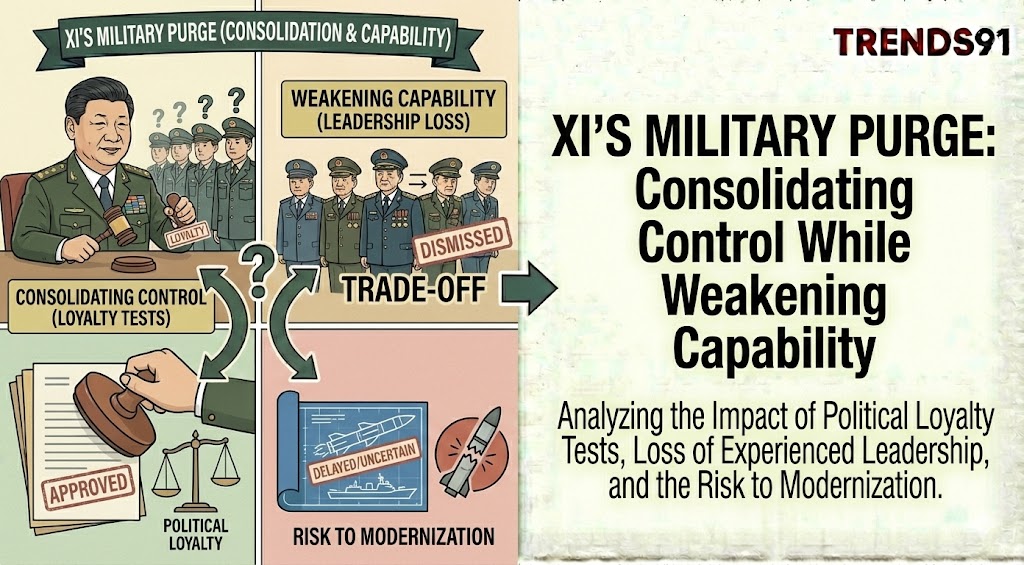
In late January 2026, Chinese President Xi Jinping oversaw an extraordinary purge of the People’s Liberation Army’s top command structure that reduced the seven-member Central Military Commission (CMC) to just two members: Xi himself and a disciplinary chief. The removal of General Zhang Youxia—Xi’s most senior military aide and, critically, the last serving PLA officer with combat experience from China’s last war in 1979—signals that Xi has achieved near-absolute control over the military at the precise moment when systemic structural weaknesses are making the PLA less capable of executing major military operations.
This paradox lies at the heart of understanding China’s strategic trajectory through 2030 and beyond. Xi is purging his military precisely as China faces three irreversible crises: a demographic collapse so severe that the birth rate in 2025 hit its lowest level since 1949, a military officer corps with no combat experience in nearly five decades, and endemic corruption in the defense-industrial complex that even Xi’s multi-year anti-corruption campaign cannot arrest. The result is a China that is simultaneously more politically centralized and less militarily capable—a leader with absolute control over an institution in structural decline.
The implications are consequential for regional security. Taiwan faces a genuine, but temporary, window of reduced Chinese invasion risk over 2026-2029. The regional balance of power—between the US-allied Quad nations and China—tilts temporarily toward the Quad as China’s leadership chaos compounds its structural vulnerabilities. But this reprieve is finite. By the early 2030s, if China overcomes the current leadership transition and demographic pressures begin to ease (demographically impossible, but militarily compensable through technology), China could emerge as a more ruthless and more technologically sophisticated military threat.
Xi’s Purge—The Decimation of Command
The January 2026 Shock
On January 24, 2026, China’s defense ministry announced in a 30-second video that General Zhang Youxia—Xi’s vice chairman of the CMC and the most senior military figure in the PLA—was under investigation for “serious violations of discipline and law.” The shock was twofold: first, that Xi would target someone so close to his inner circle; second, that Zhang’s dismissal followed a pattern of systematic decimation of the CMC itself.
When Xi took power in 2012, the CMC had seven members serving beneath him. By January 2026, that number had been reduced to two: Xi Jinping and Zhang Shengmin, the disciplinary chief. Of the six officers appointed to serve under Xi, five have been removed. The Central Military Commission—China’s supreme military decision-making body with oversight of the army, navy, air force, nuclear arsenal, police, and militia—now functions as Xi’s personal command structure with almost no institutional peers or institutional checks.
Zhang Youxia’s Fall: Why It Matters
General Zhang was not merely a senior officer; he was an anomaly in the modern PLA. Born in 1953 and rising through the ranks under Deng Xiaoping’s military reforms, Zhang was one of the vanishingly few active-duty Chinese generals with battlefield command experience. Specifically, Zhang had served in the 1979 Sino-Vietnamese War—China’s last major military conflict, now nearly five decades past. In an institution where 70% of combat troops come from one-child households and where no officer below the rank of general has ever commanded troops in actual warfare, Zhang represented continuity with institutional knowledge and combat-tested judgment.
Yet this very experience and seniority may have been what sealed his fate. According to Foreign Policy’s analysis, the most plausible explanation for Zhang’s dismissal involves disagreement over Taiwan readiness. Xi had ordered the PLA to be “capable” of invading Taiwan by 2027. Zhang, based on his assessment of the military’s actual readiness, likely concluded that this deadline was unrealistic. In Xi’s political economy of authority, such disagreement—especially from someone with the seniority and respect that Zhang commanded—constitutes a threat to the “Chairman Responsibility System” that the PLA Daily explicitly cited as having been “undermined” by Zhang and Liu Zhenli (the CMC Joint Staff Department head, also purged).
This interpretation aligns with a broader pattern in Xi’s governance: the intolerance for any institutional power center independent of his own authority. As one Brookings analyst noted, “There cannot be two tigers on the same mountain—Xi is unlikely to tolerate dissent, even from a highly esteemed figure like Zhang.”
The Cascading Purges: 2012-2026
Zhang’s fall was not an isolated incident but the apex of a systematic purge that has consumed China’s military leadership for over a decade. The timeline reveals an accelerating pattern:
- 2012: Xi initiates anti-corruption campaign upon taking power
- 2023: Defense Minister Li Shangfu vanishes from public view; subsequently relieved of duties alongside multiple senior military officials
- 2023-2024: Rocket Force commander and political commissar purged; senior Equipment Development Department leadership removed
- 2024: Multiple defense ministry staff and state-owned enterprise executives implicated in corruption
- 2025-2026: Acceleration and consolidation; Zhang Youxia (the most shocking removal)
The aggregate toll: At least 17 PLA generals dismissed since 2012; 8 former high-ranking officials removed; approximately 20% of officers promoted by Xi to three-star rank either removed or under investigation. The Wall Street Journal’s analysis found that “at least 20% of the officers promoted by Xi to the rank of three-star have either been removed or are under scrutiny for grave misconduct.”
The Structural Weaknesses Exposed—Why the Purge Occurred Now
Demographic Collapse: The Irreversible Crisis
The most significant context for understanding the timing of the purge is a demographic crisis so severe that it calls into question China’s long-term capacity to field a large military at all. On January 17, 2026, China released 2025 population statistics that shocked even demographers who had been warning of catastrophe for years:
The Numbers:
- 7.92 million births in 2025, down 17% from 9.54 million in 2024
- Lowest birth rate since 1949, when Mao’s Communist Party took power
- Birth rate of 5.63 per 1,000 people, the lowest on record
- 11.31 million deaths, the highest since 1968
- Population declined 3.39 million, marking the fourth consecutive year of decline
The fertility rate—the average number of children a woman is expected to have in her lifetime—stands at approximately 1.09, far below the 2.1 rate required to maintain population size. China, the world’s most populous nation until 2023 (when overtaken by India), is aging faster and more severely than any developed nation while remaining far poorer than Japan, South Korea, or Germany when they experienced comparable demographic transitions.
The Military Implications:
The demographic crisis directly undermines military recruitment and quality. Seventy percent of PLA troops and 80% of combat forces are now drawn from one-child households—a cohort raised in conditions of extreme parental investment, educational pressure, and socialization away from military hardiness. As the working-age population (15-59) has declined from 69.2% in 2012 to 62.6% in 2023, the number of potential military recruits shrinks by approximately 1-2 million per year.
Mandatory military service has been officially suspended since 1949, yet the PLA maintains strength through conscription based on volunteerism and demographic availability. Fewer young people means lower-quality recruits; lower-quality recruits mean reduced combat effectiveness regardless of technological advancement.
Critically, there is no technological fix for demographic decline in the 5-10 year timeframe. Robotics, autonomous weapons, and AI can augment military power but cannot substitute for the human capital base that underpins large-scale military operations. China’s demographic deficit is permanent and accelerating.
Combat Experience Deficit: The “Peace Disease”
A second structural vulnerability that precipitated the purge is the PLA’s near-total lack of combat experience. The PLA has not engaged in major combat operations since 1979—47 years ago. That war, with Vietnam, was a military failure by any objective assessment; even Vietnamese commanders expressed surprise at how poorly the PLA performed. The PLA’s reliance on Korean War–style infantry assaults and rigid command structures proved catastrophic against a more flexible, mobile Vietnamese force.
Since 1979, the PLA has engaged in no significant military operations. No living generation of Chinese officers below the rank of general has commanded troops in actual combat. No mid-career officer has experienced the fog of war, the stress of real-time decision-making under fire, or the logistical realities of sustained military operations. The institutional knowledge that comes from wartime experience—the hard-earned lessons about what doctrine actually works versus what works on paper—is entirely absent.
Xi himself recognized this vulnerability, emphasizing the PLA’s “Two Inabilities”: insufficient capacity to wage modern war and officers’ inadequate ability to command under modern warfare conditions. The irony is that by purging the few remaining officers with combat experience (particularly Zhang Youxia), Xi is exacerbating rather than resolving this institutional vulnerability.
Endemic Defense Industrial Corruption: Unsolved Despite Purges
A third structural problem that the purges were ostensibly designed to address—but have failed to resolve—is endemic corruption in the defense-industrial complex. The 2023-2024 purges, particularly of Rocket Force leadership, exposed “entrenched corruption networks spanning research, development, and procurement.” The scope of corruption is stunning: In 2024, a subsidiary of China Electronics Technology Group was implicated in leaking classified information while serving as a procurement agent for the PLA Strategic Support Force.
The System’s Structural Problems:
The corruption is not incidental but structural. China’s defense industrial base is dominated by 10 state-owned conglomerates—Aviation Industry Corporation of China, China Electronics Technology Group Corporation, and others—that enjoy monopolistic access to state financing and political protection. These state-owned enterprises crowd out private competitors, eliminate competitive pressure, and create procurement systems characterized by “vague technical specifications, weak performance benchmarks, and flexible delivery timelines” that reduce accountability.
The executives of these giants hold powerful vice-ministerial ranks within the party-state hierarchy, giving them substantial influence over procurement authorities and incentivizing collusion. The result: corruption that Xi’s purges cannot address because the corruption is embedded in the institutional architecture itself.
The 2020 Global Defense Integrity Index rated China’s procurement system at 24 out of 100—in the “critical risk” category, well below the Asia-Pacific regional average of 48 (moderate risk). A 24-point procurement integrity rating means that contracts are characterized by:
- Insufficient oversight
- Weak performance incentives
- Inadequate transparency
- Persistent collusion between military procurement officials and defense contractors
- Systematic underperformance on delivery timelines
These problems are not new. They have persisted despite—or arguably, because of—Xi’s anti-corruption campaign. The reason is that anti-corruption campaigns, when used as political tools rather than systemic reforms, cannot address institutional corruption. They can purge people; they cannot restructure incentive systems. They can eliminate patronage networks; they cannot replace them with functional alternatives.
The Readiness Paradox—How Purges Degrade Military Effectiveness
The Immediate Chain of Command Crisis
Zhang Youxia’s removal, combined with the broader CMC purge, has created an operational crisis that Xi may not fully appreciate until a crisis forces the issue. With 5 of the 6 officers appointed to serve on the CMC now removed, there is no functioning peer structure, no collective decision-making body, and no institutional buffer between Xi’s personal decisions and military implementation.
More critically, there are “hardly any officers left at the general rank.” The promotion pipeline has been so disrupted by purges that there are fewer experienced generals to assume senior roles. Xi is now appointing lower-ranking PLA officers to fill vacated positions—officers who are younger, less experienced, and untested at this level of responsibility.
The 2027 Contradiction: Readiness Deadline vs. Leadership Chaos
This timing raises a profound strategic question: Did Xi miscalculate by purging his top general just 12 months before his stated 2027 deadline for PLA capability to invade Taiwan?
The evidence suggests Xi did calculate, but accepted the short-term readiness cost in exchange for long-term political consolidation. Analysis from Brookings suggests that Xi viewed the Trump administration as “not particularly focused on Taiwan” and Taiwan’s 2028 elections as occurring after a purge-consolidation window. In other words, Xi likely concluded that a 2027 invasion was unlikely regardless, and that the political imperative of consolidating military control outweighed the military imperative of maintaining readiness through the 2027-2028 window.
The Implication: The 2027 capability deadline is now effectively postponed to the early 2030s. PLA readiness for major operations (Taiwan invasion or large-scale South China Sea operations) is degraded in 2026-2029 but will gradually recover as new leadership consolidates authority and gains operational experience.
Why Purges Leave Armies Ill-Prepared for War
Historical precedent strongly suggests that Xi’s purge will degrade PLA readiness for years. As Foreign Policy notes, “History shows that purges leave armies ill-prepared for war.” The dynamics are predictable:
- Risk Aversion: In a system where independent decision-making can be interpreted as disloyalty, officers become risk-averse. They defer decisions upward; they avoid innovative approaches; they implement orders precisely as given rather than adapting to circumstances. This reduces tactical flexibility and increases casualty rates in actual combat.
- Broken Institutional Knowledge: Purges eliminate the informal networks of experienced officers who solve problems through institutional memory. New officers lack the context to understand why certain protocols exist or how to adapt them to novel situations.
- Loyalty Concentration: Remaining officers are selected for loyalty to Xi rather than military competence. The result is a command structure optimized for political reliability but sub-optimal for military effectiveness.
- Integration Challenges: New officers appointed from lower ranks lack experience operating at CMC level. Their learning curve occurs while they hold positions of critical importance.
The Regional Strategic Implications
Taiwan’s Temporary Window: 2026-2029
The most immediate implication of China’s military leadership chaos is that Taiwan faces a temporary but genuine reprieve from the threat of Chinese military action. With the PLA’s CMC decimated, chain of command broken, and new leadership untested, the risk calculus for Xi changes:
- Invasion readiness reduced: If Xi had planned a Taiwan invasion for 2027-2028, the leadership chaos makes execution substantially riskier
- Higher probability of failure: An amphibious assault on Taiwan is the most complex military operation in modern history; it requires flawless coordination across services and seamless logistics. This coordination is precisely what a purged command structure cannot provide.
- Political cost of failure unacceptable: For Xi, a failed Taiwan invasion would be politically catastrophic—the first major military defeat for the PLA in the modern era
- Rational postponement: Better to consolidate control now, accept a 2030-2035 timeline, than risk catastrophic failure in 2027
The Regional Balance Tilts Temporarily Toward the Quad
As China’s military readiness is degraded by internal purges, the Quad (US, Japan, India, Australia) and broader Indo-Pacific partners gain temporary advantage:
- Taiwan can accelerate defensive modernization without immediate invasion risk
- Japan can consolidate security partnerships with US, Philippines, India, South Korea
- India can advance without Chinese military pressure in South Asia
- Philippines can strengthen Quad ties knowing China’s military is internally compromised
- US can reassure allies that the regional balance favors them in the near term
This window—2026-2029—is strategically critical. Taiwan should use it to harden defenses, acquire asymmetric weaponry, and strengthen civil-military planning. Japan should use it to forward-deploy critical defense systems. India should use it to resolve border management protocols with China while China’s military is distracted. The US should use it to visibly reinforce commitment to Indo-Pacific security.
Xi’s Political Risk: The “No One Is Safe” Signal
Yet the purge also sends a message to China’s broader elite and to foreign observers: no one in the system is truly secure, not even the most senior figures closest to Xi. Zhang Youxia had decades-long loyalty to Xi; Zhang had combat experience and institutional respect; Zhang had survived previous purges. Yet Zhang fell.
This message is intended to consolidate control domestically, but it also signals to foreign adversaries that Xi is capable of the kind of paranoia and risk-taking that characterizes declining authoritarian systems. This paradoxically makes Xi more unpredictable and potentially more dangerous: a leader who purges his own military leadership to ensure absolute control may be willing to take military risks that rational calculation would reject.
The Longer-Term Trajectory: 2030 and Beyond
The Recovery Question: Can China Overcome?
The pessimistic case is that the combination of demographic collapse, combat experience deficit, and corruption will permanently degrade China’s military capacity. By this logic, China’s window for successful military conquest has closed; the PLA will never again be ready for a large-scale amphibious operation against a defended target like Taiwan.
The optimistic case—from China’s perspective—is that the purges and leadership consolidation will ultimately create a more efficient military command structure, corruption will be (partially) arrested, and by the early 2030s, China will have a smaller but more technologically advanced military more capable of executing precision operations against Taiwan.
The Likely Case: Both narratives contain partial truth. The PLA will recover operationally by 2030-2035, but not to the level Xi imagined in his 2027 capability deadline. Demographic constraints will remain permanent; combat experience will gradually accumulate through exercises and naval operations; corruption will persist despite purges but be partially mitigated.
The result: a PLA that is smaller (fewer recruits due to demographics), less experienced (lost two-generation gap between 1979 veterans and current officers), but more technologically advanced (AI integration, unmanned systems, precision weapons) and more politically loyal (Xi’s loyalty-focused purges ensure no institutional check on his authority).
The Demographic Trap: Irreversible for Decades
Critically, China cannot reverse the demographic collapse through any policy innovation. Subsidies, tax changes, and pro-natalist campaigns have failed to move birth rates upward. The structural problems—housing costs, education costs, workplace discrimination against childbearing-age women, and the deep cultural shift away from large families—are not amenable to government policy changes.
Even if birth rates stabilized tomorrow at 2.1 (the replacement level), China would not see the cohort benefits until 2050+. For the next 25-30 years, China faces an absolute decline in the number of 18-25 year-old males available for military recruitment. This is not a temporary problem; it is a permanent feature of Chinese demographics through at least 2050.
The implication: China will have to accept a smaller military or accept dramatically reduced quality of recruits. It cannot have both a large military and high-quality recruits in the face of demographic collapse. The only workaround is technology-heavy, autonomous-systems-dependent military, which reduces China’s current advantage in mass.
A Strengthened Leader, a Weakening Institution
Xi Jinping has achieved near-absolute political control over China’s military through the January 2026 purges. By reducing the CMC to just two members and removing five of six military leaders appointed to serve under him, Xi has eliminated any institutional constraint on his authority. No officer can now credibly challenge Xi’s strategic decisions or institutional decisions; no peer group can constrain his power; no alternative power center exists within the military.
Yet this consolidation of political power occurs simultaneously with a degradation of military capability. The purges:
- Removed the last serving officer with major combat experience (Zhang Youxia)
- Broke the institutional chain of command through CMC elimination
- Failed to solve endemic corruption in the defense-industrial complex
- Occurred amid irreversible demographic decline that reduces recruitable population
- Postponed PLA readiness for major operations from 2027 to the early 2030s
This is the paradox of authoritarian decay: political consolidation through institutional purging comes at the cost of institutional effectiveness. Xi has created a military that is politically loyal but operationally weakened—exactly the opposite of what a rising great power needs when challenged by peer competitors.
For the Indo-Pacific region, the implications are mixed. Taiwan gets a 4-5 year window (2026-2030) to strengthen defenses without immediate invasion risk. But this window is temporary. By 2030-2035, if Xi survives political challenges and China’s demographic pressures are managed through technology, China could emerge as a more ruthless and more militarily dangerous actor—a leader with absolute control over a modernized, if smaller, military.
The race is now between China’s institutional recovery trajectory and the region’s defensive preparedness timeline. Taiwan, Japan, India, Philippines, Australia, and the US must use the 2026-2030 window to establish defense architectures, technological superiority, and strategic partnerships that can withstand renewed Chinese pressure in the 2030s. The question is whether they will recognize the opportunity and act decisively, or whether they will mistake a temporary respite for a permanent shift in the balance of power.